Using the Contents Page and Index to Find Answers Fast in the 18th Edition Exam
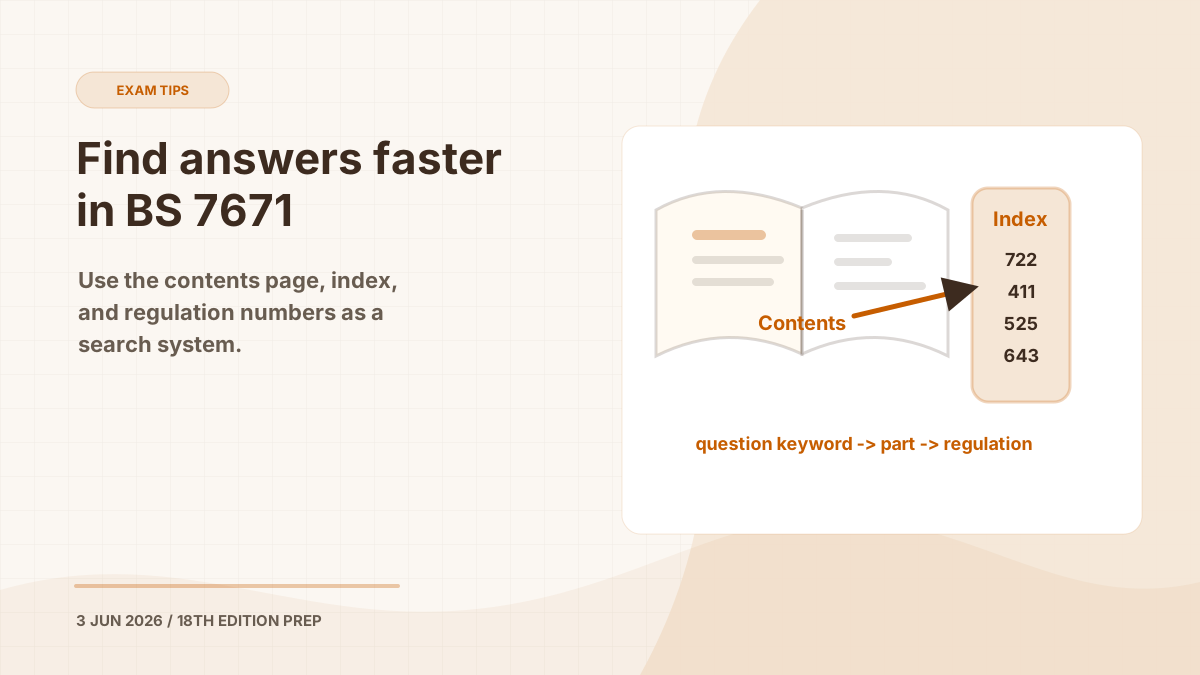
The current 18th Edition exam — City & Guilds 2382-26 — is open-book, and that catches a lot of candidates out. They assume the book will rescue them, then run out of time because they spend too long flicking through BS 7671:2018+A4:2026. The difference between passing comfortably and running out of time is often navigation.
There is one page that fixes this, and most candidates barely glance at it: the contents page on page 3. It’s the map of the whole of BS 7671. Learn to use it well and your ability to find answers quickly improves dramatically. This guide walks through the method qualified electricians use to turn the contents page — and the index behind it — into a fast, reliable search system.
In This Guide
Why the Contents Page Matters
The contents page is simply the map of the BS 7671 wiring regulations book. It tells you what is in the book and where to find it. It helps you navigate quickly to the correct part and chapter, it helps you understand the structure of the regulations, and — with practice — it lets you jump straight to the right section. It’s your first stop whenever you don’t know where something lives in the regs.
Here’s why it matters so much specifically for the exam:
| Exam Reality | What the Contents Page Does About It |
|---|---|
| It’s open book | You can use the book — there’s no need to guess, so long as you can find things |
| It’s timed (≈2 min/question) | It points you to the right part or chapter quickly, saving precious minutes |
| The book is 700+ pages | It stops you flicking through aimlessly hoping for “the hand of fate” |
| You can pair it with the index | It narrows your search before you even open the index |
The page itself lists the eight parts plus the appendices, plus the very useful table of figures and the equally useful table of tables, with the index bringing up the rear at the back of the book. Pause on it during revision and genuinely study what it’s telling you.
Key point: The contents page is the single most useful page in the book for exam navigation. Knowing it cold means you spend your two minutes per question answering, not searching.
The Part-Chapter-Regulation System
The whole book is built on one logical pattern: part → chapter → regulation. There are eight distinct part numbers. Each part contains several chapters on a particular theme, and each chapter is divided into regulations.
The clever bit is how the numbering carries through. Take Part 4. The number 4 is at the start of every chapter in Part 4, and 4 is the start of every regulation in Part 4. Go deeper into Chapter 41 and every regulation begins 4‑1. So look at any regulation number and you instantly know which part and chapter it belongs to.
| Regulation Digit | Tells You |
|---|---|
| First digit | The Part number (e.g. 4 = Protection for Safety) |
| First two digits | The Chapter (e.g. 41 = Protection against electric shock) |
| Remaining digits | The specific regulation within that chapter |
So 411.3.2 is Part 4, Chapter 41, regulation 1.3.2. This works in both directions: from a topic you can predict the opening digits, and from a regulation number you can locate it on the page. If you want to go deeper on how the eight parts are organised, our section-by-section revision breakdown maps out what lives where.
Remember: The part number, chapter number and regulation number are all linked by their leading digits. Internalise this and the book stops feeling like 700 random pages and starts feeling like a filing system.
Read the Question, Find the Keywords
It sounds obvious, but the most common navigation mistake is not reading the question properly. Before you touch the book, ask yourself four things:
- What type of question is it?
- Which part does it belong to?
- What is the keyword or phrase?
- What is the question actually asking?
If you know the keywords, you’ll know the part. Use instinct to narrow it down to a chapter. A question about disconnection times or shock protection is keeping you safe, so it’s Part 4. A question about putting cables in walls is erecting a wiring system, so it’s Part 5. A question with the word “defined” is almost always Part 2. The keyword decides the part; the part decides where you look.
Exam tip: Train yourself to translate plain-English keywords into parts. “Earthing arrangements” → Part 5 Chapter 54. “External influences” → Appendix 5. “Initial verification” → Part 6. This mental index is faster than any sticky tab.
Worked Examples Using Only the Contents Page
Many questions can be answered from the contents page alone — you don’t always need the index. Here are typical ones, with the keyword that unlocks each:
| Question | Keyword | Answer (Part / Chapter) |
|---|---|---|
| Where is a “skilled person” defined? | defined | Part 2 — Definitions |
| Which part deals with earthing and protective conductors? | earthing | Part 5, Chapter 54 |
| Protection against electric shock? | electric shock | Part 4, Chapter 41 |
| Isolation and switching? | isolation, switching | Part 5, Chapter 53 |
| Classification of external influences? | external influences | Appendix 5 |
| RCD protection for socket outlets? | RCD (= shock safety) | Part 4, Chapter 41 |
| Cables concealed in walls? | wiring system | Part 5, Chapter 52 |
| Initial verification? | verification, testing | Part 6, Chapter 64 |
| Protection against thermal effects? | thermal (= safety) | Part 4, Chapter 42 |
| EV charging installations? | special installation | Part 7, Section 722 |
Notice the pattern: anything about keeping people safe gravitates to Part 4, anything about selecting and installing equipment to Part 5, and anything “special” to Part 7. Part 7 in particular has a section for almost every unusual location — our guide to Part 7 special installations breaks down the sections that come up most often.
Important: Watch the near-miss sections. A caravan is Section 721, but a caravan park is the separate Section 708. Agricultural premises are Section 705. The contents page lists them side by side, which is exactly why scanning it beats guessing.
Combining the Contents Page With the Index
Sometimes you know roughly where a topic sits but need the exact regulation. That’s where the index earns its keep — but the index is not an easy list to follow at first, and it repeats terms across many entries. The trick is to use the contents page to narrow the search before you open it.
Two things to know about the index:
- It does not give page numbers — only regulation numbers, table numbers and figure numbers.
- Once you have the regulation number, the first digit gives the part and the first two digits give the chapter, so you can flick straight to the right region of the book using the running heads at the top of each page.
The method is always the same four steps:
- Find the keywords in the question.
- Use the contents page to home in on a part and chapter number.
- Go to the index and look up the keyword — pick the entry whose number starts with the part and chapter you already identified.
- Go to that regulation in the book and read what it actually says.
Three Full Worked Searches
Here’s the method in action on three real-style questions.
1. “A semiconductor device is to be used as an isolator.” Keywords: semiconductor device, isolator. Isolation is part of erecting an installation, so the contents page points to Part 5, Chapter 53 — the regulation must begin 5‑3. Go to the index, find Isolator, then semiconductor device beneath it, and you get Regulation 537.2.2. It tells you semiconductor devices shall not be used as isolating devices.
2. “Where do you find the nature of the supply and the assessment of its characteristics?” Keywords: nature, supply, assessment. This is an assessment of general characteristics, so the contents page points to Part 3, Chapter 31 — the regulation begins 3‑1. In the index under Supplies, find nature of, assessment and you get Regulation 313.1.
3. “Which regulation covers extra-low-voltage socket outlets in a caravan?” Keywords: extra-low voltage, socket outlets, caravan. Caravans are a special installation, so the contents page points to Part 7, Section 721 — the regulation begins 721. In the index under Socket outlets, find caravans, in and you get Regulation 721.55.2.2, which requires every ELV socket outlet to have its voltage visibly marked.
| Question Keyword | Contents Page → | Index Gives |
|---|---|---|
| Semiconductor isolator | Part 5, Ch 53 | Reg 537.2.2 |
| Supply assessment | Part 3, Ch 31 | Reg 313.1 |
| ELV socket in caravan | Part 7, Sec 721 | Reg 721.55.2.2 |
Exam tip: Choosing the right keyword to search first matters. With a multi-keyword question, start from the one that defines the location (caravan → Section 721), then use the second keyword (socket outlet) to find the line within that block.
Common Navigation Traps
Even with the method, a few things still cost candidates time and marks:
| Trap | How to Avoid It |
|---|---|
| Treating open book as a substitute for study | Use the book to confirm, not to learn from scratch on the day |
| Searching the index blind | Always narrow to a part/chapter on the contents page first |
| Expecting page numbers in the index | It gives regulation numbers — translate the leading digits to a location |
| Confusing adjacent sections | Caravan (721) vs caravan park (708); agriculture (705) vs construction (704) |
| Ignoring the table of tables and figures | These find a specific table far faster than the main index |
If you want a wider list of the errors that quietly drain marks, our roundup of the most common 18th Edition exam mistakes covers the technique pitfalls in detail.
How to Practise This Skill
Navigation is a skill, and like any skill it only gets fast with repetition. Set yourself short drills: take a list of topics, and for each one race to name the part and chapter from memory, then verify on the contents page. Next, take harder ones and run the full contents-page-then-index method against the clock. The goal is for the leading digits of any regulation to feel automatic — see 41x and think “shock protection” without pausing.
Remember: The contents page should be your go-to page when searching for an answer. Find the keywords in the question, scan the contents page for the part and chapter, and only then drop into the index to pin down the exact regulation. Practise this and it will save you time on the day.
Practice and Further Study
The fastest way to build navigation speed is to answer lots of questions that force you to locate the right part and chapter. Our app includes 690+ practice questions across all eight parts, each with explanations that reference the specific regulation number — so every question doubles as navigation practice. The timed mock exams use the same weighted distribution and two-hour limit as the real paper, which is the best way to rehearse finding answers under pressure.
Test your part-by-part navigation with these topic quizzes:
- Part 4 — Protection for Safety quiz
- Part 5 — Selection and Erection of Equipment quiz
- Part 6 — Inspection and Testing quiz
- Part 7 — Special Installations quiz
For more on exam technique, see our guide on how to pass the 18th Edition first time and the breakdown of exam question formats and types.
Study on the go with our mobile app: App Store | Google Play
Prepare for your exam with our mobile app
690+ practice questions with detailed explanations