The Most Common 18th Edition Exam Mistakes (and How to Avoid Them)
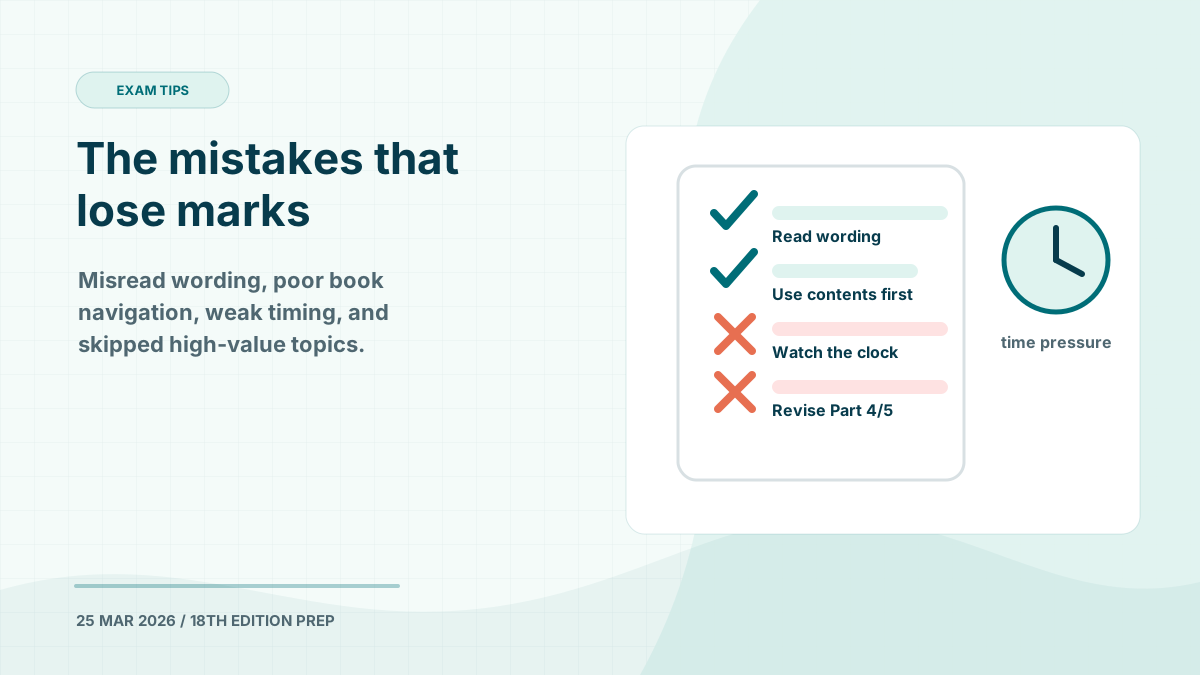
The City & Guilds 2382-26 exam can catch out even experienced candidates. Electricians who work with BS 7671 daily still lose marks—not necessarily because they lack practical knowledge, but because they walk into avoidable exam traps.
We’ve spoken to training providers, assessors, and electricians who’ve been through the exam. The same mistakes come up again and again. The good news? Every one of them is fixable with the right preparation.
This guide covers the mistakes that cost the most marks and gives you a concrete fix for each one. If you’re preparing for the exam, this is your checklist of things not to do.
In This Guide
- The Pass Rate Problem
- Mistake 1: Treating It as a Book Lookup Exercise
- Mistake 2: Running Out of Time
- Mistake 3: Misreading the Question Wording
- Mistake 4: Neglecting the High-Value Parts
- Mistake 5: Leaving Questions Blank
- Mistake 6: Confusing Similar Concepts
- Mistake 7: Ignoring Part 2 Definitions
- Mistake 8: Getting the Testing Sequence Wrong
- Mistake 9: Forgetting the 80% Rule
- Mistake 10: Using Outdated Study Materials
- Your Pre-Exam Checklist
- Practice and Further Study
The Pass Rate Problem
Let’s start with the numbers. The 18th Edition exam is 60 multiple-choice questions in 2 hours, open-book, with a 60% pass mark — 36 out of 60. On paper, that sounds manageable. In practice, a significant proportion of candidates don’t pass first time.
| Detail | What to Know |
|---|---|
| Qualification | City & Guilds 2382-26 |
| Based on | BS 7671:2018+A4:2026 |
| Format | 60 multiple-choice questions |
| Duration | 2 hours (120 minutes) |
| Pass mark | 60% (36 out of 60) |
| Open book? | Yes — your copy of BS 7671 |
| Negative marking? | No — guessing carries no penalty |
The candidates who fail aren’t typically lacking knowledge. They’re making process errors — mistakes in how they approach the exam rather than gaps in what they know. Fix the process and the pass follows.
Mistake 1: Treating It as a Book Lookup Exercise
This is the single most damaging mistake, and the open-book format is directly responsible. Candidates assume that because they can bring BS 7671 into the exam, they don’t need to learn anything — they’ll just look it up.
The problem: BS 7671 is over 700 pages across 8 Parts and 17 Appendices. Looking up a regulation from scratch — finding the right Part, the right Chapter, the right Section, then reading through to confirm the answer — takes 2–4 minutes per question. You only have 2 minutes per question total.
| Approach | Time per Question | Questions Completed in 2 Hours |
|---|---|---|
| Look up everything | 3–4 minutes | 30–40 (fail) |
| Know key values, confirm with book | 1–2 minutes | 55–60 (pass) |
| Memorised core content, book for specifics | Under 1.5 minutes | 60 with review time |
The fix: Use the book to confirm answers you’re fairly sure about and to look up specific values you can’t memorise. It’s a reference tool, not a substitute for study. For a complete breakdown of effective book technique, see our guide on how to pass the 18th Edition exam first time.
Tab your book before the exam — mark key tables like Table 41.3 (maximum Zs values), Table 54.7 (CPC sizing), Appendix 4 (current-carrying capacity), and the start of each Part. Practise navigating your tabbed book until you can find any major section in under 10 seconds.
Mistake 2: Running Out of Time
Time management is the difference between a comfortable pass and a panicked fail. Every minute spent agonising over one difficult question is a minute stolen from two easier questions later in the paper.
The Three-Pass Strategy
| Pass | What to Do | Time Budget |
|---|---|---|
| First | Answer every question you know immediately — no book needed | 30–40 minutes |
| Second | Tackle questions requiring a quick book lookup | 40–50 minutes |
| Third | Return to flagged difficult questions with remaining time | 20–30 minutes |
Key rule: Never spend more than 3 minutes on a single question during your first pass. If you can’t answer it quickly, flag it and move on. Spending 5 minutes wrestling with question 12 means you might never reach questions 55–60 — and those could be the ones you find easy.
Most candidates who fail report not finishing the paper. They got stuck on hard questions early and never recovered. The three-pass strategy prevents this by guaranteeing you see every question at least once.
Mistake 3: Misreading the Question Wording
BS 7671 uses precise language, and the exam questions mirror this precision. The difference between one word can point you to an entirely different answer.
| Question Uses | It’s Asking About | Points to |
|---|---|---|
| ”Required” | A mandatory regulation | A “shall” statement |
| ”Recommended” | Best practice, not mandatory | A “should” statement |
| ”Permitted” | An acceptable option | A “may” statement |
| ”Minimum” | The lowest acceptable value | A specific threshold |
| ”Maximum” | The upper limit | A specific threshold |
Exam tip: Read every question twice before answering. On the second read, underline the key word — required, recommended, permitted, minimum, maximum. This takes 5 seconds and prevents the single most common source of wrong answers.
Another frequent trap: reading all four options. The exam designers deliberately include answers that are partially correct or correct in a different context. Option A might be correct for TN systems but the question asks about TT systems. Option C might state the right value but for the wrong test. For more on how questions are structured, see our post on 18th Edition exam question formats and types.
Mistake 4: Neglecting the High-Value Parts
Not all parts of BS 7671 carry equal weight in the exam. Candidates who study evenly across all 8 Parts are misallocating their time.
| Part | Approximate Questions | % of Exam |
|---|---|---|
| Part 1 — Scope & Fundamentals | 4 | 7% |
| Part 2 — Definitions | 2 | 3% |
| Part 3 — General Characteristics | 6 | 10% |
| Part 4 — Protection for Safety | 15 | 25% |
| Part 5 — Selection & Erection | 14 | 23% |
| Part 6 — Inspection & Testing | 4 | 7% |
| Part 7 — Special Installations | 7 | 12% |
| Part 8 & Appendices | 8 | 13% |
Where the marks are: Parts 4 and 5 together carry 29 questions — 48% of the exam. If you’re scoring poorly on protection for safety or cable sizing, you’re leaving nearly half the marks on the table. For a deep dive into Part 4, see our guide on understanding protection for safety.
The fix: Weight your study time to match the exam weighting. If you have 20 hours of study time, spend at least 8–10 of those on Parts 4 and 5. Don’t ignore the other parts — Part 2 definitions underpin everything, and Part 7 is worth a solid 7 questions — but prioritise ruthlessly.
Mistake 5: Leaving Questions Blank
There is no negative marking in the current assessment. A blank answer scores zero. A guess gives you a 1-in-4 chance — 25%. Over 5 unanswered questions, a random guess may gain a mark that a blank answer cannot.
| Scenario | Unanswered | Marks Gained from Guessing (Expected) |
|---|---|---|
| Left 5 blank | 5 | +1.25 marks |
| Left 10 blank | 10 | +2.5 marks |
| Left 15 blank | 15 | +3.75 marks |
Important: Never leave a question unanswered. If time is running out, quickly fill in your best guess for every remaining question. Even an uninformed guess is better than nothing. Eliminate obviously wrong options first and your odds improve significantly — eliminating just one option raises your chance from 25% to 33%.
Mistake 6: Confusing Similar Concepts
The exam is designed to test precision. Several pairs of concepts are close enough to confuse under pressure:
| Easily Confused | Key Distinction |
|---|---|
| EIC vs MEIWC vs EICR | EIC = new installation, MEIWC = minor work/additions, EICR = periodic inspection of existing installation |
| Basic protection vs Fault protection | Basic = prevents contact with live parts in normal use (insulation, barriers). Fault = disconnects supply under fault conditions (CPCs, RCDs) |
| Exposed-conductive-part vs Extraneous-conductive-part | Exposed = part of equipment that can become live under fault (metal luminaire casing). Extraneous = not part of the installation but can introduce earth potential (metal water pipe) |
| Overload vs Short-circuit | Overload = excess current in a healthy circuit. Short-circuit = fault current between live conductors |
| SELV vs PELV vs FELV | SELV = not earthed, fully separated. PELV = may be earthed. FELV = functional only, needs additional protection |
| Isolation vs Switching off for mechanical maintenance | Isolation = cutting supply to work on equipment. Switching off = preventing unexpected restart during non-electrical work |
The fix: Make a comparison table for each pair and test yourself until the distinctions are automatic. If you hesitate on any of these in the exam, you’ll lose time and marks.
Mistake 7: Ignoring Part 2 Definitions
Part 2 directly contributes only about 2 questions. So candidates skip it. This is a false economy — Part 2 definitions are tested indirectly throughout the entire paper. If you don’t understand what “extraneous-conductive-part” means, you’ll get the bonding question wrong. If you can’t distinguish TN-S from TN-C-S, the earthing questions become guesswork.
| Term | Definition | Why It Matters |
|---|---|---|
| Design current (Ib) | The current the circuit is intended to carry in normal service | Used in overload coordination: Ib ≤ In ≤ Iz |
| Prospective fault current (Ipf) | The highest current that could flow under fault conditions | Must not exceed the rated breaking capacity of the protective device |
| Earth fault loop impedance (Zs) | Total impedance of the fault current path | Must be low enough for the protective device to disconnect within the required time |
Exam tip: Spend one full study session reading through every Part 2 definition. Create flashcards for the ones you can’t immediately explain in your own words. These definitions are the language the exam speaks — if you don’t know them, you’re translating under pressure.
Mistake 8: Getting the Testing Sequence Wrong
The correct order of initial verification tests (Regulation 612) is one of the most frequently examined topics. It appears in some form on almost every paper, and candidates who get it wrong throw away marks that should be straightforward.
The sequence exists for a reason: each test depends on satisfactory results from the previous one. You can’t measure earth fault loop impedance if you haven’t first confirmed the CPC is continuous.
| Order | Test | Dead/Live |
|---|---|---|
| — | Visual inspection (Reg. 611) | — |
| 1 | Continuity of protective conductors | Dead |
| 2 | Continuity of ring final circuit conductors | Dead |
| 3 | Insulation resistance | Dead |
| 4 | SELV and PELV verification | Dead |
| 5 | Polarity | Dead |
| 6 | Earth electrode resistance | Dead |
| 7 | Earth fault loop impedance (Zs) | Live |
| 8 | RCD testing | Live |
| 9 | Prospective fault current (Ipf) | Live |
Remember: Dead tests first, then live tests. This is a safety principle. For a detailed breakdown of the testing procedure, see our guide on Part 6: Inspection and Testing.
Mistake 9: Forgetting the 80% Rule
This trips up candidates who understand Parts 4, 5, and 6 individually but don’t see how they connect. Table 41.3 gives maximum Zs values at conductor operating temperature (70°C). Your loop impedance tester measures at ambient temperature (~20°C). Because copper resistance rises with temperature, a cold reading will be lower than the actual Zs under load.
The correction: Measured Zs must be ≤ 0.8 × Table 41.3 value.
| 32A Type B MCB | Value |
|---|---|
| Table 41.3 maximum Zs | 1.37 Ω |
| 80% corrected limit | 1.10 Ω |
Common trap: A measured Zs of 1.20 Ω appears to pass against the table value of 1.37 Ω — but it fails the 80% rule. At operating temperature, it would rise above the table limit. For a full worked example, see our guide on Maximum Zs and the 80% Rule.
Mistake 10: Using Outdated Study Materials
The current 2382-26 exam is based on BS 7671:2018+A4:2026 — the Orange Book including Amendment 4. Older material may omit new or revised sections covering stationary secondary batteries, ICT functional earthing and bonding, Power over Ethernet, and medical locations.
| Material Vintage | What It Misses |
|---|---|
| Pre-2018 | The entire 18th Edition |
| Pre-2022 (before A2) | Part 8, Section 722, revised Section 712 |
| Pre-2024 (before A3) | Updated RCD requirements, circuit-breaker selection changes |
The fix: Check the publication date on every resource you use. For a current 2382-26 booking, your copy of BS 7671 should be the A4:2026 Orange Book.
Your Pre-Exam Checklist
Use this in the final week before your exam:
| Check | Done? |
|---|---|
| Can you find any tabbed section in your book in under 10 seconds? | ☐ |
| Do you know the disconnection times for TN and TT systems without looking them up? | ☐ |
| Can you recite the testing sequence from memory? | ☐ |
| Have you completed at least 3 full mock tests under timed conditions? | ☐ |
| Are you consistently scoring above 50/60 on mocks? | ☐ |
| Can you distinguish every pair of commonly confused terms? | ☐ |
| Do you know the 80% rule and how to apply it? | ☐ |
| Is your copy of BS 7671 the current A4:2026 Orange Book? | ☐ |
| Have you studied Parts 4 and 5 in depth? | ☐ |
| Do you have a time management strategy for the exam? | ☐ |
If you can tick every box, you’re ready. If not, focus your remaining study time on the gaps.
Practice and Further Study
The best way to avoid exam mistakes is to make them in practice first. Test yourself under realistic conditions:
- Part 4 — Protection for Safety quiz
- Part 5 — Selection and Erection of Equipment quiz
- Part 6 — Inspection and Testing quiz
- Part 7 — Special Installations quiz
Our app includes 690+ practice questions covering all 8 parts with detailed explanations referencing specific regulation numbers, plus full timed mock tests that mirror the real exam’s weighted question distribution — so you can identify and fix your weak spots before exam day.
Study on the go with our mobile app: App Store | Google Play
Prepare for your exam with our mobile app
690+ practice questions with detailed explanations