18th Edition Exam Questions: Format, Structure, and Question Types Explained
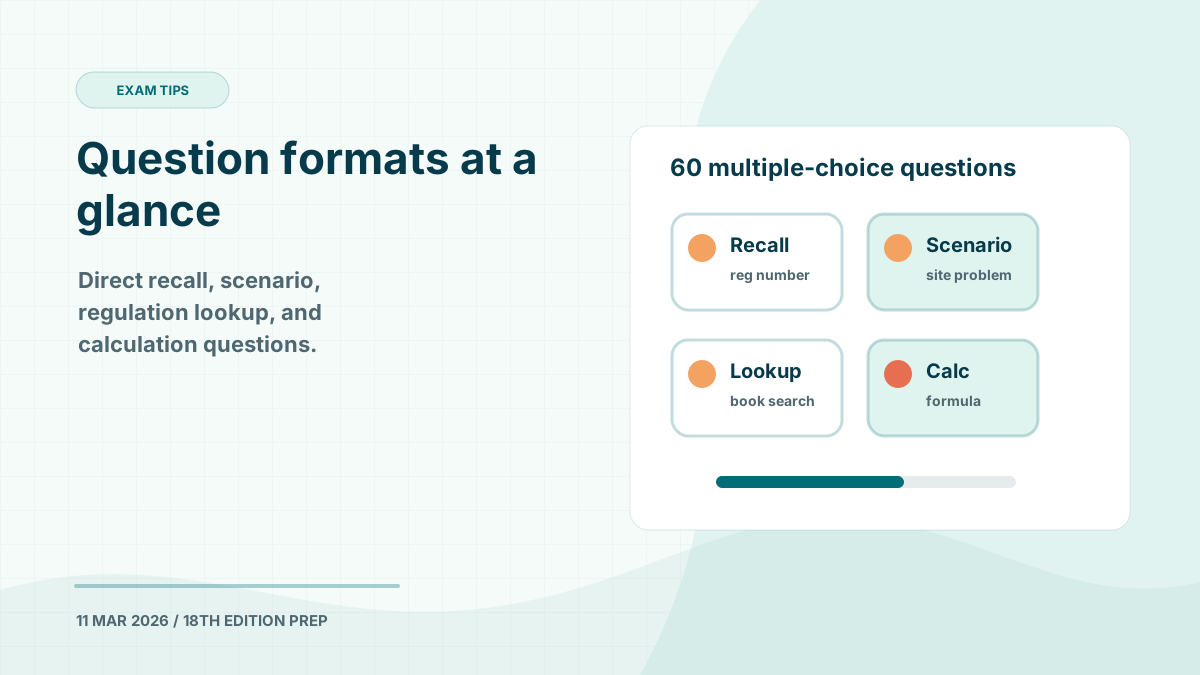
Knowing what to expect in the 18th Edition exam is half the battle. Candidates who understand the question format, the types of questions they’ll face, and how marks are distributed consistently outperform those who go in blind — even if both groups have studied the same material.
This guide breaks down the current City & Guilds 2382-26 exam structure, walks through every question type with realistic examples, and gives you a targeted preparation strategy for each one. The older 2382-22 assessment is in its final 2026 run-out period, so confirm the exact code on any existing booking.
In This Guide
- Exam Format at a Glance
- Question Distribution by Topic
- The Four Question Types
- Type 1: Direct Recall Questions
- Type 2: Scenario-Based Questions
- Type 3: Regulation Look-Up Questions
- Type 4: Calculation Questions
- How Distractors Work
- Preparation Strategies by Question Type
- Time Management on Exam Day
- Common Exam Questions
- Practice and Further Study
Exam Format at a Glance
The current 18th Edition exam is the City & Guilds 2382-26. Here’s what new candidates should prepare for:
| Detail | What to Know |
|---|---|
| Qualification | City & Guilds 2382-26 |
| Based on | BS 7671:2018+A4:2026 (18th Edition including Amendment 4) |
| Format | 60 multiple-choice questions, four options per question (A–D) |
| Duration | 2 hours (120 minutes) |
| Pass mark | 60% — 36 out of 60 correct |
| Open book? | Yes — you may bring your personal copy of BS 7671 |
| Permitted materials | BS 7671 (tabbed/highlighted OK), pens, calculator |
| Not permitted | Loose notes, revision cards, electronic devices (except calculator) |
Key point: Every question has exactly four options and only one correct answer. There is no negative marking — a wrong answer scores the same as a blank, so never leave a question unanswered.
Question Distribution by Topic
The 60 questions are not evenly spread across BS 7671. Understanding the weighting tells you where to focus your study time:
| Topic | Questions | % of Exam |
|---|---|---|
| Part 1 — Scope & Fundamentals | 4 | 7% |
| Part 2 — Definitions | 2 | 3% |
| Part 3 — General Characteristics | 6 | 10% |
| Part 4 — Protection for Safety | 15 | 25% |
| Part 5 — Selection & Erection | 14 | 23% |
| Part 6 — Inspection & Testing | 4 | 7% |
| Part 7 — Special Installations | 7 | 12% |
| Part 8 & Appendices | 8 | 13% |
| Total | 60 | 100% |
Exam tip: Parts 4 and 5 together account for 29 questions — 48% of the exam. If you can score well on these two parts alone, you only need 7 correct answers from the remaining 31 questions to pass.
The Four Question Types
Every question in the 2382-26 falls into one of four broad categories. Recognising the type instantly tells you the best approach — whether to answer from memory, look it up, or work through a calculation.
| Type | What It Tests | Best Approach | Approx. % of Exam |
|---|---|---|---|
| Direct recall | Key values, definitions, and facts | Answer from memory — don’t waste time looking up | 30–35% |
| Scenario-based | Application of regulations to real situations | Read carefully, identify the relevant Part/regulation | 30–35% |
| Regulation look-up | Ability to find specific information in BS 7671 | Navigate to the correct section using your tabs | 15–20% |
| Calculation | Applying formulas (adiabatic, voltage drop, Zs) | Use your calculator and reference the correct table | 10–15% |
Type 1: Direct Recall Questions
These test whether you know key values, definitions, and fundamental principles without needing to look them up. They should be your fastest questions — ideally answered in under a minute.
Example Question Styles
Style A — Key value recall:
“What is the maximum disconnection time for a TN system final circuit not exceeding 32A?”
- A) 0.2 seconds
- B) 0.4 seconds
- C) 1 second
- D) 5 seconds
Answer: B — Regulation 411.3.2.2. This is one of the values you should know by heart.
Style B — Definition recall:
“Which of the following best describes an ‘extraneous-conductive-part’?”
- A) A conductive part of equipment that can be touched
- B) A conductive part forming part of the electrical installation
- C) A conductive part not forming part of the electrical installation but liable to introduce a potential
- D) A conductive part that is normally live
Answer: C — Part 2 definition. Understanding the difference between exposed-conductive-parts and extraneous-conductive-parts is essential.
What to Memorise
The following values come up repeatedly in direct recall questions:
| Category | Key Value | Reference |
|---|---|---|
| Disconnection time (TN, ≤32A) | 0.4s | Reg. 411.3.2.2 |
| Disconnection time (TT) | 0.2s | Reg. 411.3.2.4 |
| Disconnection time (distribution) | 5s | Reg. 411.3.2.3 |
| Additional protection RCD rating | 30 mA | Reg. 415.1.1 |
| Overload coordination | Ib ≤ In ≤ Iz | Reg. 433.1 |
| Insulation resistance test voltage | 500V DC | Reg. 612.3 |
| Minimum insulation resistance | 1.0 MΩ | Reg. 612.3 |
| Max voltage drop (lighting) | 3% | Reg. 525 |
| Max voltage drop (other) | 5% | Reg. 525 |
| Bathroom Zone 1 height | 2.25 m | Section 701 |
Exam tip: If you memorise the values above, you can answer roughly 15–20 questions without opening BS 7671 at all. That saves 20+ minutes for harder questions later. For more on what to commit to memory, see our guide on how to pass the 18th Edition exam first time.
Type 2: Scenario-Based Questions
These are the most common question type and the one that separates candidates who understand the regulations from those who’ve just memorised values. You’re given a real-world situation and asked to identify the correct regulation, requirement, or course of action.
Example Question Styles
Style A — Identifying the correct protection:
“An electrician is installing a socket outlet circuit in a domestic kitchen. The circuit is rated at 32A and protected by a Type B MCB on a TN-C-S system. According to BS 7671, what additional protection is required?”
- A) No additional protection is required
- B) A 100 mA RCD
- C) A 30 mA RCD
- D) A time-delayed RCD
Answer: C — Regulation 415.1.1 requires additional protection by a 30 mA RCD for socket outlets rated up to 32A.
Style B — Applying Part 7 requirements:
“A contractor is installing a lighting circuit in a hotel bathroom. Which of the following statements about Zone 1 is correct?”
- A) Any luminaire may be installed provided it is RCD protected
- B) Only fixed equipment with a minimum rating of IPX4 may be installed
- C) Equipment rated at IPX2 is sufficient
- D) No electrical equipment is permitted in Zone 1
Answer: B — Section 701 requires a minimum of IPX4 in Zone 1, and only fixed equipment is permitted.
How to Approach Scenario Questions
- Read the entire question — identify the circuit type, earthing system, and location
- Identify which Part of BS 7671 applies — is this a protection question (Part 4), a cable sizing question (Part 5), or a special location (Part 7)?
- Watch for the earthing system — TN-S, TN-C-S, and TT systems have different requirements for disconnection times and RCD protection
- Check if Part 7 applies — special locations add requirements on top of the general rules
Key point: Scenario questions often combine knowledge from multiple Parts. A bathroom question might test Part 7 (zones), Part 4 (RCD requirements), and Part 2 (IP ratings) all at once.
Type 3: Regulation Look-Up Questions
These test your ability to navigate BS 7671 and find specific information. They’re designed to be answerable — but only if you can find the right page quickly.
Example Question Styles
Style A — Finding a specific regulation:
“According to BS 7671, what is the minimum cross-sectional area of a main protective bonding conductor in a TN-C-S system where the supply neutral conductor is 16 mm² copper?”
- A) 6 mm²
- B) 10 mm²
- C) 16 mm²
- D) 25 mm²
Answer: B — Table 54.8 specifies minimum bonding conductor sizes based on the supply neutral. This requires navigating to the correct table.
Style B — Referencing an appendix table:
“A 2.5 mm² twin and earth cable is clipped direct (Reference Method C). According to Table 4D5, Column 6, what is the current-carrying capacity?”
- A) 20A
- B) 24A
- C) 27A
- D) 32A
Answer: C — Found in Appendix 4, Table 4D5. You need to know the correct table and column.
Navigation Strategy
Tab these sections in advance — they’re the most commonly referenced in look-up questions:
| Section | What You’ll Look Up |
|---|---|
| Table 41.3 | Maximum Zs values for MCBs and fuses |
| Table 54.7 | Minimum CPC sizes |
| Appendix 4 (Tables 4D1–4D5) | Current-carrying capacity |
| Appendix 14 | Maximum Zs values (alternative) |
| Table 4Ab | Voltage drop values |
| Reg. 612 | Testing sequence |
Exam tip: Practise navigating to these tables until you can find any of them within 15 seconds. Our guide on tabbing your BS 7671 covers the best tabbing strategy.
Type 4: Calculation Questions
These require you to apply formulas and use tables to arrive at a numerical answer. They take the longest per question but are entirely predictable — the same calculation types appear in every sitting.
Common Calculation Types
| Calculation | Formula / Method | Reference |
|---|---|---|
| Adiabatic equation | S = √(I²t) ÷ k | Reg. 543.1.3 |
| Voltage drop | Vd = (mV/A/m × Ib × L) ÷ 1000 | Appendix 4, Table 4Ab |
| 80% rule for Zs | Measured Zs ≤ 0.8 × Table 41.3 value | GN3 / Appendix 14 |
| Overload coordination | Check Ib ≤ In ≤ Iz and I2 ≤ 1.45 × Iz | Reg. 433.1 |
Example Calculation Question
“A 6 mm² copper conductor with PVC insulation (k = 115) is protected by a 40A Type B MCB. The energy let-through (I²t) of the MCB is 50,000 A²s. Using the adiabatic equation, is the CPC adequately sized?”
- A) Yes — the minimum size is 1.94 mm²
- B) Yes — the minimum size is 4.0 mm²
- C) No — the minimum size is 8.0 mm²
- D) No — the minimum size is 10.0 mm²
Answer: A — S = √(50000) ÷ 115 = 223.6 ÷ 115 = 1.94 mm². Since 6 mm² exceeds 1.94 mm², the conductor is adequate.
Important: You don’t need to memorise every k value — they’re in Table 54.4 of BS 7671. But you must know how to apply the formula quickly. See our detailed walkthrough of the adiabatic equation for worked examples.
How Distractors Work — Reading the Options
Every question has one correct answer and three distractors — wrong answers designed to catch common mistakes. Understanding how distractors are constructed helps you avoid traps.
| Distractor Type | How It Works | Example |
|---|---|---|
| Close value | Uses a similar but incorrect number | 0.2s instead of 0.4s for TN disconnection time |
| Related regulation | Correct regulation from a different context | Giving a TT requirement when the question asks about TN |
| Partially correct | Answer is right for part of the question but not all | Correct IP rating but wrong zone |
| Common misconception | Exploits widespread misunderstandings | Confusing basic protection with fault protection |
| Outdated information | Uses values from older editions of BS 7671 | Pre-Amendment 4 requirements |
How to Avoid Distractor Traps
- Read every option before selecting — the “most correct” answer may be C or D
- Check the earthing system — TN and TT values are close but different
- Note the exact wording — “shall” (mandatory) vs “should” (recommended) vs “may” (permissible) changes the correct answer entirely
- Watch for “not” and “except” — questions phrased negatively trip up candidates who read too quickly
Exam tip: If two options look very similar, one of them is almost certainly the correct answer. The question is testing whether you know the precise distinction. For more on the language of BS 7671, see our guide on getting started with the IET Wiring Regulations.
Preparation Strategies by Question Type
Different question types require different preparation approaches. Here’s how to train for each:
For Direct Recall Questions
- Create flashcards for all key values, definitions, and regulation numbers
- Use spaced repetition — review cards daily, spacing out intervals as you get them right
- Test yourself actively — don’t just re-read, cover the answer and try to recall it
- Study our topic guides for Part 2 Definitions and Part 4 Protection — these are the heaviest recall topics
For Scenario-Based Questions
- Practise with realistic questions — our app includes 690+ scenario-style questions with detailed explanations
- Study by earthing system — understand what changes between TN-S, TN-C-S, and TT for every major topic
- Learn the Part 7 special locations — at least bathrooms, construction sites, EV charging, and solar PV
- Read our special installations guide for the most exam-relevant Part 7 content
For Look-Up Questions
- Tab your BS 7671 thoroughly — use coloured tabs for different categories (tables, regulations, Part 7 sections)
- Time yourself finding specific tables — aim for under 15 seconds per look-up
- Do practice questions with the book — simulate the actual exam experience
- Know the table structure — which column is which installation method, which row is which cable size
For Calculation Questions
- Learn the formulas — there are only four or five you need to know
- Practise worked examples — do at least 10 adiabatic equation and 10 voltage drop calculations before the exam
- Know which table to use — the formula is useless if you can’t find the right k value or mV/A/m figure
- Work through our guides on voltage drop and cable sizing and the adiabatic equation
Time Management on Exam Day
With 60 questions in 120 minutes, you have exactly 2 minutes per question. Here’s how to allocate your time:
| Phase | Time | What to Do |
|---|---|---|
| First pass | 80–90 min | Work through all 60 questions. Answer everything you can. Mark difficult ones |
| Second pass | 20–30 min | Return to marked questions. Use your book to look up answers |
| Final check | 5–10 min | Verify no questions are left blank. Review any you’re unsure about |
The Three-Stack Method
As you work through the exam, mentally sort each question:
| Stack | Action | Time Per Question |
|---|---|---|
| Know it | Answer immediately from memory | 30–60 seconds |
| Can find it | Mark it, answer on second pass using BS 7671 | 2–3 minutes |
| Don’t know | Make your best guess, mark it, review at the end | 1 minute (guess) + review |
Important: Never spend more than 3 minutes on a single question during the first pass. Mark it and move on. A question you’re stuck on for 5 minutes is stealing time from three easier questions you haven’t reached yet.
Common Exam Questions
These questions come up frequently when candidates are preparing for the 18th Edition exam:
| Question | Answer |
|---|---|
| How many questions are in the exam? | 60 multiple-choice questions with four options each |
| What’s the time limit? | 2 hours (120 minutes) |
| What’s the pass mark? | 60% — 36 out of 60 correct |
| Can I use my own copy of BS 7671? | Yes — tabbed and highlighted is fine. No loose notes |
| Is there negative marking? | No — a wrong answer scores zero, same as a blank |
| Which edition of BS 7671 is the current exam based on? | BS 7671:2018+A4:2026 (the 18th Edition including Amendment 4) |
| Do I need to memorise regulation numbers? | Not all of them, but knowing key regulation numbers helps you navigate faster and answer recall questions without the book |
| Can I use a calculator? | Yes — a basic scientific calculator is permitted |
Practice and Further Study
The best way to prepare for the 18th Edition exam is to practise with questions that match the real exam format. Test yourself across all question types:
- Part 4 — Protection for Safety quiz
- Part 5 — Selection and Erection of Equipment quiz
- Part 6 — Inspection and Testing quiz
- Part 7 — Special Installations quiz
For deeper study on the topics covered in this guide:
- How to Pass the 18th Edition Exam First Time — 10 tips from qualified electricians
- Mock Test Tips and Strategies — how to get the most from practice tests
- Understanding Protection for Safety — Part 4 — the highest-weighted exam topic
- Maximum Zs and the 80% Rule — the calculation that catches everyone out
Our app includes 690+ practice questions covering all 8 parts with detailed explanations referencing specific regulation numbers, plus full mock tests with the same weighted question distribution as the real exam.
Study on the go with our mobile app: App Store | Google Play
Prepare for your exam with our mobile app
690+ practice questions with detailed explanations