The Adiabatic Equation Explained: How to Check if Your CPC Is Big Enough
The adiabatic equation is one of those formulas that looks intimidating but is actually straightforward once you understand what it’s doing. It answers one simple question: is the circuit protective conductor (CPC) big enough to handle the energy released during an earth fault — without melting?
If the CPC is too small, the fault current will heat it beyond its safe limit before the protective device trips. The insulation could melt, the conductor could burn through, and the protective earth path would be lost — exactly when you need it most.
In This Guide
The Formula
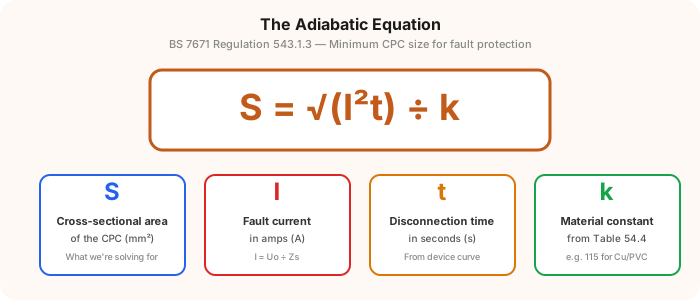
S = √(I²t) ÷ k
Where:
| Variable | Description | Unit |
|---|---|---|
| S | Minimum cross-sectional area of the CPC | mm² |
| I | Prospective earth fault current | Amps |
| t | Operating time of the protective device | Seconds |
| k | A constant depending on the conductor material and insulation type | — |
The equation calculates how much energy (I²t) the fault will dump into the CPC before the protective device disconnects, and whether the conductor can absorb that energy without exceeding its temperature limit.
When Do You Need It?
You use the adiabatic equation when:
- The CPC is not part of the same cable as the line conductor (e.g., a separate earth wire run alongside the circuit cable)
- You want to verify that the CPC within a standard T&E cable is adequate for the circuit
- The exam asks you to prove that a protective conductor is correctly sized
For standard T&E cable, the manufacturer has already designed the CPC to work with the cable’s rated circuit — but you still need to be able to demonstrate the calculation in an exam, and there are situations (long runs, high fault currents) where the standard CPC may not be sufficient.
Understanding the Variables
Fault Current (I)
The fault current is calculated from:
I = Uo ÷ Zs
Where Uo is the nominal voltage (230V) and Zs is the earth fault loop impedance at the furthest point. The lower the impedance, the higher the fault current, and the more energy the CPC must handle.
Disconnection Time (t)
This is how long the protective device takes to trip at the calculated fault current. For an MCB, you read this from the time-current characteristic curve:
| MCB Type | Magnetic Trip Threshold |
|---|---|
| Type B | 3–5 × In |
| Type C | 5–10 × In |
| Type D | 10–20 × In |
If the fault current is well above the magnetic trip threshold, t is typically 0.1 seconds or less. If it’s below, the MCB operates on its thermal element, which is slower.
The k Value
The k value represents how much energy per mm² the conductor material and insulation combination can absorb before reaching its maximum permissible temperature.
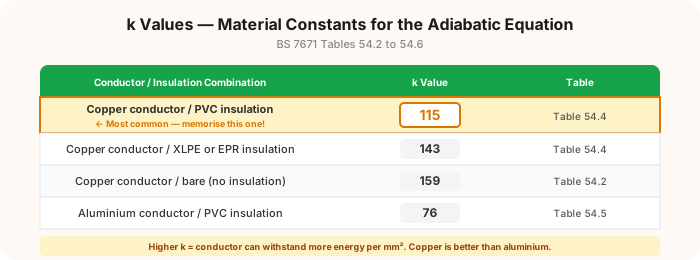
Exam Tip: The most important k value to remember is k = 115 — copper conductor with PVC insulation (Table 54.4). This covers the vast majority of domestic installations using standard T&E cable.
Worked Example
Let’s work through a real scenario:
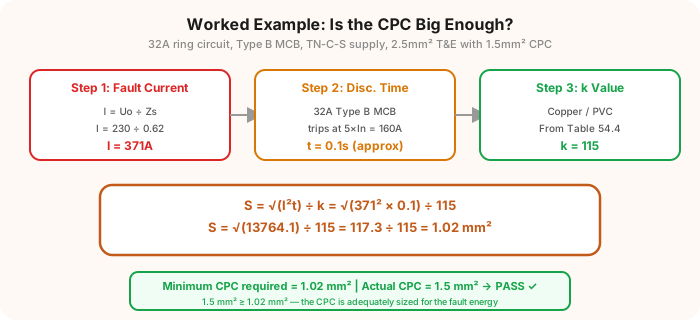
Circuit: 32A ring final circuit, Type B MCB, TN-C-S supply. The cable is 2.5 mm² T&E with a 1.5 mm² CPC. Measured Zs at the furthest socket is 0.62 Ω.
Step-by-Step Calculation
Step 1 — Calculate the fault current:
I = Uo ÷ Zs = 230 ÷ 0.62 = 371A
Step 2 — Determine the disconnection time:
A 32A Type B MCB trips magnetically at 5 × 32 = 160A. Our fault current of 371A is well above this, so the MCB will trip on its magnetic element. From the manufacturer’s time-current curve, t ≈ 0.1 seconds.
Step 3 — Get the k value:
Copper conductor with PVC insulation → k = 115 (Table 54.4)
Step 4 — Apply the formula:
S = √(I²t) ÷ k = √(371² × 0.1) ÷ 115 = √(13,764) ÷ 115 = 117.3 ÷ 115 = 1.02 mm²
Step 5 — Compare with actual CPC:
Minimum CPC required = 1.02 mm². Actual CPC in the cable = 1.5 mm².
Result: 1.5 mm² ≥ 1.02 mm² — the CPC is adequate. ✓
What If the CPC Is Too Small?
If the calculation shows the minimum S is larger than the actual CPC, you have three options:
- Increase the cable size — use a cable with a larger CPC
- Reduce the fault current — this isn’t usually practical (it would mean increasing Zs)
- Reduce the disconnection time — use a more sensitive protective device (e.g., lower rated MCB or an RCD)
- Run a separate CPC — install an additional earth conductor alongside the cable
Quick Reference
| Variable | What it is | Where to find it |
|---|---|---|
| I (fault current) | Uo ÷ Zs | Calculate from measured Zs |
| t (disconnection time) | Time for device to trip at current I | MCB time-current curves |
| k (material constant) | Conductor/insulation thermal capacity | BS 7671 Tables 54.2–54.6 |
| S (minimum CPC) | Required CPC cross-sectional area | Calculate using S = √(I²t) ÷ k |
Key Regulations
| Regulation | Requirement |
|---|---|
| Reg. 543.1.1 | CPC sizing using Table 54.7 (simplified method) |
| Reg. 543.1.3 | CPC sizing using the adiabatic equation (calculation method) |
| Table 54.2 | k values for protective conductors not in a cable |
| Table 54.4 | k values for protective conductors as a core in a cable (most common) |
| Table 54.5 | k values for aluminium conductors |
| Reg. 434.5.2 | Adiabatic equation for line conductors (same formula, different application) |
Practice and Further Study
The adiabatic equation appears in Part 5: Selection and Erection of Equipment of BS 7671. Test your knowledge:
Study on the go with our mobile app: App Store | Google Play
Prepare for your exam with our mobile app
690+ practice questions with detailed explanations