Maximum Zs and the 80% Rule: Using the Tables Correctly
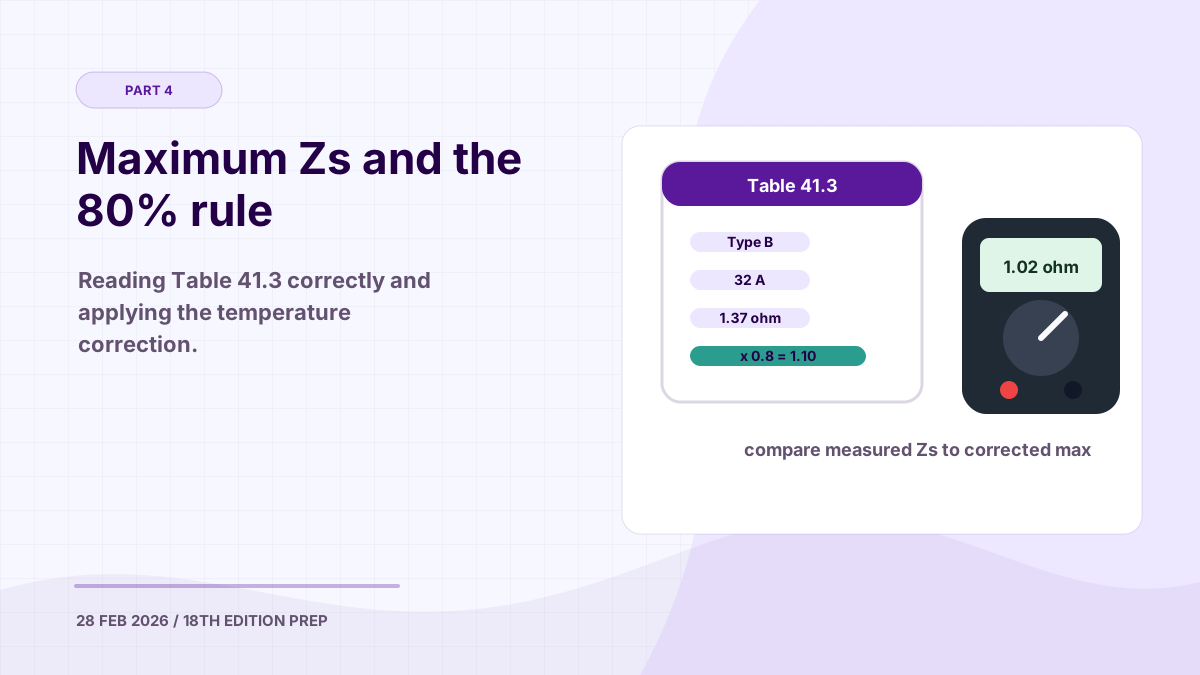
Every circuit in an installation must disconnect within the required time when an earth fault occurs. The maximum earth fault loop impedance (Zs) is the value that determines whether this happens — and Table 41.3 of BS 7671 gives you the maximum permitted values.
But there’s a catch: the values in Table 41.3 are at conductor operating temperature, not at the ambient temperature you test at. This is where the 80% rule comes in — and where many candidates lose marks in the exam.
In This Guide
What Is Zs and Why Does It Matter?
Zs is the total impedance of the earth fault loop — the path that fault current takes from the point of fault, through the protective conductor, back through the supply transformer, and through the line conductor to the protective device.
Zs = Ze + (R1 + R2)
Where:
| Variable | Description |
|---|---|
| Ze | External earth fault loop impedance (the part outside your installation) |
| R1 | Resistance of the line conductor from the DB to the fault |
| R2 | Resistance of the CPC from the fault back to the DB |
The lower the Zs, the higher the fault current, and the faster the protective device trips. If Zs is too high, the fault current is too low to trip the MCB within the required disconnection time — leaving the circuit live during a fault.
Table 41.3 — Maximum Zs Values
Table 41.3 gives the maximum Zs for different types and ratings of MCB at the required disconnection time. Here are the most commonly used values:
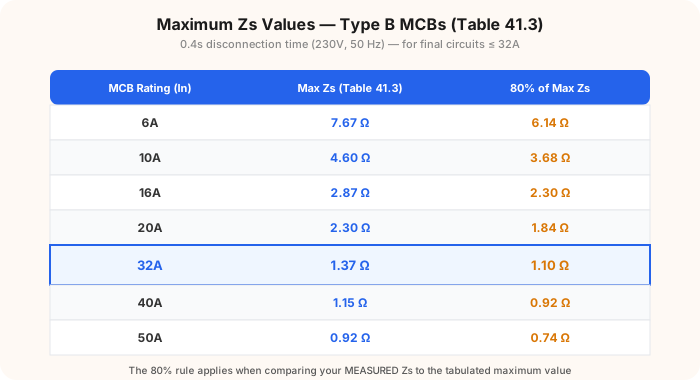
Disconnection Times
BS 7671 requires earth faults to be disconnected within:
| Circuit Type | Time | Regulation |
|---|---|---|
| Final circuits not exceeding 32A | 0.4 seconds | Reg. 411.3.2.2 |
| Distribution circuits and final circuits exceeding 32A | 5 seconds | Reg. 411.3.2.3 |
The Zs values in Table 41.3 for 0.4s disconnection are the ones you’ll use most often. The 5-second values are higher (more lenient) because the device has longer to trip.
Type B vs Type C vs Type D MCBs
The MCB type affects the maximum Zs because different types require different multiples of their rated current to achieve magnetic (instantaneous) tripping:
| MCB Type | Magnetic Trip Range | Effect on Zs |
|---|---|---|
| Type B | 3–5 × In | Highest Zs values (trips at lowest fault current) |
| Type C | 5–10 × In | Lower Zs values (needs higher fault current) |
| Type D | 10–20 × In | Lowest Zs values (needs very high fault current) |
For a 32A circuit:
| Type | Max Zs | Fault Current |
|---|---|---|
| Type B | 1.37 Ω | 160A to trip in 0.4s |
| Type C | 0.68 Ω | 320A to trip in 0.4s |
| Type D | 0.34 Ω | 640A to trip in 0.4s |
Tip: Type B is the default choice for domestic installations — it provides the widest margin for Zs compliance. Only use Type C or D where inrush currents demand it.
The 80% Rule Explained
Here’s the critical point that catches many people out.
The Problem
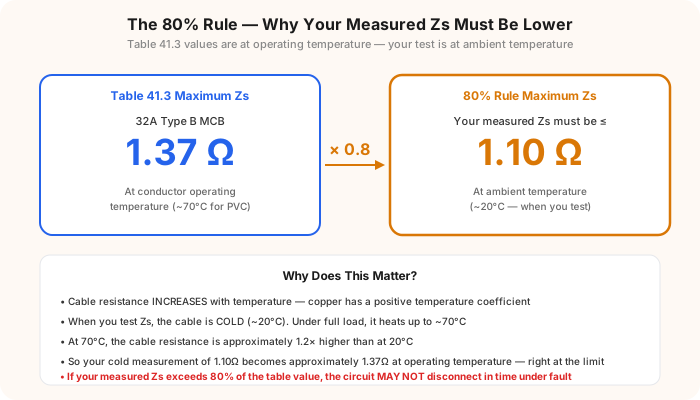
The maximum Zs values in Table 41.3 are given at conductor operating temperature — typically 70°C for PVC-insulated cables. But when you measure Zs with a loop impedance tester, the circuit is cold — typically at ambient temperature (~20°C).
Key Principle: Copper has a positive temperature coefficient — its resistance increases as temperature rises. At 70°C, cable resistance is approximately 1.2 times higher than at 20°C.
This means your cold measurement will understate the actual Zs the circuit will have when fully loaded and hot. A measurement that looks compliant at 20°C could exceed the Table 41.3 limit when the cable heats up under load.
The Rule
To account for this temperature rise, when comparing a measured (live test) Zs value against Table 41.3:
The 80% Rule: Measured Zs must be no greater than 0.8 × Maximum Zs from Table 41.3. This 80% factor (or equivalently, multiplying your measurement by 1.2) accounts for the resistance increase from ambient to operating temperature.
Common 80% Values (Type B MCBs, 0.4s)
| Rating | Table 41.3 Max Zs | 80% Limit (Measured Max) |
|---|---|---|
| 6A | 7.28 Ω | 5.82 Ω |
| 10A | 4.37 Ω | 3.50 Ω |
| 16A | 2.73 Ω | 2.18 Ω |
| 20A | 2.19 Ω | 1.75 Ω |
| 32A | 1.37 Ω | 1.10 Ω |
| 40A | 1.09 Ω | 0.87 Ω |
When to Apply the 80% Rule
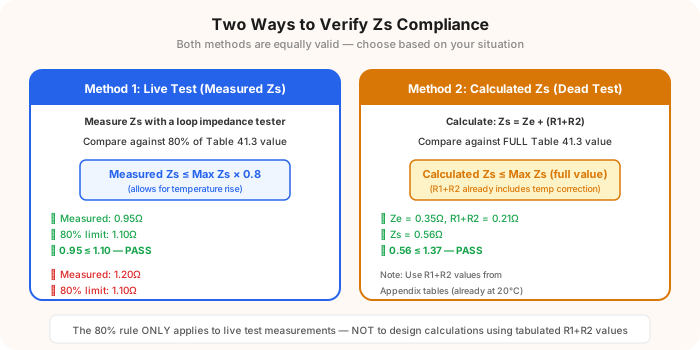
This is the single most common source of confusion. The rule depends on how you determined Zs:
Live Test Measurement → Apply 80%
If you measured Zs using a loop impedance tester (a live test), apply the 80% rule:
Measured Zs ≤ 0.8 × Table 41.3 value
Because the measurement was taken at ambient temperature, you need the correction to account for the cable heating up under fault conditions.
Calculated Zs (from R1+R2) → Compare to Full Table Value
If you calculated Zs using the formula Zs = Ze + (R1+R2), where R1+R2 was measured at ambient temperature, you should apply the correction factor to R1+R2 before adding Ze:
Corrected Zs = Ze + 1.2 × (R1+R2)
Then compare this corrected Zs against the full Table 41.3 value (not the 80% value).
Design Calculation → Compare to Full Table Value
If you’re using tabulated resistance values from BS 7671 Appendix tables during the design stage, those values are already given at 20°C. Apply the 1.2 multiplier to the R1+R2 portion:
Design Zs = Ze + 1.2 × (tabulated R1+R2 per metre × length)
Compare against the full Table 41.3 value.
Worked Examples
Example 1: Live Measurement
A 32A Type B ring circuit is measured with a loop impedance tester. The reading is 1.05 Ω.
- Table 41.3 maximum Zs for 32A Type B (0.4s) = 1.37 Ω
- 80% of 1.37 = 1.10 Ω
- Measured Zs (1.05 Ω) ≤ 80% limit (1.10 Ω) → PASS ✓
Example 2: Live Measurement — Marginal
Same circuit, but the measured Zs is 1.15 Ω.
- 80% of 1.37 = 1.10 Ω
- Measured Zs (1.15 Ω) > 80% limit (1.10 Ω) → FAIL ✗
- Even though 1.15 Ω is below the table value of 1.37 Ω, it fails because at operating temperature it would rise to approximately 1.15 × 1.2 = 1.38 Ω, exceeding the table limit.
Example 3: Calculated Zs
A 20A Type B lighting circuit. Ze = 0.35 Ω. R1+R2 measured at ambient temperature = 0.80 Ω.
- Corrected R1+R2 = 0.80 × 1.2 = 0.96 Ω
- Zs = Ze + corrected R1+R2 = 0.35 + 0.96 = 1.31 Ω
- Table 41.3 maximum for 20A Type B (0.4s) = 2.19 Ω
- 1.31 Ω ≤ 2.19 Ω → PASS ✓
Example 4: Design Stage
Design a 32A ring circuit on a TN-C-S supply (Ze = 0.35 Ω). Cable: 2.5/1.5 mm² T&E, length 50 metres.
- R1+R2 per metre (from tables, at 20°C) = 19.51 mΩ/m
- R1+R2 for 50 m = 19.51 × 50 ÷ 1000 = 0.976 Ω (but this is a ring, so divide by 4: 0.244 Ω)
- Corrected R1+R2 = 0.244 × 1.2 = 0.293 Ω
- Zs = 0.35 + 0.293 = 0.643 Ω
- Table 41.3 maximum for 32A Type B = 1.37 Ω
- 0.643 Ω ≤ 1.37 Ω → PASS ✓
Common Exam Questions
| Question | Answer |
|---|---|
| ”What is the 80% rule?” | Your measured Zs must not exceed 80% of the Table 41.3 maximum to allow for conductor temperature rise |
| ”When do you apply the 80% rule?” | When comparing a live test measurement of Zs against Table 41.3 |
| ”Why does Zs increase with temperature?” | Copper resistance increases with temperature (positive temperature coefficient) |
| “Max Zs for 32A Type B at 0.4s?“ | 1.37 Ω (or 1.10 Ω at 80%) |
| “Why is Type C Zs lower than Type B?” | Type C needs a higher fault current (5-10× In) to trip magnetically, requiring lower impedance |
| ”Disconnection time for final circuits ≤ 32A?“ | 0.4 seconds |
| ”Disconnection time for distribution circuits?“ | 5 seconds |
Key Regulations
| Regulation | Requirement |
|---|---|
| Reg. 411.3.2.2 | Maximum disconnection time: 0.4s for final circuits ≤ 32A |
| Reg. 411.3.2.3 | Maximum disconnection time: 5s for distribution circuits |
| Reg. 411.4.5 | Earth fault loop impedance requirements |
| Table 41.2 | Maximum disconnection times |
| Table 41.3 | Maximum Zs values for MCBs (Type B, C, D) |
| Table 41.4 | Maximum Zs values for fuses (BS 88, BS 1361, BS 3036) |
| Reg. 612.9 | Verification of earth fault loop impedance |
Practice and Further Study
Maximum Zs and disconnection times are covered under Part 4: Protection for Safety of BS 7671. Test your knowledge:
Study on the go with our mobile app: App Store | Google Play
Prepare for your exam with our mobile app
690+ practice questions with detailed explanations