How to Calculate Cable Size and Protective Device Rating: The BS 7671 Procedure
Cable sizing is the calculation that electricians and designers get asked about most often — and it’s the question that appears in almost every IET exam. Get it wrong, and you end up with a cable that either overheats (too small) or costs far more than necessary (too big).
This guide walks you through the full BS 7671 cable sizing procedure, from design current to final verification, with a worked example you can follow along with.
In This Guide
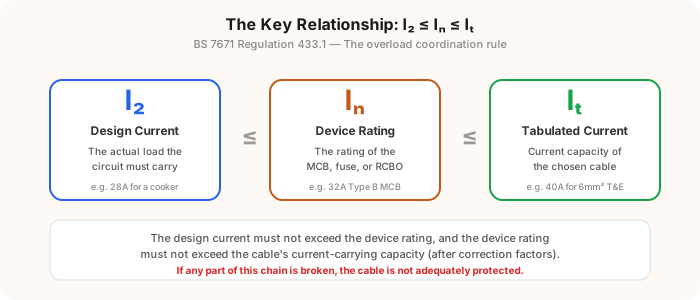
The Key Rule: Ib ≤ In ≤ It
Before diving into the steps, you need to understand the fundamental relationship that governs cable sizing in BS 7671:
| Symbol | Meaning |
|---|---|
| Ib (design current) | The actual current the circuit needs to carry |
| In (nominal rating) | The rating of the protective device (MCB, fuse, RCBO) |
| It (tabulated current) | The current-carrying capacity of the cable |
Fundamental Rule: The device rating (In) must be at least as big as the design current (Ib), and the cable (It) must be able to carry at least as much as the device rating (In). This ensures the cable is always protected against overload: Ib ≤ In ≤ It.
The Cable Sizing Procedure — Step by Step
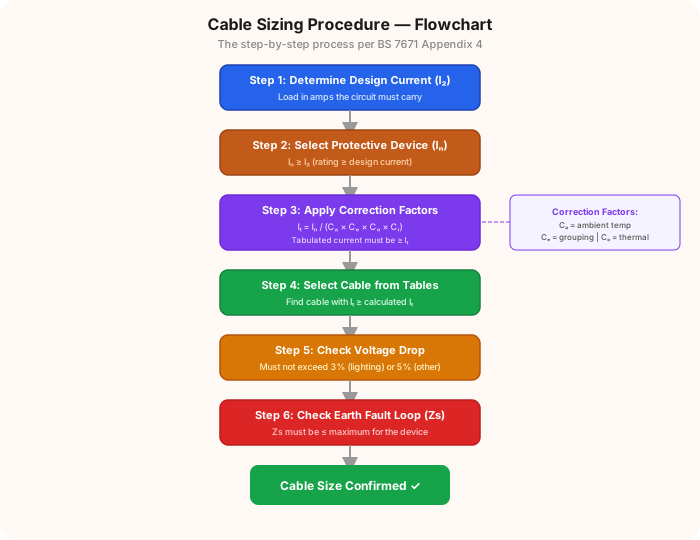
Step 1: Determine the Design Current (Ib)
The design current is the maximum current the circuit will normally carry. How you calculate it depends on the type of load:
| Load Type | Formula / Method |
|---|---|
| Resistive loads (heaters, kettles) | Ib = P ÷ V (e.g., 3000W ÷ 230V = 13.0A) |
| Motor loads | Use the motor’s full-load current from the manufacturer’s data |
| Diversity (multiple loads) | Apply diversity factors per BS 7671 Appendix 1 |
Step 2: Select the Protective Device (In)
Choose an MCB, fuse, or RCBO with a rating equal to or greater than Ib. Standard MCB ratings are: 6, 10, 16, 20, 25, 32, 40, 50, 63A.
For example, if Ib = 28A, the next standard MCB rating up is 32A, so In = 32A.
Note: You must also consider the type of MCB (B, C, or D) based on the load characteristics. Type B is standard for most domestic circuits. Type C is used for motor loads with higher inrush currents, and Type D for very high inrush loads such as transformers.
Step 3: Apply Correction Factors
This is where most exam candidates struggle. The cable’s published current rating (from BS 7671 tables) assumes ideal installation conditions: 30°C ambient temperature, cables not grouped together, no thermal insulation, and an MCB or HRC fuse as the protective device.
If conditions differ from the ideal, you need correction factors that increase the required cable capacity.
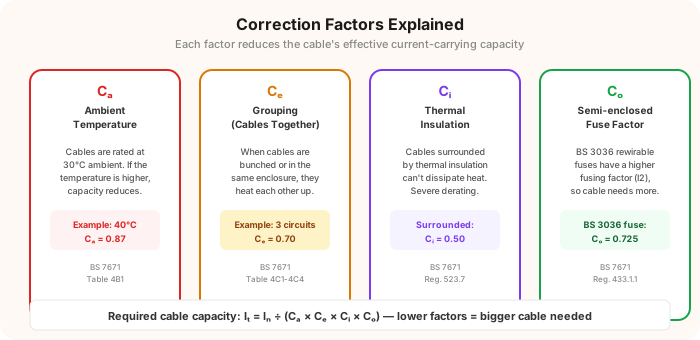
The four main correction factors are:
| Factor | What it accounts for | Typical values | BS 7671 Reference |
|---|---|---|---|
| Ca | Ambient temperature above 30°C | 0.94 (35°C) to 0.50 (60°C) for 70°C thermoplastic | Table 4B1 |
| Cg | Grouping (cables bunched together) | 0.65 to 1.00 | Tables 4C1–4C4 |
| Ci | Length of run totally surrounded by thermal insulation | 0.88 (50 mm) to 0.50 (0.5 m or more) | Reg. 523.9, Appendix 4 §2.6 |
| Cf | BS 3036 fuse (rewirable) | 0.725 | Reg. 433.1.1 |
The required tabulated current capacity of the cable is:
It = In ÷ (Ca × Cg × Ci × Cf)
If no correction factor applies, use 1.0 for that factor.
Step 4: Select the Cable from Tables
Look up the appropriate BS 7671 current-carrying capacity table for your installation method (e.g., Table 4D5 for thermoplastic flat cable clipped direct). Find a cable size where the tabulated current (It) is greater than or equal to your calculated minimum It.
Step 5: Check Voltage Drop
Even if the cable can carry the current safely, it may drop too much voltage over a long run. BS 7671 limits the voltage drop to:
| Circuit Type | Maximum Voltage Drop | As Voltage |
|---|---|---|
| Lighting circuits | 3% of 230V | 6.9V |
| Other circuits | 5% of 230V | 11.5V |
Key Limit: If the voltage drop exceeds these limits, you must increase the cable size — a bigger cable has lower resistance per metre and therefore less voltage drop.
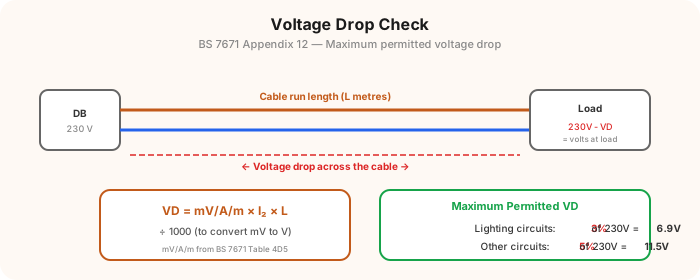
The formula is:
VD = (mV/A/m × Ib × L) ÷ 1000
Where:
- mV/A/m = millivolts per amp per metre (from BS 7671 Table 4D5)
- Ib = design current in amps
- L = cable length in metres (one way, not total)
Step 6: Check Earth Fault Loop Impedance (Zs)
Finally, verify that the earth fault loop impedance for the circuit is low enough to ensure the protective device will trip within the required disconnection time. This check is covered in detail in our separate guide on testing Zs.
Worked Example
Scenario: A 9.2 kW electric shower is to be installed in a bathroom. The cable run is 18 metres, clipped direct to a wall, at 30°C ambient. On its way it passes through 200mm of loft insulation, where it is totally surrounded for that 200mm length. The circuit is protected by a Type B MCB.
Step 1 — Design current:
Ib = P ÷ V = 9200 ÷ 230 = 40A
Step 2 — Protective device:
Next standard MCB rating ≥ 40A = 40A Type B MCB
Step 3 — Correction factors:
| Factor | Value | Reason |
|---|---|---|
| Ca | 1.0 | 30°C ambient — no correction needed |
| Cg | 1.0 | Single circuit — no grouping |
| Ci | 0.63 | Totally surrounded by insulation for a 200mm run (Reg. 523.9, Appendix 4 §2.6) |
| Cf | 1.0 | MCB, not a BS 3036 fuse |
Minimum It = 40 ÷ (1.0 × 1.0 × 0.63 × 1.0) = 63.5A
Important: The Ci factors of Appendix 4 §2.6 are for cables up to 10 mm² totally surrounded by insulation, and they are applied to the clipped direct (Method C) rating. There is no factor for a cable that merely touches insulation on one side: Reg. 523.9 rates that cable from its tabulated installation method (for flat T&E, the insulated-wall and ceiling columns of Table 4D5).
Step 4 — Cable selection:
From Table 4D5 (Method C — clipped direct), a 6 mm² T&E cable is rated 47A — less than 63.5A, so it fails. A 10 mm² T&E cable has a tabulated current of 64A, which is ≥ 63.5A. ✓
Step 5 — Voltage drop:
From Table 4D5, the mV/A/m for 10 mm² is 4.4.
VD = (4.4 × 40 × 18) ÷ 1000 = 3.17V
3.17V is well within the 5% limit of 11.5V. ✓
Result: Use 10 mm² T&E cable with a 40A Type B MCB. The cable’s 64A rating meets the 63.5A minimum required after correction factors, and the 3.17V voltage drop is well within the 11.5V limit.
Common Mistakes
| Mistake | Problem | Solution |
|---|---|---|
| Forgetting to apply correction factors | Cable undersized — risk of overheating | Always check Ca, Cg, Ci, and Cf |
| Using the wrong installation method table | Incorrect current ratings selected | Match the table to your actual installation method |
| Calculating voltage drop with total cable length | VD appears twice as high as actual | Use one-way cable length, not there-and-back |
| Selecting In less than Ib | Protective device trips under normal load | In must be ≥ Ib — always round up to next standard rating |
| Ignoring thermal insulation | Cable in loft insulation overheats | Apply Ci for the length surrounded (0.88 at 50 mm to 0.50 at 0.5 m or more); a cable touching insulation on one side is rated from its tabulated installation method (Reg. 523.9) |
Key Regulations
| Regulation | Requirement |
|---|---|
| Reg. 433.1 | Overload protection: Ib ≤ In ≤ Iz |
| Reg. 433.1.1 | BS 3036 fuse factor (0.725) |
| Reg. 523.9 | Cables in thermal insulation |
| Appendix 4 | Current-carrying capacity and voltage drop tables |
| Table 4B1 | Ambient temperature correction factors |
| Tables 4C1–4C4 | Grouping correction factors |
| Table 4D5 | Current ratings for flat T&E cable |
| Appendix 12 | Voltage drop limits |
Practice and Further Study
Cable sizing calculations are covered under Part 4: Protection for Safety and Part 5: Selection and Erection of Equipment of BS 7671. Test your knowledge:
Study on the go with our mobile app: App Store | Google Play
Prepare for your exam with our mobile app
690+ practice questions with detailed explanations