BS 7671 Section by Section: A Revision Breakdown for the 18th Edition Exam
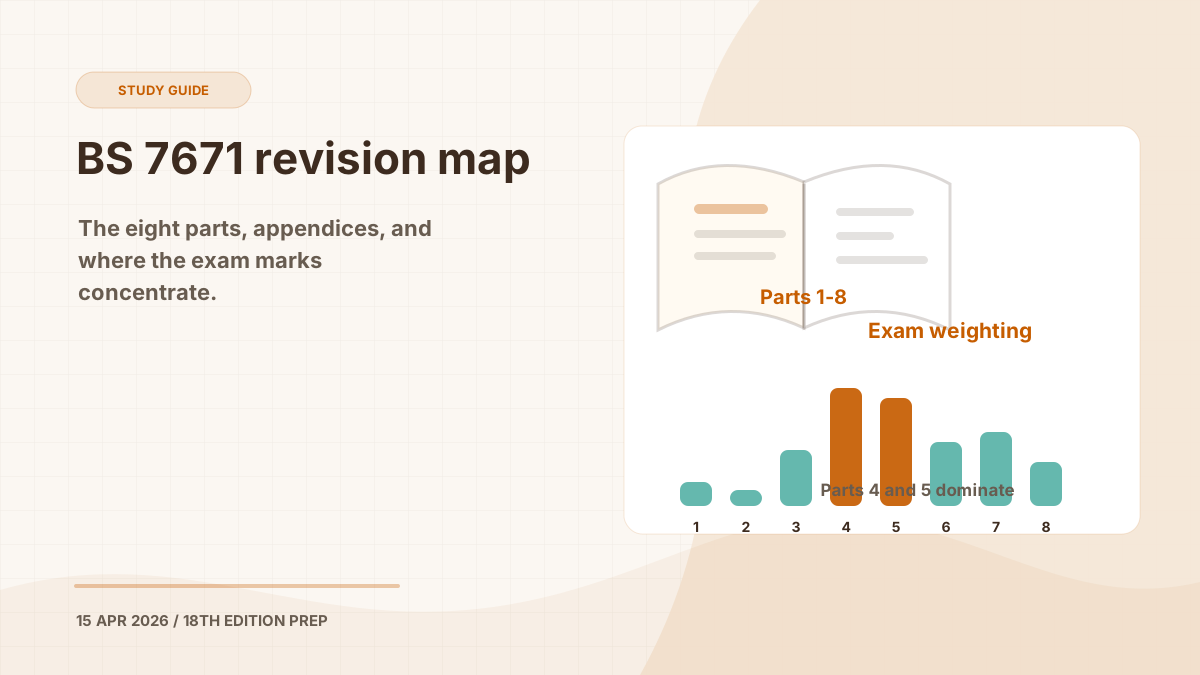
BS 7671:2018+A4:2026 is a substantial book covering 8 Parts plus the Appendices. If you’re preparing for the City & Guilds 2382-26 exam, you don’t have time to give every page equal attention — and you shouldn’t try to. The question weighting is uneven, and understanding where the marks are concentrated is one of the most effective things you can do before you start revising.
This guide breaks down every part of BS 7671, tells you what each one covers, how heavily it’s tested, and what to prioritise within it. Think of it as your revision map — so you spend your study hours where they’ll earn you the most marks.
If you haven’t already, read our overview of how to pass the 18th Edition exam first time for general exam strategy. This guide goes deeper into the regulations themselves.
In This Guide
- The Big Picture — How the Marks Are Spread
- Part 1 — Scope, Object and Fundamental Principles
- Part 2 — Definitions
- Part 3 — Assessment of General Characteristics
- Part 4 — Protection for Safety
- Part 5 — Selection and Erection of Equipment
- Part 6 — Inspection and Testing
- Part 7 — Special Installations or Locations
- Part 8 — Prosumers Installation
- The Appendices — Your Practical Reference
- Putting It Together — A Priority-Based Revision Order
- Practice and Further Study
The Big Picture — How the Marks Are Spread
Before diving into each part, here’s the approximate question distribution across the 60-question paper:
| Part | Topic | Questions | % of Exam | Priority |
|---|---|---|---|---|
| 1 | Scope & Fundamental Principles | 4 | 7% | Medium |
| 2 | Definitions | 2 | 3% | High (underpins everything) |
| 3 | General Characteristics | 6 | 10% | Medium–High |
| 4 | Protection for Safety | 15 | 25% | Critical |
| 5 | Selection & Erection | 14 | 23% | Critical |
| 6 | Inspection & Testing | 4 | 7% | Medium–High |
| 7 | Special Installations | 7 | 12% | High |
| 8 | Prosumers & Appendices | 8 | 13% | Medium–High |
| Total | 60 | 100% |
Key point: Parts 4 and 5 together account for 29 questions — 48% of the paper. Add Parts 3 and 7 and you’re at 42 questions (70%). Your revision time should reflect this weighting.
Now let’s look at each part in detail.
Part 1 — Scope, Object and Fundamental Principles
Approximate questions: 4 (7%)
Part 1 defines what BS 7671 applies to and what it excludes. It’s short, but it sets the foundation for everything that follows.
| Key Area | What to Know |
|---|---|
| Scope (Chapter 11) | BS 7671 applies to installations operating at up to 1000V AC. It excludes lightning protection systems, mines and quarries, and equipment on board ships |
| Exclusions | Know what’s specifically excluded — questions often test the boundaries |
| Fundamental principles (Chapter 13) | Every installation must be designed, erected, and verified so that it provides protection against electric shock, fire, burns, and overcurrent |
| Responsibility | The designer, installer, and inspector/tester each carry specific responsibilities |
Exam tip: Part 1 questions are usually straightforward — they test whether you know the scope and limitations of the regulations. Read this part once carefully and you should pick up the marks without difficulty.
Part 2 — Definitions
Approximate questions: 2 (3%)
Only 2 direct questions, but Part 2 is far more important than its weighting suggests. Every technical term used across the remaining 6 Parts is defined here. Misunderstand a definition and you’ll cascade into wrong answers on questions about protection, cable selection, and testing.
Definitions You Must Know Cold
| Term | What It Means | Why It Matters |
|---|---|---|
| Basic protection | Prevents contact with live parts in normal conditions | Insulation, barriers, enclosures |
| Fault protection | Ensures disconnection under fault conditions | CPCs, RCDs, overcurrent devices |
| Exposed-conductive-part | Metal part of equipment, not normally live, that may become live under fault | Drives earthing and bonding requirements |
| Extraneous-conductive-part | Conductive part not forming part of the installation, liable to introduce a potential | Metal water pipes, structural steelwork |
| TN-S, TN-C-S, TT | The three earthing systems | Determines RCD requirements, disconnection times, and Zs limits |
| SELV, PELV, FELV | Extra-low voltage classifications | Each has different earthing and protection requirements |
Remember: The distinction between exposed-conductive-parts and extraneous-conductive-parts drives bonding requirements throughout Parts 4 and 5. If you confuse these two, you’ll get bonding questions wrong. See our guide on earthing and bonding explained for a detailed breakdown.
Part 3 — Assessment of General Characteristics
Approximate questions: 6 (10%)
Part 3 covers what you need to know about the supply before you design the installation. It’s the assessment stage — gathering the characteristics of the incoming supply and the conditions in which the installation will operate.
| Chapter | Topic | What to Revise |
|---|---|---|
| 31 | Purposes, supplies, and structure | Single-source vs multi-source supplies, maximum demand |
| 32 | External influences | IP rating codes, temperature ranges, environmental conditions |
| 33 | Compatibility | Harmonic currents, voltage disturbances |
| 34 | Maintainability | Access for inspection, testing, and maintenance |
| 35 | Safety services | Supplies for fire alarm circuits and emergency lighting |
Exam tip: Chapter 32 (external influences) is a common question source. Know what the IP code digits mean — the first digit is protection against solid objects, the second is protection against water. IP44, IPX4, and IPX7 appear throughout Parts 5 and 7.
Part 4 — Protection for Safety
Approximate questions: 15 (25%) — the single most heavily tested part
This is where the marks are. Part 4 covers the four types of protection and it’s the densest part of the exam. If you’re going to over-prepare on anything, over-prepare on this.
| Chapter | Topic | Key Content |
|---|---|---|
| 41 | Protection against electric shock | ADS (automatic disconnection of supply), disconnection times, Zs limits, 30 mA RCD requirements |
| 42 | Protection against thermal effects | Fire safety, protection against burns |
| 43 | Protection against overcurrent | Overload (Ib ≤ In ≤ Iz), fault current, I2 ≤ 1.45 × Iz |
| 44 | Protection against voltage disturbances | Overvoltage protection, SPD requirements (updated in Amendment 3) |
The Numbers You Must Memorise from Part 4
| Value | What It Means | Regulation |
|---|---|---|
| 0.4s | Max disconnection time — TN system, final circuits ≤ 32A | 411.3.2.2 |
| 5s | Max disconnection time — distribution circuits | 411.3.2.3 |
| 0.2s | Max disconnection time — TT system, final circuits | 411.3.2.4 |
| 30 mA | Additional protection by RCD | 415.1.1 |
| Ib ≤ In ≤ Iz | Overload coordination rule | 433.1 |
Key point: Chapter 41 alone can generate 8–10 questions. Know the disconnection times, when RCDs are required for additional protection (Reg. 415.1), and how to use Table 41.3 for maximum Zs values. For a deeper look, see our Part 4 revision guide.
Part 5 — Selection and Erection of Equipment
Approximate questions: 14 (23%)
Part 5 is the second-highest weighted part and covers the practical side — choosing cables, wiring systems, protective devices, and switchgear.
| Chapter | Topic | Key Content |
|---|---|---|
| 51 | Common rules | Selection based on voltage, current, frequency, compatibility |
| 52 | Wiring systems | Cable installation methods, grouping factors, thermal insulation |
| 53 | Switchgear and controlgear | Isolators, switching devices, coordination |
| 54 | Earthing and protective conductors | CPC sizing (Table 54.7), main bonding conductor sizes, earthing arrangements |
| 55 | Other equipment | Luminaires, high-voltage discharge lighting, generators |
| 56 | Safety services | Circuits for fire safety and emergency systems |
Key Values from Part 5
| Value | What It Means | Regulation |
|---|---|---|
| 3% / 5% | Max voltage drop — 3% for lighting circuits, 5% for all others | 525 |
| 6 mm² Cu | Minimum main protective bonding conductor (TN system, 25 mm² supply) | 544.1 |
| Table 54.7 | Minimum CPC sizes based on line conductor cross-section | 543.1 |
Exam tip: Cable sizing questions often link Part 5 with Part 4 — you need to select a cable that satisfies both overload protection (Part 4) and voltage drop limits (Part 5). Our guide on cable size calculation and protective device rating walks through the full procedure.
Part 6 — Inspection and Testing
Approximate questions: 4 (7%)
Only 4 questions, but they’re among the most predictable in the exam. The testing sequence from Regulation 612 appears almost every sitting.
| Key Area | What to Know |
|---|---|
| Chapter 61 | Initial verification must include visual inspection (Reg. 611) followed by testing (Reg. 612) |
| Chapter 62 | Periodic inspection and testing — intervals, condition report coding (C1, C2, C3, FI) |
| Chapter 63 | Certification — EIC for new work, MEIWC for additions/alterations, EICR for periodic inspection |
The Testing Sequence (Reg. 612)
| Order | Test | Type |
|---|---|---|
| 1 | Continuity of protective conductors | Dead |
| 2 | Continuity of ring final circuit conductors | Dead |
| 3 | Insulation resistance (500V DC, min 1.0 MΩ) | Dead |
| 4 | SELV and PELV verification | Dead |
| 5 | Polarity | Dead |
| 6 | Earth electrode resistance | Dead |
| 7 | Earth fault loop impedance (Zs) | Live |
| 8 | Additional protection — RCD testing | Live |
| 9 | Prospective fault current (Ipf) | Live |
| 10 | Phase sequence | Live |
| 11 | Functional testing | Live |
| 12 | Voltage drop | Live |
Remember: Dead tests always come before live tests — you don’t energise the circuit until you’ve confirmed it’s electrically sound. Learn this sequence in order. It’s near-guaranteed marks.
Part 7 — Special Installations or Locations
Approximate questions: 7 (12%)
Part 7 contains individual sections for locations that present increased risk. You can’t learn all of them in depth, but five sections account for the vast majority of questions:
| Section | Location | Key Requirement |
|---|---|---|
| 701 | Bathrooms | Zone system (0, 1, 2), 30 mA RCD on all circuits, IP ratings per zone |
| 704 | Construction sites | 110V centre-tapped (55V to earth), 30 mA RCD ≤ 32A, 3-monthly inspection |
| 712 | Solar PV | DC side live during daylight, labelling requirements, string isolation |
| 722 | EV charging | Dedicated circuit, Type A RCD minimum, continuous duty rating |
| 801/802 | Prosumers | Anti-islanding (Reg. 802.4), labelling at all isolation points |
Important: Part 7 requirements supplement the general rules in Parts 1–6 — they don’t replace them. A bathroom installation must comply with all of Part 4 and Section 701’s additional requirements. Exam questions frequently test whether you understand this relationship.
Part 8 — Prosumers Installation
Approximate questions: 3–4 (within the “Part 8 & Appendices” allocation)
Part 8 was introduced in Amendment 2 and covers installations where the consumer also generates electricity — solar PV systems, battery storage, wind turbines, or any combination of these. Amendment 3 updated several requirements.
| Chapter | Topic | Key Content |
|---|---|---|
| 801 | General requirements | Labelling requirements, safety at every point of isolation |
| 802 | Sources of supply | Anti-islanding protection, switching and isolation for on-site generators |
Exam tip: Part 8 is short — about 20 pages. It’s worth reading in full because questions tend to test the specific requirements (anti-islanding, labelling) rather than broad principles. Straightforward marks if you’ve read the text.
The Appendices — Your Practical Reference
The Appendices carry roughly 4–5 questions and contain the data tables you’ll use both in the exam and on site. Three are critical:
| Appendix | Content | When You’ll Use It |
|---|---|---|
| 3 | Adiabatic equation and k values | CPC sizing verification — k = 115 for Cu/PVC is one to memorise |
| 4 | Current-carrying capacity tables | Cable selection — rating factors for grouping, ambient temperature, thermal insulation |
| 14 | Maximum Zs values | Quick-reference alternative to Table 41.3 — used for verification |
Tab these in your copy of BS 7671 before the exam. You will need to look up specific values from these appendices under time pressure.
Putting It Together — A Priority-Based Revision Order
Based on the mark weighting and the predictability of questions, here’s a suggested revision order:
| Priority | Part(s) | Reason |
|---|---|---|
| 1st | Part 4 | 25% of marks — the single most heavily tested part |
| 2nd | Part 5 | 23% of marks — cable sizing, voltage drop, CPC sizing |
| 3rd | Part 7 | 12% of marks — learn the big five special locations |
| 4th | Part 2 + Part 3 | Part 2 underpins all other questions; Part 3 carries 10% |
| 5th | Part 6 | Testing sequence is near-guaranteed marks |
| 6th | Part 8 + Appendices | Short enough to read in full; predictable questions |
| 7th | Part 1 | Important but low question count — one careful read is usually sufficient |
Key point: This isn’t a suggestion to skip anything. It’s a guide to where your time will have the most impact. If you’re consistently scoring well on Parts 4 and 5 in practice tests, shift your focus to the parts where you’re still dropping marks. For a realistic timeline, see our guide on how long to study for the 18th Edition.
Practice and Further Study
Understanding the structure of BS 7671 is only the first step — you need to test yourself under exam conditions. Try our topic-specific quizzes to identify where your weak spots are:
- Part 4 — Protection for Safety quiz
- Part 5 — Selection and Erection of Equipment quiz
- Part 6 — Inspection and Testing quiz
- Part 7 — Special Installations quiz
Our app includes 690+ practice questions covering all 8 Parts of BS 7671 with detailed explanations referencing specific regulation numbers, plus full timed mock exams that mirror the real exam’s weighted question distribution — so you practise on the parts that carry the most marks.
Study on the go with our mobile app: App Store | Google Play
Prepare for your exam with our mobile app
690+ practice questions with detailed explanations