Earthing and Bonding Explained: TN-C-S, TN-S, TT Systems & BS 7671 Requirements
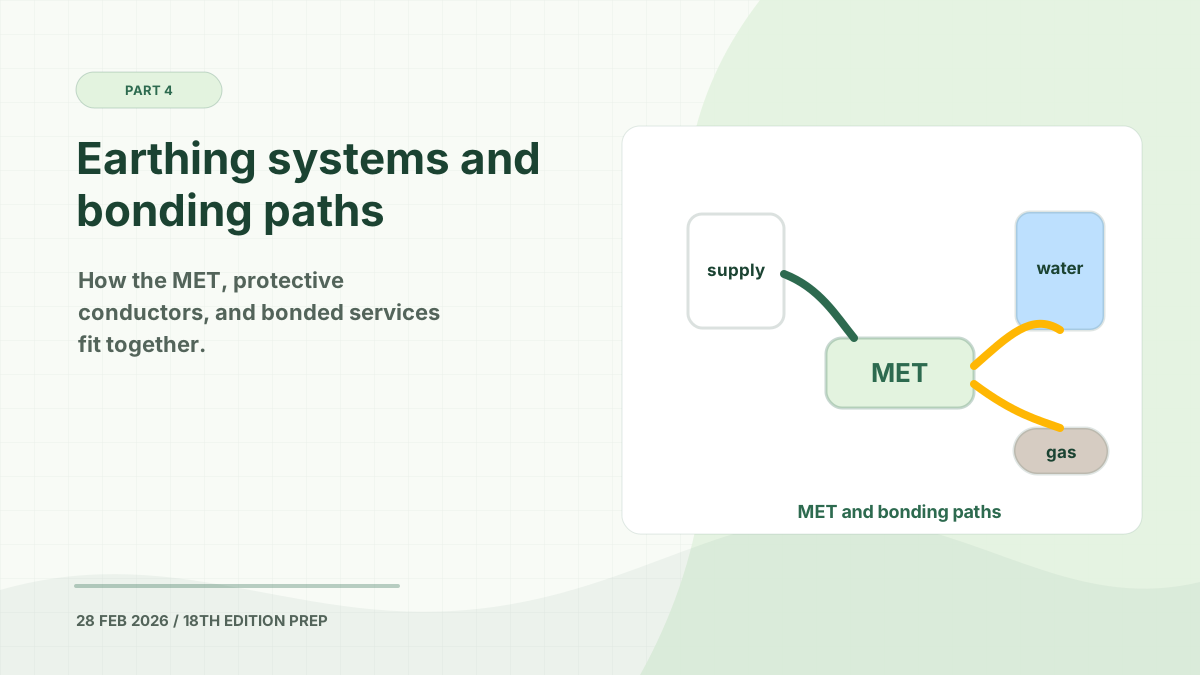
Earthing and bonding are the foundation of electrical safety. Every protective device in an installation — MCBs, RCDs, fuses — relies on a properly designed earth fault path to operate correctly. If the earthing or bonding is wrong, protection against electric shock fails.
This is also one of the most heavily tested topics in the IET exam. This guide covers the three earthing systems, main protective bonding, circuit protective conductors, conductor sizes, and the key BS 7671 regulations you need to know.
For a focused explanation of each arrangement, use our dedicated guides to the TN-C-S earthing system, TN-S earthing system, and TT earthing system.
In This Guide
Why Do We Need Earthing?
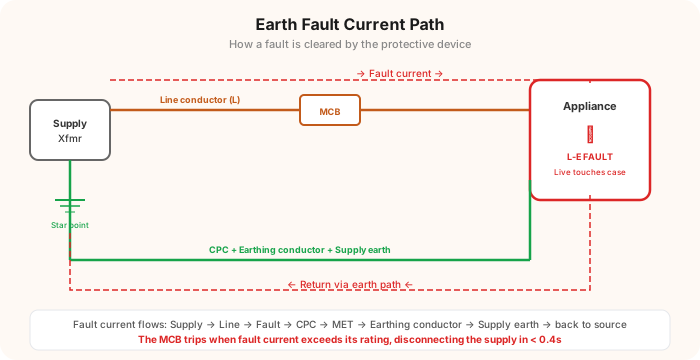
The purpose of earthing is simple: if a fault occurs — say the live conductor touches the metal casing of an appliance — the fault current needs a low-resistance path back to the source so that the protective device (MCB, fuse, or RCD) can detect it and disconnect the supply quickly.
Key Principle: Without a low-resistance earth fault path, the metal casing of a faulty appliance sits at a dangerous voltage. Anyone touching it becomes the path to earth — through their body.
Regulation 411.3.1.1 of BS 7671 requires that, under earth fault conditions, the protective device must disconnect the circuit within:
| Circuit Type | Maximum Disconnection Time |
|---|---|
| Socket outlets and portable equipment (up to 32A) | 0.4 seconds |
| Fixed equipment and distribution circuits | 5 seconds |
The Three Earthing Systems
BS 7671 recognises three earthing systems, identified by a letter code:
| Letter | Meaning | Description |
|---|---|---|
| T | Terre (earth) | Connection to earth |
| N | Neutral | Connection to the supply neutral |
| C | Combined | Neutral and earth are the same conductor |
| S | Separate | Neutral and earth are separate conductors |
The first letter describes the supply side (how the source is earthed). The second letter describes the installation side (how the installation is earthed).
| System | Earth Source | Typical Ze | Key Characteristics |
|---|---|---|---|
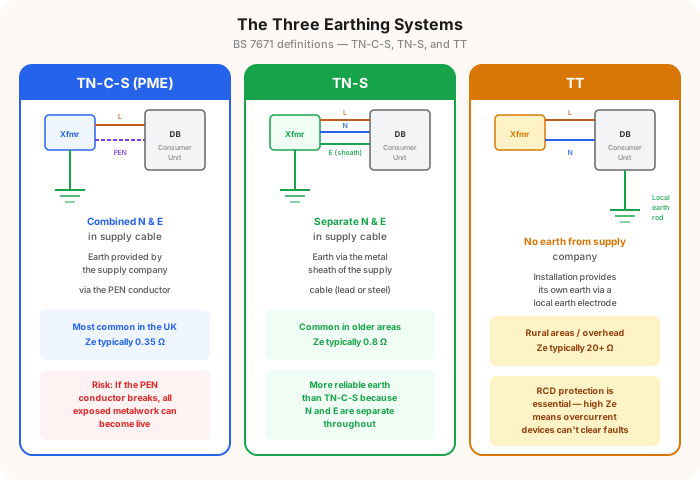
| TN-C-S (PME) | PEN conductor (combined neutral/earth from supply) | 0.35 Ω | Most common UK system. Neutral and earth combined in supply cable, separated at consumer unit. Risk of open PEN fault. |
| TN-S | Metal sheath of supply cable | 0.8 Ω | Neutral and earth are separate throughout. Common in older underground networks. More reliable — no PEN conductor to fail. |
| TT | Local earth electrode (earth rod) | 20 Ω or more | No earth provided by supply company. Common in rural areas with overhead lines. RCD protection is essential. |
Warning: On TN-C-S (PME) systems, if the PEN conductor breaks (open PEN fault), all exposed metalwork connected to the earthing system can rise to a dangerous voltage. Because of this risk, there are restrictions on using PME earthing for certain situations — for example, it’s generally not permitted as the sole earth for swimming pools or caravan sites.
Main Protective Bonding
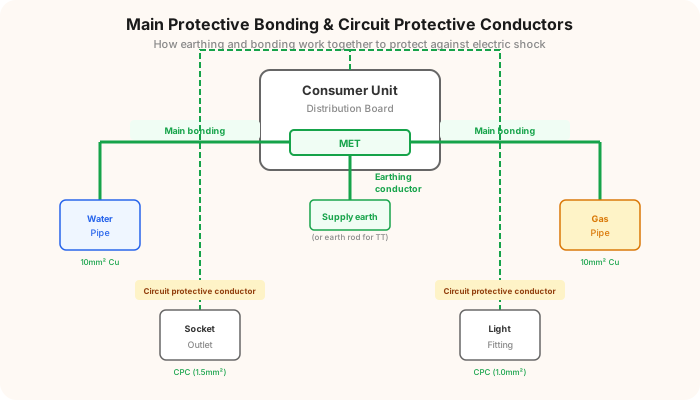
Main protective bonding connects extraneous conductive parts — metallic services entering the building that could introduce an earth potential — to the Main Earthing Terminal (MET).
The purpose is to ensure that all metalwork in the building is at the same potential. If a fault occurs, bonding prevents a dangerous voltage difference between, say, a gas pipe and an earthed appliance.
What Must Be Bonded?
Under Regulation 411.3.1.2, the following extraneous conductive parts must be connected to the MET via main protective bonding conductors:
| Extraneous Conductive Part | Notes |
|---|---|
| Water service pipes | Main incoming service |
| Gas service pipes | Consumer’s side of meter |
| Oil supply pipes | Where metallic |
| Structural steelwork | If it forms an extraneous conductive part |
| Central heating systems | Pipework and radiators |
| Lightning protection systems | Where installed |
| Other metallic services | Any metallic service entering the building |
Where to Connect
Main bonding conductors must be connected within 600mm of the point of entry of the service into the building — and before any branch in the pipework. For gas, the connection must be on the consumer’s side of the meter, as close as practicable to the meter.
Exam Tip: The 600mm rule and the requirement to connect on the consumer’s side of the gas meter are frequently tested. Remember: within 600mm of entry, before any branch, and on the consumer’s side of the gas meter.
Conductor Sizes
One of the most commonly tested topics in the exam is knowing the minimum conductor sizes for different types of earthing and bonding conductors.
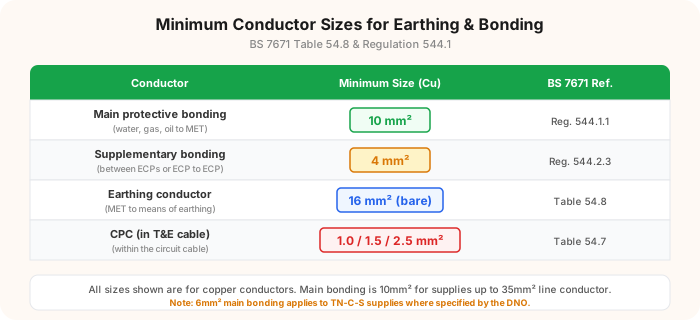
Quick Reference: Minimum Conductor Sizes
| Conductor | Minimum Size (Cu) | BS 7671 Reference |
|---|---|---|
| Main protective bonding | 10 mm² | Reg. 544.1.1 |
| Supplementary bonding | 4 mm² | Reg. 544.2.3 |
| Earthing conductor (MET to means of earthing) | 16 mm² for a 16–35 mm² line conductor | Table 54.7, Reg. 542.3.1 |
| Earthing conductor buried bare (not protected against corrosion) | 25 mm² | Table 54.1 |
| Earthing conductor buried, sheathed and mechanically protected | 2.5 mm² | Table 54.1 |
| CPC (within cable) | Per Table 54.7 | Reg. 543.1.1 |
Note: Where PME conditions apply, the main bonding conductor is 10 mm² Cu for a supply PEN conductor up to 35 mm², and larger above that (Table 54.8). Where they do not (TN-S, TT), it is half the earthing conductor, at least 6 mm² and need not exceed 25 mm² (Reg. 544.1.1).
The Main Earthing Terminal (MET)
The MET is the central connection point for the installation’s earthing system. Everything connects here:
- The earthing conductor (from the means of earthing — supply earth or earth rod)
- All main protective bonding conductors
- The circuit protective conductors (CPCs) via the distribution board
Regulation 542.4.1 requires that the MET must be accessible for testing and inspection, and must allow individual conductors to be disconnected for measurement. In practice, this is often an earth bar inside or adjacent to the consumer unit.
Circuit Protective Conductors (CPCs)
The CPC is the earth conductor within each circuit cable (the bare copper wire in T&E cable, for example). Its job is to carry fault current from the point of the fault back to the MET and then to the source.
The size of the CPC depends on the size of the line conductor and is selected using Table 54.7 of BS 7671:
| Line conductor (mm²) | Minimum CPC (mm²) |
|---|---|
| Up to 16 | Same as line conductor |
| 16 to 35 | 16 |
| Over 35 | Half of line conductor |
In practice, the CPC size in standard T&E cable is often smaller than the line conductor (e.g., 2.5 mm² T&E has a 1.5 mm² CPC). This is important for calculating R1+R2 values during testing.
Common Exam Questions
| Question Type | What to Remember |
|---|---|
| ”What is the minimum size of main bonding?“ | 10 mm² Cu (for supplies up to 35 mm²) |
| “On a TT system, what provides fault protection?” | RCD protection (overcurrent devices can’t clear faults quickly enough) |
| “What does the first letter in TN-S mean?” | T = the source (transformer) is directly connected to earth |
| ”Where must main bonding be connected on gas?” | Consumer’s side of the meter, within 600mm of entry |
| ”What is the typical Ze for a TN-C-S system?“ | 0.35 Ω |
| ”Why is an open PEN fault dangerous?” | All bonded metalwork can rise to supply voltage |
| ”What disconnection time for a 32A socket circuit?“ | 0.4 seconds |
Key Regulations
For quick reference, here are the main BS 7671 regulations for earthing and bonding:
| Regulation | Requirement |
|---|---|
| Reg. 411.3.1.1 | Maximum disconnection times for fault protection |
| Reg. 411.3.1.2 | Main protective bonding requirements |
| Reg. 411.4.2 | TT system fault protection (RCD required) |
| Reg. 542.1 | Earthing arrangements general requirements |
| Reg. 542.4.1 | Main earthing terminal requirements |
| Reg. 543.1.1 | CPC sizing (Table 54.7) |
| Reg. 544.1.1 | Main bonding conductor sizing |
| Table 54.7 | Minimum CPC sizes related to line conductor |
| Table 54.1 | Minimum buried earthing conductor sizes |
| Table 54.8 | Minimum main protective bonding conductor sizes (PME) |
Practice and Further Study
Earthing and bonding falls under Part 4: Protection for Safety of BS 7671. Test your knowledge with our practice quizzes:
Study on the go with our mobile app: App Store | Google Play
Prepare for your exam with our mobile app
690+ practice questions with detailed explanations