Three Essential Formulas for the 18th Edition Exam: Adiabatic, Voltage Drop and Rating Factors
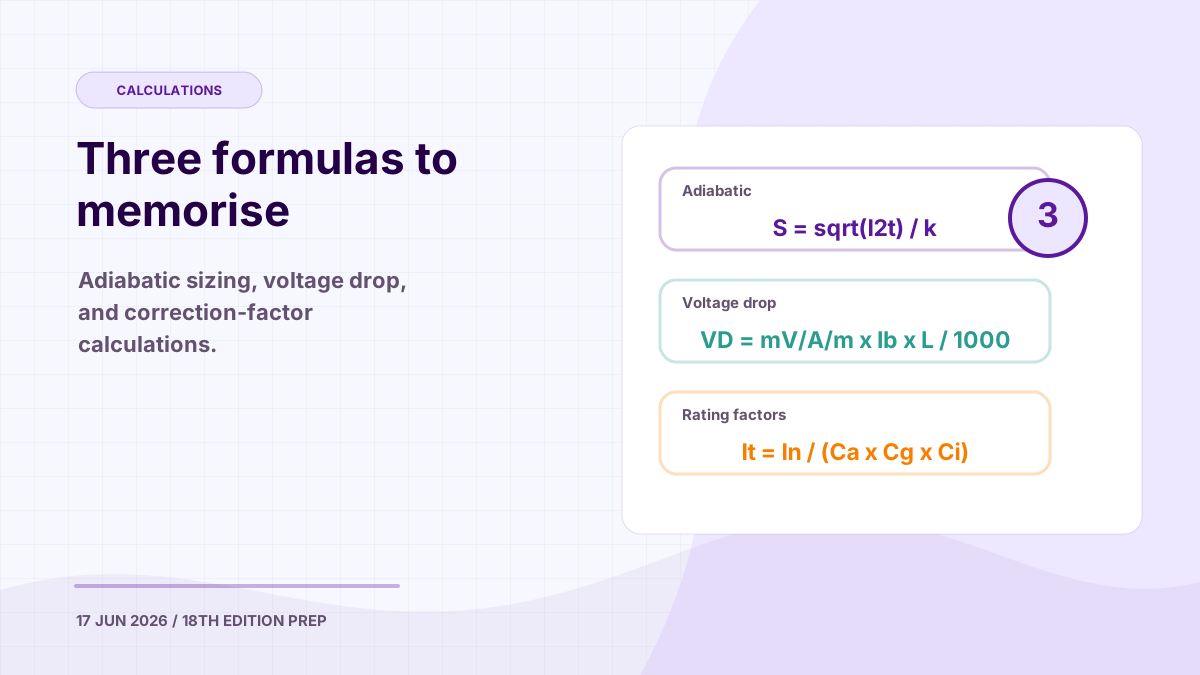
Calculation questions remain an important part of the 18th Edition exam, and candidates regularly ask the same thing: which formulas should I actually learn? The good news is that the list is short. Master three calculations and you’ll be equipped for the core maths used in the City & Guilds 2382-26 assessment.
This guide walks through all three — the adiabatic equation, voltage drop, and rating factors — with fully worked examples in the same style the exam uses. Where calculations are required, the relevant data is almost always given to you in the question. Your job is to recognise the correct formula, enter the numbers, and make the calculation inside your two-minute window.
Key insight: The exam does not print these formulas for you (with one partial exception). Knowing them by heart — and knowing where the supporting data lives in the Brown Book — is what separates a confident calculation answer from a guess.
In This Guide
Calculator Skills First
You do not need a scientific calculator or anything fancy. A cheap basic calculator from any stationer will do everything required. But you must be fluent with three operations before exam day.
| Operation | What It Means | Example |
|---|---|---|
| Squaring | A number multiplied by itself | 4² = 4 × 4 = 16 |
| Square root | The number that, multiplied by itself, gives the original | √25 = 5, because 5 × 5 = 25 |
| Calculation order | When two or more numbers sit on the bottom of a fraction, work them out first, then divide into the top | See below |
Some calculators want the square root key pressed before the number, others after. Find out which yours does now — not in the exam hall.
Exam tip: Calculation order is where marks quietly disappear. Take 20 ÷ (0.94 × 0.725). Work the bottom row first: 0.94 × 0.725 = 0.6815. Then divide: 20 ÷ 0.6815 = 29.35. Type it left to right without the bracket and you’ll get a wrong answer — and the exam will often list that wrong answer as a tempting option.
Formula vs Calculation
It’s worth being clear on the language, because the two words get used loosely. A formula is a set of symbols showing the order of operations — think of it as a written recipe. A calculation is the act of putting the numbers into the calculator to get the answer — the actual mixing and baking. You learn the formula; you perform the calculation.
The Adiabatic Equation
The word adiabatic means all the heat generated in the conductor by the fault current stays in the conductor — none is lost to the surroundings. It’s the worst-case scenario, and if a conductor survives the worst case, it’s fine in normal service. We use it to check the minimum size of a protective conductor (CPC).
The equation can be transposed into two forms — one solving for time, one solving for size:
| Solving For | Formula | Use It When… |
|---|---|---|
| Time | t = (k² × S²) ÷ I² | You need to know how long a given conductor takes to reach its limiting temperature |
| Size | S = √(I² × t) ÷ k | You need the minimum CSA that won’t overheat in the given disconnection time |
Here, S is the conductor cross-sectional area (mm²), I is the fault current (A), t is the disconnection time (s), and k is a material factor (115 for copper with PVC insulation).
Worked Example — Time
Calculate the time for a copper CPC in PVC insulation to reach its limiting temperature of 70°C. Data: k = 115, S = 4 mm², I = 650 A.
Three steps — top row, bottom row, then divide:
- Top: 115 × 115 × 4 × 4 = 211,600
- Bottom: 650 × 650 = 422,500
- Divide: 211,600 ÷ 422,500 = 0.5 s
The conductor would reach 70°C in 0.5 seconds — but it won’t, because the protective device will trip long before that. The answer is 0.5 s.
Worked Example — Size
What minimum CSA should a copper PVC CPC be to carry a fault current of 750 A safely on a final circuit? Data: k = 115, t = 0.4 s, I = 750 A.
This one involves a square root. Work out I² × t first, square root it, then divide by k:
- 750 × 750 × 0.4 = 225,000
- √225,000 = 474.34
- 474.34 ÷ 115 = 4.12 mm²
Remember: A result of 4.12 mm² does not round down to 4 mm² just because copper is expensive. When a minimum size lands between two standard sizes, always go up — the answer is 6 mm².
For a deeper walkthrough of where this equation comes from and how it links to CPC selection, see our guide on the adiabatic equation explained. If transposing equations is what trips you up, the transposition of electrical formulae guide covers the algebra step by step.
The Voltage Drop Formula
Voltage drop tells you how many volts are lost in the cable run, and therefore what voltage is actually available at the equipment. BS 7671 gives the limits as percentages of the nominal supply voltage:
| Circuit Type | Limit | Max Drop (230 V) |
|---|---|---|
| Lighting | 3% | 6.9 V |
| All other (power) circuits | 5% | 11.5 V |
The limits and a written description live in Appendix 4 (referenced by Regulation 525), but — and this catches people out — BS 7671 does not print the formula itself. You must memorise it:
Voltage drop = (mV/A/m × I_b × L) ÷ 1000
Where mV/A/m is the millivolts-per-amp-per-metre value for the cable (from the Appendix 4 tables), I_b is the design current, and L is the circuit length in metres.
Worked Example — Voltage Drop
Calculate the voltage drop in a 230 V domestic water heater cable. Data: mV/A/m = 18, I_b = 20 A, L = 30 m.
(18 × 20 × 30) ÷ 1000 = 10,800 ÷ 1000 = 10.8 V
Exam tip: Always check the result against the right limit. A water heater is a power circuit, so the limit is 11.5 V — and 10.8 V passes comfortably. If this had been a lighting circuit, the 6.9 V limit would mean it fails. Same number, different verdict, depending on circuit type.
Voltage drop is a core part of cable selection — see how it fits the full procedure in our cable size and protective device rating guide.
Rating Factors (C Factors)
A cable can be derated by its environment: high ambient temperature, grouping with other cables, or contact with thermal insulation. To compensate, we select a larger conductor with a higher current rating. Note that the circuit current doesn’t change — only the cable size does.
Key point: Picture a body-builder carrying an old lady’s shopping basket with one hand. The contents of the basket haven’t changed — only the size of who’s carrying it. The load current is fixed; we’re just choosing a bigger conductor to carry it comfortably.
The formula determines the minimum tabulated current the cable must be rated for:
I_t ≥ I_n ÷ (C_a × C_g × C_i × C_f)
| Symbol | Factor |
|---|---|
| C_a | Ambient temperature |
| C_g | Grouping |
| C_i | Thermal insulation |
| C_f | Fuse factor (0.725 for BS 3036 semi-enclosed fuses) |
Only include the factors named in the question — drop the rest entirely. (Some books set unused factors to 1, which has the same effect; it’s simpler just to leave them out.)
Worked Example — One Factor
Find I_t for a circuit protected by a 20 A circuit breaker in an ambient temperature of 40°C. Take C_a = 0.87.
Only C_a applies, so the formula simplifies to I_t ≥ I_n ÷ C_a:
20 ÷ 0.87 = 22.99 ≈ 23 A
Worked Example — Two Factors
Find I_t for a circuit protected by a 20 A BS 3036 semi-enclosed fuse in an ambient of 35°C. Take C_a = 0.94 and C_f = 0.725.
Only C_a and C_f are mentioned, so ignore C_g and C_i. Bottom row first:
- 0.94 × 0.725 = 0.6815
- 20 ÷ 0.6815 = 29.35 A
Important: This is the single most common place to lose a calculation mark. Divide by 0.94 and then multiply by 0.725 and you’ll get the wrong number — and it’ll be sitting right there in the answer options. Always combine the bottom row before dividing.
The Three Formulas at a Glance
| Formula | Equation | In the Book? |
|---|---|---|
| Adiabatic (time) | t = (k² × S²) ÷ I² | Yes — Chapter 54 / Appendix material |
| Adiabatic (size) | S = √(I² × t) ÷ k | Yes — Regulation 543.1.3 |
| Voltage drop | VD = (mV/A/m × I_b × L) ÷ 1000 | No — limits only, Appendix 4 |
| Rating factors | I_t ≥ I_n ÷ (C_a × C_g × C_i × C_f) | Permutations in Appendix 4 |
Remember: Exact page numbers shift between amendments, so don’t rely on memorising pages from an older Brown Book. Tab the relevant tables and regulations in your copy and learn the formulas by heart — especially voltage drop, which the book never prints.
Common Calculation Mistakes
| Mistake | Why It Costs Marks |
|---|---|
| Dividing the bottom row left to right | Skipping the bracket on grouped denominators gives a wrong answer — often a listed option |
| Rounding a minimum size down | A result of 4.12 mm² must go up to 6 mm², never down to 4 mm² |
| Checking the wrong voltage drop limit | 3% for lighting, 5% for power — using the wrong one flips pass to fail |
| Including factors you don’t need | Only apply the C factors the question actually gives you |
| Expecting the formula on the paper | Voltage drop in particular is never printed — memorise it |
| Mis-keying the square root | Know whether your calculator wants √ before or after the number |
Practice and Further Study
Calculation questions reward repetition more than any other topic — once the method is automatic, the two-minute limit stops being a problem. Make up your own values, work them through, and check your method against the limits every time.
Test your calculation skills across the parts these formulas touch:
- Part 4 — Protection for Safety quiz
- Part 5 — Selection and Erection of Equipment quiz
- Part 6 — Inspection and Testing quiz
Our app includes 690+ practice questions covering all 8 parts with detailed explanations referencing specific regulation numbers, plus full mock tests with the same weighted question distribution as the real exam — so you can rehearse calculation questions under genuine time pressure.
Study on the go with our mobile app: App Store | Google Play
Prepare for your exam with our mobile app
690+ practice questions with detailed explanations