Transposition of Electrical Formulae: The Maths You Need for the IET Exam
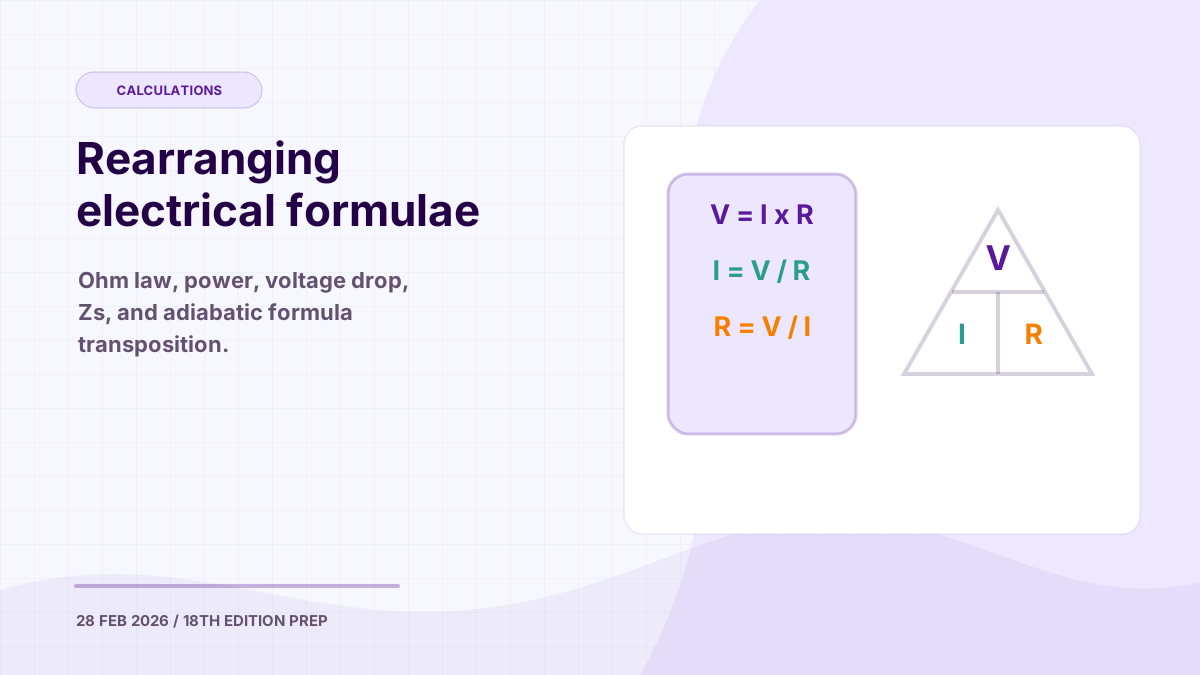
Transposing formulae — rearranging equations to make a different quantity the subject — is one of the skills candidates struggle with most in the IET exam. The good news is that you only need to master a handful of key formulae, and the transposition rules are always the same.
This guide covers the essential electrical formulae, shows you how to rearrange them step by step, and gives you worked examples to practice.
In This Guide
The Golden Rule of Transposition
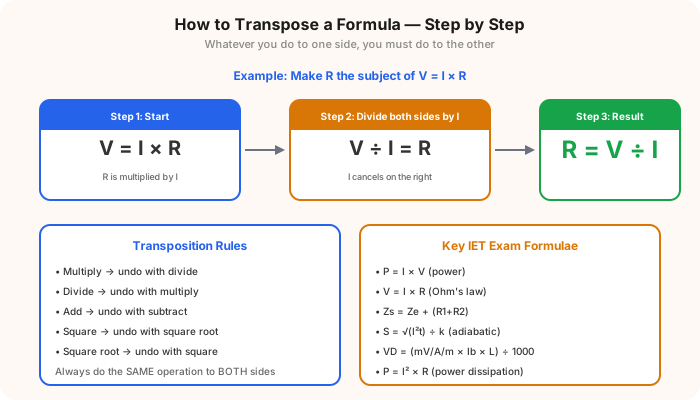
Remember: Whatever you do to one side of the equation, you must do to the other side. This single principle governs every transposition.
That’s it. If a quantity is multiplied on one side, divide both sides by it to move it. If it’s added, subtract it from both sides.
| Operation on one side | Undo it by | Example |
|---|---|---|
| Multiply (×) | Divide (÷) both sides | V = IR → I = V ÷ R |
| Divide (÷) | Multiply (×) both sides | I = V/R → V = I × R |
| Add (+) | Subtract (−) both sides | Zs = Ze + R → R = Zs − Ze |
| Subtract (−) | Add (+) both sides | R = Zs − Ze → Ze = Zs − R |
| Square (²) | Square root (√) both sides | P = I²R → I = √(P/R) |
| Square root (√) | Square (²) both sides | S = √(I²t)/k → Sk = √(I²t) → (Sk)² = I²t |
The Essential Formulae
These are the formulae you must know for the IET exam.
Exam Tip: For each formula below, you must be able to make any variable the subject. Practise until every rearrangement is automatic.
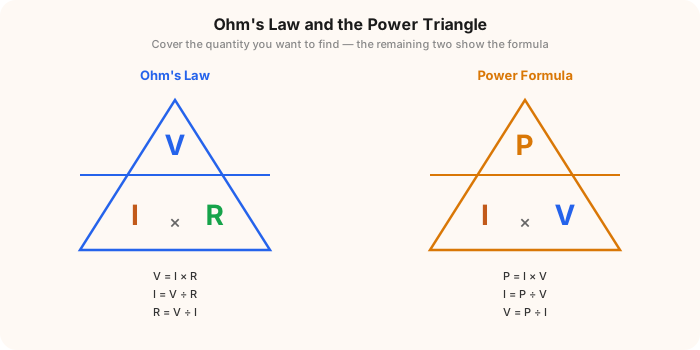
1. Ohm’s Law
V = I × R
| Find | Formula | Example |
|---|---|---|
| Voltage (V) | V = I × R | I = 10A, R = 23Ω → V = 10 × 23 = 230V |
| Current (I) | I = V ÷ R | V = 230V, R = 23Ω → I = 230 ÷ 23 = 10A |
| Resistance (R) | R = V ÷ I | V = 230V, I = 10A → R = 230 ÷ 10 = 23Ω |
2. Power Formula
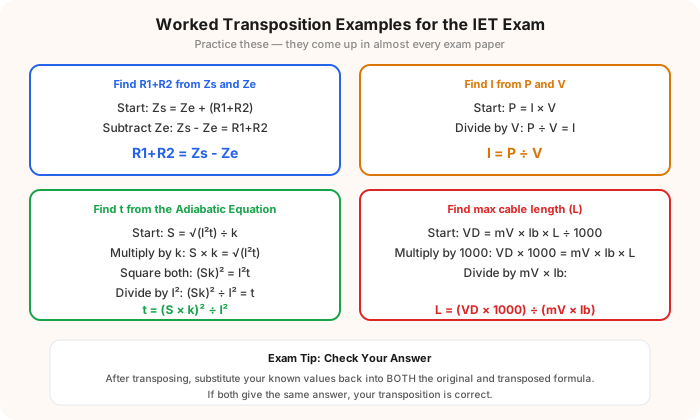
P = I × V
| Find | Formula | Example |
|---|---|---|
| Power (P) | P = I × V | I = 13A, V = 230V → P = 13 × 230 = 2990W |
| Current (I) | I = P ÷ V | P = 3000W, V = 230V → I = 3000 ÷ 230 = 13.04A |
| Voltage (V) | V = P ÷ I | P = 3000W, I = 13A → V = 3000 ÷ 13 = 230.8V |
3. Power Dissipation
P = I² × R
This combines Ohm’s law and the power formula. It’s used to calculate the power dissipated in a cable (heat generated).
| Find | Formula | Example |
|---|---|---|
| Power (P) | P = I² × R | I = 20A, R = 0.5Ω → P = 400 × 0.5 = 200W |
| Current (I) | I = √(P ÷ R) | P = 200W, R = 0.5Ω → I = √400 = 20A |
| Resistance (R) | R = P ÷ I² | P = 200W, I = 20A → R = 200 ÷ 400 = 0.5Ω |
4. Earth Fault Loop Impedance
Zs = Ze + (R1 + R2)
| Find | Formula | Example |
|---|---|---|
| Zs | Zs = Ze + (R1+R2) | Ze = 0.35Ω, R1+R2 = 0.21Ω → Zs = 0.56Ω |
| Ze | Ze = Zs − (R1+R2) | Zs = 0.56Ω, R1+R2 = 0.21Ω → Ze = 0.35Ω |
| R1+R2 | R1+R2 = Zs − Ze | Zs = 0.56Ω, Ze = 0.35Ω → R1+R2 = 0.21Ω |
5. Voltage Drop
VD = (mV/A/m × Ib × L) ÷ 1000
| Find | Formula |
|---|---|
| Voltage drop (VD) | VD = (mV × Ib × L) ÷ 1000 |
| Maximum cable length (L) | L = (VD × 1000) ÷ (mV × Ib) |
| Design current (Ib) | Ib = (VD × 1000) ÷ (mV × L) |
| mV/A/m value | mV = (VD × 1000) ÷ (Ib × L) |
Worked example: What is the maximum cable length for a 6.0 mm² T&E circuit carrying 32A if the voltage drop must not exceed 11.5V? (mV/A/m = 7.3)
L = (VD × 1000) ÷ (mV × Ib) = (11.5 × 1000) ÷ (7.3 × 32) = 11500 ÷ 233.6 = 49.2 metres
6. The Adiabatic Equation
S = √(I²t) ÷ k
This is the most complex transposition in the IET exam. Let’s break down each possible rearrangement:
| Find | Steps | Result |
|---|---|---|
| S (conductor size) | Direct formula | S = √(I²t) ÷ k |
| t (disconnection time) | Multiply by k, square both sides, divide by I² | t = (S × k)² ÷ I² |
| I (fault current) | Multiply by k, square both sides, divide by t, take root | I = (S × k) ÷ √t |
| k (material factor) | Multiply by k, then k = √(I²t) ÷ S | k = √(I²t) ÷ S |
Worked example: A 4.0 mm² CPC (k = 115) carries a fault current of 800A. What is the maximum disconnection time?
t = (S × k)² ÷ I² = (4.0 × 115)² ÷ 800² = (460)² ÷ 640000 = 211600 ÷ 640000 = 0.33 seconds
Step-by-Step Transposition Method
If you get stuck on any transposition, follow this method:
| Step | Action |
|---|---|
| 1 | Write the original formula clearly |
| 2 | Identify the quantity you need to find (the new subject) |
| 3 | Identify what operation connects it to the rest of the formula |
| 4 | Apply the opposite operation to both sides to isolate it |
| 5 | Repeat if the quantity is still not alone on one side |
| 6 | Check by substituting known values into both the original and transposed formulae |
Example: Make I the subject of P = I²R
- Start: P = I² × R
- Want to find: I
- I² is multiplied by R → divide both sides by R: P ÷ R = I²
- I is squared → take the square root of both sides: √(P ÷ R) = I
- Result: I = √(P ÷ R)
- Check: if P = 200W, R = 0.5Ω → I = √(200 ÷ 0.5) = √400 = 20A ✓
Common Exam Traps
| Trap | Example | How to Avoid |
|---|---|---|
| Forgetting to divide by 1000 in VD formula | Getting 7300V instead of 7.3V | Remember: mV/A/m is in millivolts — divide by 1000 to get volts |
| Not squaring/rooting correctly in adiabatic | Getting wildly wrong disconnection times | Write out every step — don’t skip |
| Confusing Zs, Ze, and R1+R2 | Subtracting the wrong values | Draw the formula triangle: Zs at top, Ze and R1+R2 at bottom |
| Forgetting units | Mixing Ω with mΩ, or V with mV | Always state units and convert before calculating |
| Using the wrong power formula | Using P = IV when P = I²R is needed | Choose the formula that has the quantities you know |
Practice Questions
Try these without looking at the answers:
Q1: A circuit has Ze = 0.35Ω and R1+R2 = 0.48Ω. What is Zs?
Q2: An appliance draws 2.3 kW from a 230V supply. What current does it draw?
Q3: A 4.0 mm² cable (mV/A/m = 11.0) supplies a 20A load over 15 metres. What is the voltage drop?
Q4: A 2.5 mm² CPC (k = 115) has a fault current of 600A for 0.4 seconds. Is the CPC adequate?
Q5: What is the maximum cable length for a circuit using 2.5 mm² cable (mV/A/m = 18.0) carrying 20A with a maximum permitted voltage drop of 11.5V?
Answers
A1: Zs = Ze + (R1+R2) = 0.35 + 0.48 = 0.83Ω
A2: I = P ÷ V = 2300 ÷ 230 = 10A
A3: VD = (11.0 × 20 × 15) ÷ 1000 = 3300 ÷ 1000 = 3.3V
A4: S = √(I²t) ÷ k = √(600² × 0.4) ÷ 115 = √(144000) ÷ 115 = 379.5 ÷ 115 = 3.3 mm². Since 3.3 > 2.5, the CPC is NOT adequate — it needs to be at least 4.0 mm².
A5: L = (VD × 1000) ÷ (mV × Ib) = (11.5 × 1000) ÷ (18.0 × 20) = 11500 ÷ 360 = 31.9 metres
Key Regulations
| Regulation | Requirement |
|---|---|
| Appendix 4 | Cable current-carrying capacity and voltage drop tables |
| Reg. 411.4.5 | Maximum earth fault loop impedance (Zs) values |
| Reg. 434 | Protection against fault current |
| Reg. 525 | Voltage drop limits |
| Reg. 543.1.3 | Adiabatic equation for CPC sizing |
| Table 41.3 | Maximum Zs values for MCBs |
Practice and Further Study
Formula transposition is a cross-cutting exam skill used across all parts of BS 7671. Test your knowledge:
Study on the go with our mobile app: App Store | Google Play
Prepare for your exam with our mobile app
690+ practice questions with detailed explanations