Amendment 4 to BS 7671: What to Expect and How It Affects Your 18th Edition Qualification
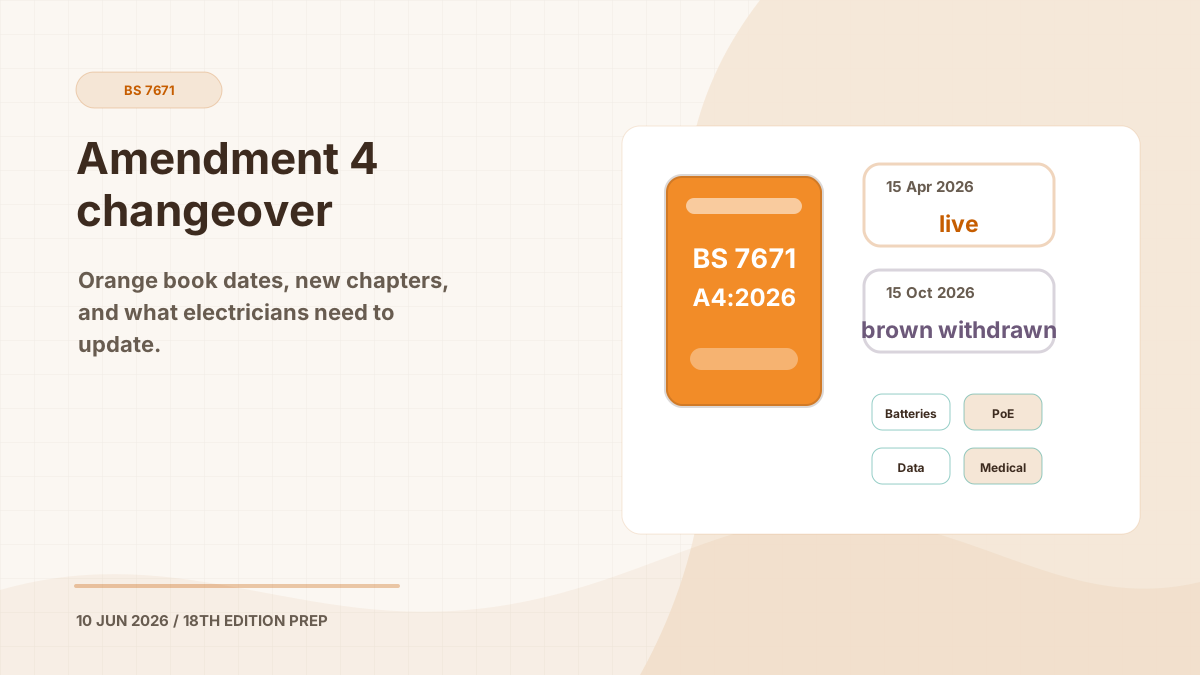
Amendment 4 to BS 7671 — formally BS 7671:2018+A4:2026 — is the biggest regulatory event for UK electricians since Amendment 3. The new orange book was published in April 2026, and we’re now in the six-month crossover period before the Amendment 2/3 brown book is withdrawn for good.
If you’re studying for the 18th Edition exam, already qualified, or registered with a competent person scheme, this affects you. The good news: there’s no need for alarm. The changes are significant in a handful of specific areas, but for most electricians working diligently to Amendments 2 and 3, you’re already 90% of the way to compliance.
This guide covers the key dates, what’s actually changing, how exams are affected, and what your scheme provider will expect from you.
In This Guide
The Key Dates at a Glance
| Date | What Happens |
|---|---|
| 15 April 2026 | Amendment 4 (orange book) becomes live |
| 15 April – 15 October 2026 | Six-month crossover — both A2/A3 and A4 are valid |
| 15 October 2026 | The A2/A3 brown book is withdrawn — all new work must comply with Amendment 4 |
Key point: The six-month parallel period exists for a reason — it gives contractors time to adapt to changes that affect their work, allows the industry to use up Amendment 3 stock, and gives training centres and exam bodies time to implement the changes.
How the Crossover Period Works
During the crossover, both books are active at the same time. Up to 15 April 2026, electricians and contractors had to use the brown book. From 15 April to 15 October 2026, its use is optional — work can be carried out to either the existing A2/A3 standard or the new A4 standard.
From 15 October 2026, only Amendment 4 is valid, and all new work must be completed to the new standard.
Exam tip: If you’re sitting the 2382 exam during the crossover period, confirm with your training centre which amendment your paper is based on before you book. Bringing an A4 book to an A3 exam (or vice versa) is a costly mistake — the question references won’t line up with your tabs.
Practically speaking, it makes sense to start working to the new amendment as soon as you can. Being up to speed with the regulations before October means the deadline passes without drama — and you won’t be caught out at your next scheme assessment.
Do You Need to Resit the 18th Edition Exam?
This is the question on everyone’s mind, and the answer is straightforward:
No. There is no requirement for anyone holding a valid 18th Edition certificate to resit the exam or attend an update course.
However, two caveats apply:
| Consideration | Detail |
|---|---|
| Employer requirements | Some employers will send electrical staff on an update course as part of CPD requirements, and sometimes for insurance purposes |
| Professional duty | All electricians are expected to familiarise themselves with the changes and additions — especially those that affect their day-to-day work |
Remember: “Not required to resit” is not the same as “not required to know.” If a change in Amendment 4 touches your area of work — battery storage, data cabling, medical locations — you’re expected to be working to it from October 2026.
How Exams and Courses Are Affected
If you started a course using the Amendment 2/3 brown book that overlaps with the introduction of Amendment 4, you will normally be allowed to complete your studies and sit the exam to Amendment 2/3 for several weeks after the changeover. After that, all exams move to the new Amendment 4 book.
The reassuring part: most of what you’ve learned from the brown book remains relevant in the orange book. The structure of BS 7671 — its 8 Parts, the regulation numbering system, the core protection principles in Part 4, the testing sequence in Part 6 — carries straight over. If you’ve been revising with our section-by-section revision breakdown, that foundation still stands.
The exam format itself is unchanged: 60 multiple-choice questions, 2 hours, open book. Our guide on how to pass the 18th Edition exam first time applies just as much under Amendment 4 — you’ll simply be tabbing an orange book instead of a brown one.
What Scheme Providers Will Expect
If you’re registered with NICEIC, NAPIT, or another competent person scheme, here’s what’s expected:
| Requirement | Detail |
|---|---|
| Update your knowledge | By self-study or an update course — whichever suits your learning style |
| Show a valid A4 book | At your next assessment after you begin working to Amendment 4 |
| Demonstrate awareness | Be fully aware of how the new regulations affect your specific work |
| Expect questions | Assessment officers will question you on the new regulations at your next annual assessment after you begin working to A4 |
| Crossover flexibility | If you choose not to implement A4 immediately, you won’t be required to provide evidence — but from 15 October 2026, you must work to A4 and provide evidence as required |
What’s Changing: The Five Main Areas
Until the industry has fully digested the new book, here’s the word on the wire — the five main areas of change, without going in too deep.
1. Functional Earthing and Functional Equipotential Bonding (ICT)
Amendment 4 brings clearer definitions relating to functional earthing, functional bonding, and earthing for EMC performance, applicable to ICT installations, data centres, and specialist installations. This is most relevant to commercial and industrial settings, where it will affect installation design and EICR coding at inspection and test.
2. Stationary Secondary Batteries — A New Chapter
A brand-new chapter covering batteries used for electrical storage and the supply of electrical installations. This is especially pertinent if you install solar storage or backup systems.
| Area | What to Expect |
|---|---|
| Technologies covered | Lithium-ion, lead-acid, and other chemistries — new and old |
| Ventilation | More explicit rules on ventilation requirements |
| Fire separation | Separation from combustible materials; protection against thermal runaway |
| Location and access | Defined requirements for battery and cabinet positioning |
| Documentation | Clear labelling and essential documentation left with the person ordering the work |
Important: Expect battery installs to become more like EV charger installs — more paperwork, an emphasis on defined zones, and enhanced scrutiny of fire safety.
3. Power over Ethernet (PoE) — A New Section
PoE is no longer just an afterthought on a network — Amendment 4 treats it as a power system in its own right, with:
- Specific requirements for cable ratings and maximum power classes
- Measures for heat generation in grouped or bundled cables — no more squeezing one last Cat 5 into overfilled trunking
- Thermal constraints to be considered, treated more like SELV and PELV
- Requirements for separation from low voltage circuits
4. Medical Locations — Major Revision of Section 710
Section 710 already exists, but it sees a major revision:
| Change | Detail |
|---|---|
| Classification | Updated classification of medical locations |
| RCDs/RCBOs | Revised RCD and RCBO requirements |
| Supplementary bonding | New guidance, plus mandatory testing (see below) |
| UPS and IPS | More clarity on uninterruptible and isolated power supply systems |
Even small clinics will need more rigorous paperwork and bonding checks.
5. Resistance of Supplementary Bonding Conductors — Measured, Not Assumed
This is a small but important change to inspection and testing. A new dedicated schedule of test results is introduced for measuring and recording the resistance of supplementary bonding conductors.
Key point: It will no longer be sufficient to look at supplementary bonding and record it as “present.” The effectiveness of the conductors cannot be assumed — they must be physically measured with a test meter and the actual values recorded on the new schedule.
If supplementary bonding is a weak spot in your revision, our guide on supplementary bonding and touch voltage covers when it’s required, where it goes, and why the resistance value matters.
How Amendment 4 Affects Domestic Installers
If your work is mainly domestic and you’re already complying diligently with Amendments 2 and 3, the impact is modest: some minor changes requiring small adjustments to working practices. You’re already 90% or more of the way to compliance.
The area of increased focus is documentation:
| Documentation Area | What’s Expected |
|---|---|
| Labelling and identification | More emphasis on clear labelling throughout the installation |
| System documentation | Battery paperwork and PoE system details where fitted |
| Handover information | Enough information left with the owner so anyone following you can understand what was done, how the system is put together, and its safety functions |
| EICR implications | These requirements flow through to EICR coding on future inspections and tests |
Exam tip: Documentation and certification questions are easy marks if you know the paperwork — and easy losses if you don’t. Expect Amendment 4 exams to probe the new schedules and labelling requirements, just as Amendment 2 exams leaned on the then-new AFDD and SPD rules.
Preparing for the Exam Under Amendment 4
Whether you’re sitting the exam to Amendment 3 during the transition window or to Amendment 4 afterwards, the fundamentals of preparation don’t change: learn the structure of the book, tab it properly, weight your study towards Parts 4 and 5, and take timed mock tests. If you’re unsure how long to allow, see our realistic study timeline guide.
For Amendment 4 specifically, give extra attention to:
- The new and revised sections — batteries, PoE, medical locations — as new material is a classic source of exam questions
- The testing changes — the supplementary bonding resistance schedule sits naturally alongside the Part 6 testing sequence
- Definitions — new and clarified terms around functional earthing and bonding will land in Part 2, and definitions underpin questions across the whole paper
Practice and Further Study
The best way to stay sharp through a regulation change is regular practice against the current standard. Test yourself across the key topics:
- Part 4 — Protection for Safety quiz
- Part 5 — Selection and Erection of Equipment quiz
- Part 6 — Inspection and Testing quiz
- Part 7 — Special Installations quiz
Our app includes 690+ practice questions covering all 8 parts of BS 7671 with detailed explanations referencing specific regulation numbers, plus full timed mock exams with the same weighted question distribution as the real paper — so when the exam moves to Amendment 4, your technique is already exam-ready.
Study on the go with our mobile app: App Store | Google Play
Prepare for your exam with our mobile app
690+ practice questions with detailed explanations