Supplementary Bonding and Touch Voltage: When, Where, and Why
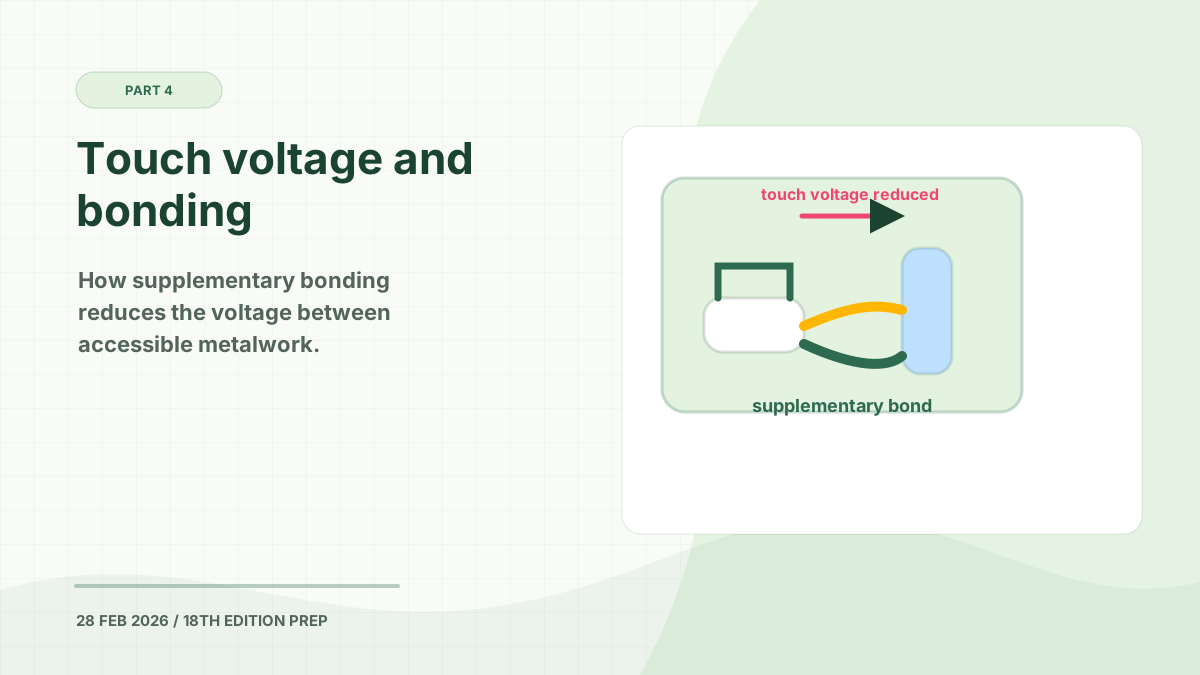
Supplementary bonding is one of those topics that generates endless debate on site and in the exam hall. When is it required? Is it still needed in bathrooms? What size conductor? And what exactly is “touch voltage” anyway?
This guide cuts through the confusion. We’ll cover what touch voltage means, how supplementary bonding controls it, where BS 7671 requires it, and the practical details of conductor sizing and testing.
In This Guide
What Is Touch Voltage?
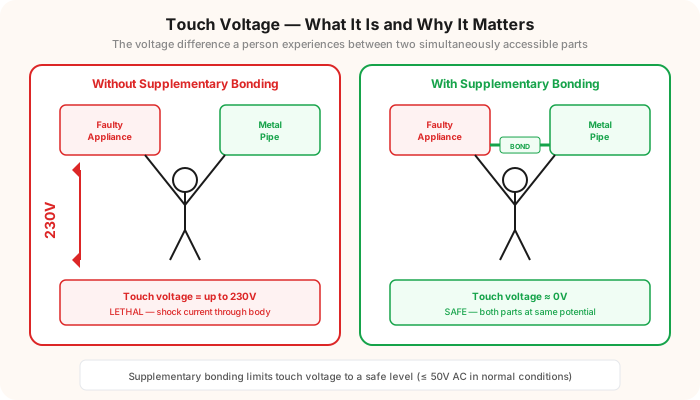
Touch voltage is the voltage that appears between two simultaneously accessible conductive parts when an earth fault occurs. In simple terms, it’s the voltage a person would experience if they touched two pieces of metalwork at the same time during a fault.
Why It Matters
Under normal conditions, all metalwork connected to the earthing system should be at the same potential — roughly 0V between any two parts. But during an earth fault, fault current flowing through the protective conductors causes a voltage drop across those conductors. Different pieces of metalwork can end up at different voltages.
If a person touches two parts that are at different voltages, current flows through their body. The greater the voltage difference, the greater the shock risk. Regulation 131.2.2 states that persons and livestock shall be protected against dangers that may arise from contact with exposed-conductive-parts or extraneous-conductive-parts.
The 50V Limit
BS 7671 uses 50V AC as the conventional touch voltage limit in normal dry conditions (Regulation 411.3.2.2). Below this level, the shock is generally considered non-lethal for healthy adults. In special locations like bathrooms, the limit is effectively lower because of the reduced body resistance when wet.
Key Insight: The 50V AC touch voltage limit (Reg 411.3.2.2) is the threshold below which shock is considered non-lethal for healthy adults in normal dry conditions. In wet locations this limit is effectively lower.
Main Bonding vs Supplementary Bonding
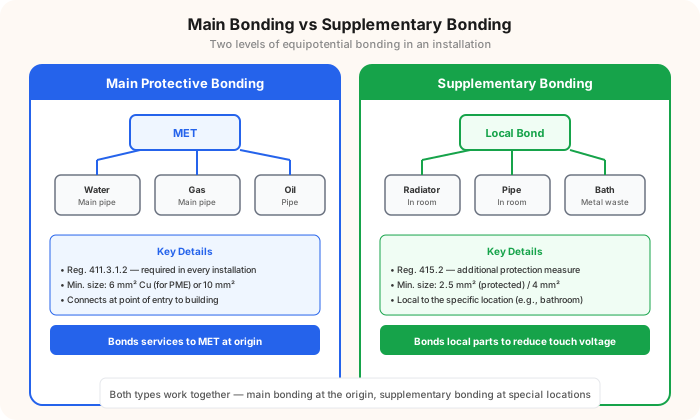
These are two distinct levels of equipotential bonding, and they serve different purposes.
Main Protective Bonding
Main protective bonding (Regulation 411.3.1.2) connects all incoming metallic services — water, gas, oil, structural steel — to the Main Earthing Terminal (MET) at the origin of the installation. This creates a main equipotential zone throughout the building.
Supplementary Bonding
Supplementary bonding (Regulation 415.2) is a local measure. It connects extraneous-conductive-parts and exposed-conductive-parts within a specific area — typically a bathroom or other special location — to ensure they’re all at the same potential.
Comparison
| Property | Main Bonding | Supplementary Bonding |
|---|---|---|
| Regulation | 411.3.1.2 | 415.2 |
| When required | In every installation | Only in specific situations |
| Location | At the point of entry to the building | Installed locally within the area of concern |
| Min. conductor size | 6 mm² Cu (10 mm² for PME/TN-C-S per Table 54.8) | 2.5 mm² Cu (protected) or 4.0 mm² Cu (unprotected) |
| Purpose | Creates main equipotential zone; handles bulk of fault current | Limits touch voltage locally even if main bonding or ADS is insufficient |
When Is Supplementary Bonding Required?
This is where the regulations have evolved over the years, and it’s a common source of exam questions.
The General Rule (Regulation 415.2)
Supplementary bonding is required where automatic disconnection of supply (ADS) cannot be achieved within the required disconnection time, OR where additional protection is deemed necessary for a specific location.
Bathrooms (Section 701)
Regulation 701.415.2 is the key regulation for bathrooms. Supplementary bonding is required in locations containing a bath or shower unless:
- All circuits in the location are protected by a 30 mA RCD, AND
- All extraneous-conductive-parts are connected to the protective equipotential bonding (main bonding) system
If both conditions are met, supplementary bonding may be omitted in bathrooms. This was a significant change introduced in the 18th Edition.
18th Edition Change: The 18th Edition introduced the ability to omit supplementary bonding in bathrooms, provided all circuits have 30 mA RCD protection and all extraneous-conductive-parts are connected to the main bonding system. This is a common exam topic.
However, in practice, many electricians still install supplementary bonding in bathrooms as a belt-and-braces approach — especially in older properties where the main bonding may be questionable.
Other Locations Requiring Supplementary Bonding
| Location | Section | Requirement |
|---|---|---|
| Swimming pools and fountains | Section 702 | Supplementary bonding is mandatory regardless of RCD protection |
| Agricultural and horticultural premises | Section 705 | Supplementary bonding is required in areas accessible to livestock |
| Medical locations | Section 710 | Supplementary bonding is required in Group 1 and Group 2 medical locations |
| Any location where ADS is insufficient | General (Reg 415.2) | Required where disconnection times cannot be met by ADS alone |
What Gets Bonded?
Understanding the terminology is critical for the exam:
| Term | Definition | Examples |
|---|---|---|
| Exposed-conductive-part | Metalwork that forms part of the electrical installation and can be touched | Metal accessory backbox, light fitting body, metal consumer unit enclosure |
| Extraneous-conductive-part | Metalwork NOT part of the electrical installation but capable of introducing a potential | Metal water pipes, gas pipes, radiators, metal baths, structural steelwork |
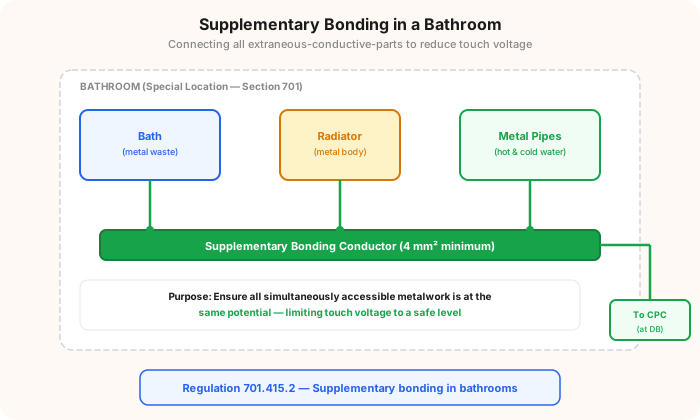
Supplementary bonding connects all simultaneously accessible exposed-conductive-parts and extraneous-conductive-parts to each other. The key phrase is “simultaneously accessible” — if a person can touch two metal parts at the same time, they need to be bonded together.
Conductor Sizes
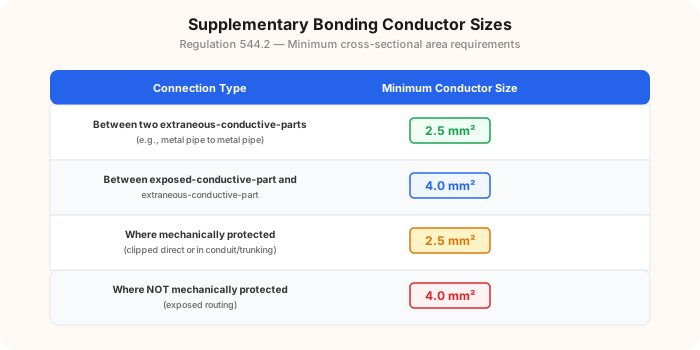
Regulation 544.2 specifies the minimum conductor sizes for supplementary bonding conductors.
The Rules
| Connection Type | Mechanically Protected | Not Protected |
|---|---|---|
| Between two extraneous-conductive-parts | 2.5 mm² Cu minimum | 4.0 mm² Cu minimum |
| Between exposed-conductive-part and extraneous-conductive-part | Not less than half the CPC cross-section, min 2.5 mm² Cu | Not less than half the CPC cross-section, min 4.0 mm² Cu |
Practical Guidance
In most domestic bathroom installations, a 4.0 mm² green/yellow single-core cable is the standard choice. It covers both the “not mechanically protected” requirement and the half-CPC rule for most circuit sizes.
Practical Guidance: Use 4 mm² green/yellow single-core as your default supplementary bonding conductor in domestic bathrooms. It satisfies the “not mechanically protected” minimum and exceeds the half-CPC requirement for virtually all domestic circuit sizes.
Tip: If the CPC of the circuit to a shower is 2.5 mm² (in 6.0/2.5 mm² T&E), half of that is 1.25 mm² — so a 4.0 mm² supplementary bonding conductor is more than adequate.
How Supplementary Bonding Reduces Touch Voltage
The physics is straightforward. During an earth fault:
- Fault current flows through the CPC back to the source
- The CPC has resistance, so a voltage develops along it (V = I × R)
- The exposed-conductive-part connected to the CPC rises in voltage
- Nearby extraneous-conductive-parts (pipes, radiator) may be at a different voltage
- The voltage difference between them is the touch voltage
By connecting these parts together with a supplementary bonding conductor:
- Both parts are held at approximately the same potential
- The touch voltage is reduced to the voltage drop across the bonding conductor itself
- Because the bonding conductor is short and has low resistance, this voltage is very small — typically well below 50V
The Formula
The touch voltage between two supplementary bonded parts is approximately:
V_touch = I_f × R_bond
Where I_f is the fault current and R_bond is the resistance of the bonding conductor. For a 1-metre length of 4.0 mm² copper, R_bond is approximately 0.005 Ω — even with a fault current of 1000A, the touch voltage would only be 5V.
Testing Supplementary Bonding
Supplementary bonding must be tested during initial verification (Regulation 612.2) and checked during periodic inspection.
Continuity Test
Using a low-resistance ohmmeter:
- Connect one test lead to the supplementary bonding conductor at one end
- Connect the other test lead to the bonding conductor at the other end
- The reading should be very low — typically less than 0.05 Ω for short connections
Verification of Supplementary Bonding (Regulation 415.2.2)
BS 7671 provides a formula to verify that supplementary bonding is effective:
R ≤ 50V ÷ I_a
Where:
- R is the resistance of the supplementary bonding conductor between the two simultaneously accessible parts
- I_a is the operating current of the protective device (in amps) for a 5-second disconnection time
- 50V is the conventional touch voltage limit (reduced to 25V in special locations)
If the resistance is less than or equal to this value, the supplementary bonding is adequate.
Common Mistakes
| Mistake | Problem | Solution |
|---|---|---|
| Bonding to plastic pipes | Plastic is not conductive — the bond does nothing | Only bond metal extraneous-conductive-parts |
| Bonding only one end | The bond must be continuous between the two parts | Verify continuity at both ends |
| Using undersize conductor | Fails to meet Regulation 544.2 | Use 4 mm² Cu as standard in bathrooms |
| Missing the bath waste | Metal bath waste pipe is often overlooked | Bond the metal waste if it’s an extraneous-conductive-part |
| Assuming all pipes are extraneous | Plastic pipes insulate the metal sections from earth | Check if metal pipes actually introduce a potential from outside |
| Omitting bonding without meeting the exemption criteria | Bathroom lacks RCD protection or main bonding is inadequate | Only omit supplementary bonding if ALL exemption conditions are met |
Exam Quick Reference
| Question | Answer |
|---|---|
| ”What is touch voltage?” | The voltage between two simultaneously accessible conductive parts during a fault |
| ”What is the conventional touch voltage limit?“ | 50V AC (normal conditions) |
| “When can supplementary bonding be omitted in bathrooms?” | When all circuits have 30 mA RCD protection AND all extraneous-conductive-parts are connected to main bonding |
| ”Minimum supplementary bonding conductor (not mechanically protected)?“ | 4.0 mm² Cu |
| ”Minimum supplementary bonding conductor (mechanically protected)?“ | 2.5 mm² Cu |
| ”Key regulation for bathroom supplementary bonding?” | Regulation 701.415.2 |
| ”Key regulation for supplementary bonding in general?” | Regulation 415.2 |
Key Regulations
| Regulation | Requirement |
|---|---|
| Reg. 411.3.1.2 | Main protective bonding requirements |
| Reg. 411.3.2.2 | Conventional touch voltage limit (50V AC) |
| Reg. 415.2 | Supplementary equipotential bonding (general) |
| Reg. 415.2.2 | Verification of supplementary bonding effectiveness |
| Reg. 544.2 | Supplementary bonding conductor sizing |
| Reg. 612.2 | Continuity of bonding conductors testing |
| Reg. 701.415.2 | Supplementary bonding in bathrooms |
Practice and Further Study
Supplementary bonding and touch voltage are covered under Part 4: Protection for Safety and Section 701: Bathrooms of BS 7671. Test your knowledge:
Study on the go with our mobile app: App Store | Google Play
Prepare for your exam with our mobile app
690+ practice questions with detailed explanations