18th Edition Exam Pass Rate: What the Stats Tell Us (and How to Beat Them)
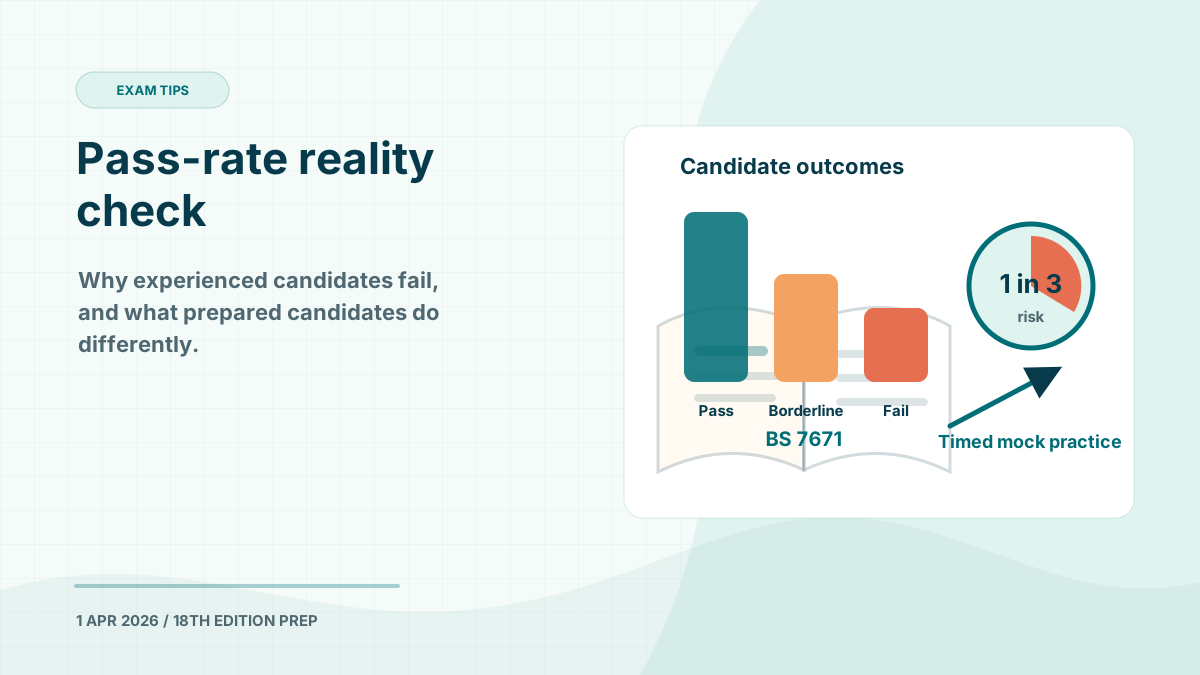
The current 18th Edition exam — City & Guilds 2382-26 — is an open-book, multiple-choice assessment based on BS 7671:2018+A4:2026. On paper, the format sounds straightforward. In practice, candidates still need fast book navigation, accurate reading, and disciplined mock-test practice.
City & Guilds does not publish a single national pass-rate figure for the qualification. Provider-level figures for earlier versions are often quoted, but they vary by cohort and should not be treated as an official forecast for the newer 2382-26 exam.
So what’s going on? And more importantly, how do you make sure you’re in the passing group?
In This Guide
- What the Pass Rate Numbers Actually Look Like
- Why the Failure Rate Is Higher Than You’d Expect
- The Five Factors That Predict Whether You’ll Pass
- Where the Marks Are — and Where They’re Lost
- What Failing Candidates Have in Common
- What Passing Candidates Do Differently
- How to Know If You’re Ready
- If You’ve Already Failed — What to Do Next
- Practice and Further Study
What the Pass Rate Numbers Actually Look Like
City & Guilds doesn’t publish a single headline pass rate for 2382-26. Training providers and assessment centres may report their own figures, so treat the following historical provider ranges as context rather than an official national statistic:
| Source | Reported Pass Rate | Notes |
|---|---|---|
| Classroom-based courses (3–5 day) | 70–80% | Structured teaching, guided book navigation |
| Online/distance learning | 55–65% | Self-directed study, less exam technique coaching |
| Self-study (no course) | 45–60% | No structured support — highest failure rate |
| Resit candidates | 65–75% | Improved, but not all candidates address root cause |
Key point: The delivery method matters. Candidates who attend a structured course with an experienced tutor consistently outperform those who self-study — not because they’re smarter, but because they learn exam technique alongside the content.
The current 2382-26 assessment introduces Amendment 4 material, so older provider figures cannot show how candidates will perform on the updated syllabus. Use them only as a reminder that an open-book exam still requires preparation.
Why the Failure Rate Is Higher Than You’d Expect
A 60% pass mark on an open-book exam should be achievable for anyone who works with electrical installations. So why does roughly a third of candidates fail?
It comes down to three misconceptions:
| Misconception | Reality |
|---|---|
| ”It’s open book, so I don’t need to study much” | The book is 700+ pages. If you’re looking up every answer, you’ll finish about 40 questions before time runs out |
| ”I’ve been wiring for 20 years — I know this” | Practical experience is invaluable, but the exam tests formal regulation knowledge, not site skills. Knowing how to wire a bathroom doesn’t mean you know the regulation numbers or the precise IP rating for Zone 1 |
| ”60% is a low bar” | 36 out of 60 sounds generous — until you realise that 10–15 questions are designed to be genuinely difficult, with answer options that look almost identical unless you understand the precise language of BS 7671 |
Exam tip: The exam doesn’t test whether you can do the work. It tests whether you can navigate BS 7671 and apply its rules correctly under time pressure. These are different skills, and both need practice.
The Five Factors That Predict Whether You’ll Pass
Based on patterns from training providers and candidate feedback, five factors consistently separate those who pass from those who don’t:
| Factor | Impact on Pass Rate |
|---|---|
| Book navigation speed | Candidates who can find a regulation in under 30 seconds pass at much higher rates than those who fumble through the index |
| Mock test practice | Candidates who complete 3+ timed mock tests before the real exam pass at rates above 85% |
| Study duration | 4–6 weeks of structured study is the sweet spot — less than 2 weeks correlates with significantly higher failure rates |
| Understanding of exam language | Knowing the difference between “shall”, “should”, and “may” in BS 7671 eliminates a category of errors |
| Familiarity with Amendment 4 | Candidates using older study materials miss new or revised content in the 2026 Orange Book |
Remember: You don’t need to memorise 700 pages. You need to understand the structure, know where to find things quickly, and have the key numbers committed to memory. For a detailed breakdown of what to study and when, see our guide on how long to study for the 18th Edition.
Where the Marks Are — and Where They’re Lost
The 60 questions are not evenly distributed across BS 7671. Understanding the weighting tells you exactly where to focus — and where most marks are lost.
| Topic | Approx. Questions | Common Pitfall |
|---|---|---|
| Part 4 — Protection for Safety | 15 | Confusing disconnection times between TN and TT systems |
| Part 5 — Selection & Erection | 14 | Errors in overload coordination (Ib ≤ In ≤ Iz) and voltage drop limits |
| Part 7 — Special Installations | 7 | Not knowing bathroom zone dimensions or construction site voltage requirements |
| Part 8 & Appendices | 8 | Ignoring Part 8 entirely — it’s new and candidates assume it won’t be heavily tested |
| Part 3 — General Characteristics | 6 | Weak understanding of supply characteristics, Ze values, and external influences |
| Parts 1, 2, and 6 | 10 | Skipping Part 2 definitions, which then causes wrong answers in other sections |
Parts 4 and 5 together account for 29 out of 60 questions — nearly half the exam. If you’re strong on these two parts, you’re already most of the way to passing. If you’re weak on them, no amount of knowledge about other sections will compensate.
Key point: For a full breakdown of the question types and how they’re structured, see our guide on 18th Edition exam question format and types.
What Failing Candidates Have in Common
When training providers analyse failed papers, the same patterns appear repeatedly:
| Pattern | What Happens |
|---|---|
| Ran out of time | Attempted to look up too many answers — typically completed only 45–50 of 60 questions |
| Unanswered questions | Left difficult questions blank instead of making an educated guess — a blank answer is guaranteed zero marks |
| Misread the question | Chose what a regulation “recommends” when asked what it “requires”, or vice versa |
| Outdated knowledge | Answered from an older Brown Book or pre-Amendment 4 guide instead of BS 7671:2018+A4:2026 |
| Ignored Part 7 and Part 8 | Assumed special locations and prosumers wouldn’t be tested heavily — lost 10–15 easy marks |
| No mock test practice | Had the knowledge but lacked the speed and technique to apply it under timed conditions |
Important: Every unanswered question is a guaranteed zero. Even a random guess gives you a 25% chance. If you’re running low on time, mark your best guess for every remaining question before the clock runs out. For a detailed look at the most common errors, see our post on the most common 18th Edition exam mistakes.
What Passing Candidates Do Differently
The electricians who pass first time — particularly those who score well above the 60% threshold — share a consistent set of habits:
1. They tab their book systematically. Coloured sticky tabs on Table 41.3, Table 54.7, Appendix 4, Appendix 14, Reg. 411.3.2, Reg. 433.1, Reg. 525, Reg. 612, and each Part 7 section. They practise navigating to these tabs under time pressure before the exam.
2. They memorise the critical numbers. Disconnection times (0.4s TN, 0.2s TT, 5s distribution), the overload formula (Ib ≤ In ≤ Iz), voltage drop limits (3% lighting, 5% other), insulation resistance values (500V DC, 1.0 MΩ minimum), and CPC sizing from Table 54.7.
3. They take at least 3–5 full timed mock tests. Not topic quizzes — full 60-question, 2-hour simulations under exam conditions. They review every wrong answer and track which parts they’re weakest on.
4. They use a two-pass strategy. First pass: answer every question you’re confident about without opening the book (typically 25–35 questions). Second pass: use the book to tackle remaining questions and verify uncertain answers. This ensures they finish the paper.
5. They study the language, not just the content. They understand that “shall” means mandatory, “should” means recommended, and “may” means permissible — and they watch for these words in both the regulations and the exam questions.
Exam tip: The two-pass strategy alone can be the difference between passing and failing. If you can answer 30 questions confidently in the first 40 minutes, you have 80 minutes to work through the remaining 30 with your book — that’s nearly 3 minutes per question.
How to Know If You’re Ready
Use mock test scores as your readiness indicator:
| Mock Test Score | What It Means | Action |
|---|---|---|
| 50–60 / 60 | Comfortably ready | Maintain knowledge, light revision |
| 42–49 / 60 | Ready but sharpen weak areas | Review wrong answers, one more mock test |
| 36–41 / 60 | Borderline — risk of failing on the day | Focused study on weak parts, 2+ more mock tests |
| Below 36 / 60 | Not ready | Postpone if possible, focus on content before technique |
Remember: Exam-day nerves, unfamiliar surroundings, and time pressure typically cost 3–5 marks compared to your practice scores. If you’re scoring 38 in mocks, you’re at serious risk of falling below 36 on the day. Aim for a consistent 45+ in mock tests before booking your exam.
If You’ve Already Failed — What to Do Next
Failing isn’t the end. Most resit candidates pass on their second attempt — but only if they change their approach. Simply rebooking and hoping for easier questions is not a strategy.
| Step | What to Do |
|---|---|
| 1 | Get your results breakdown — most centres provide a topic-by-topic score. Identify which parts you lost marks on |
| 2 | Diagnose the root cause — was it time management, content gaps, or question misinterpretation? Each requires a different fix |
| 3 | Address weak areas specifically — if you dropped marks on Part 4, study Part 4. Don’t re-study topics you already passed |
| 4 | Take 3+ timed mock tests scoring above 45 before rebooking |
| 5 | Improve your book navigation — if time was the issue, practise finding tabbed sections until it’s automatic |
Key point: There’s no mandatory waiting period for a resit, but booking immediately without preparation is throwing money away. Give yourself at least 2 weeks of targeted study before your next attempt.
Practice and Further Study
The pass rate statistics tell a clear story: candidates who practise under realistic conditions pass at significantly higher rates than those who don’t. Test your knowledge across the highest-weighted topics:
- Part 4 — Protection for Safety quiz
- Part 5 — Selection and Erection of Equipment quiz
- Part 6 — Inspection and Testing quiz
- Part 7 — Special Installations quiz
Our app includes 690+ practice questions covering all 8 parts of BS 7671 with detailed explanations referencing specific regulation numbers, plus full timed mock exams that mirror the real exam’s weighted question distribution — so you know exactly where you stand before exam day.
Study on the go with our mobile app: App Store | Google Play
Prepare for your exam with our mobile app
690+ practice questions with detailed explanations