Earthing and Bonding Explained: Key Concepts for the 18th Edition Exam
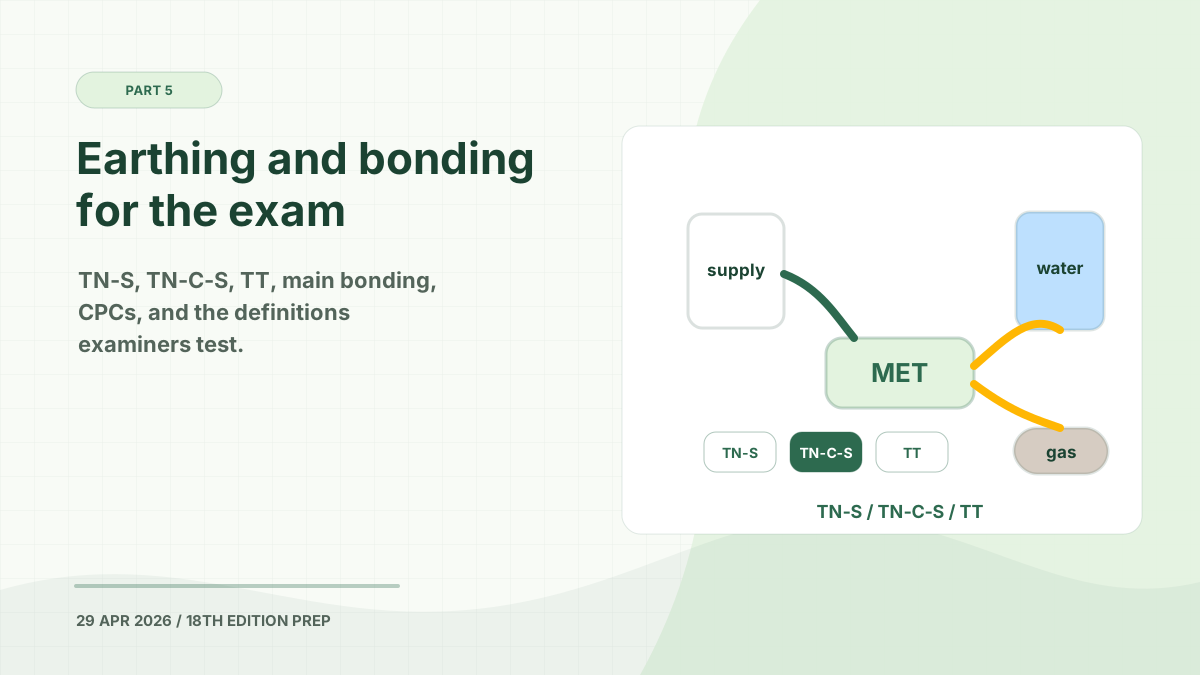
Of all the topics on the City & Guilds 2382-26 exam, earthing and bonding produces some of the most confusion. The two terms get used interchangeably on site, but BS 7671 treats them as fundamentally different systems doing different jobs.
Get the distinction wrong and a chain of related questions starts to fall — fault protection, disconnection times, special locations, and inspection and testing all assume you’ve got earthing and bonding clear in your head.
This guide breaks down the concepts the 18th Edition exam tests most often, with the regulation numbers worth committing to memory.
In This Guide
Earthing vs Bonding — The Core Distinction
Earthing and bonding both connect metalwork to the same terminal in the consumer unit, which is why they get conflated. But they exist for different reasons.
| Concept | What It Connects | Purpose |
|---|---|---|
| Earthing | Exposed-conductive-parts (metalwork that’s part of the electrical equipment, e.g. metal luminaire body, appliance casing) | Provides a low-impedance path for fault current to return to source, allowing the protective device to disconnect within the required time |
| Bonding | Extraneous-conductive-parts (metalwork that isn’t part of the electrical installation but could introduce a potential, e.g. metal water pipes, structural steelwork) | Keeps all exposed metalwork at the same potential during a fault, preventing dangerous touch voltages between simultaneously accessible parts |
Key point: Earthing makes the protective device operate. Bonding stops you getting a shock between two pieces of metal during the brief period before disconnection. Both are needed — they’re not alternatives.
Confusing the two is the single most common reason candidates lose marks on Part 4 and Part 5 questions. If a question mentions a metal water pipe, you’re almost certainly being asked about bonding. If it mentions a metal appliance casing, you’re being asked about earthing.
The Three Earthing Systems
BS 7671 recognises three earthing system arrangements you must know inside out. The letter codes describe the source earthing (first letter) and the installation earthing (second letter).
| System | Source Earthing | Installation Earthing | Typical Use |
|---|---|---|---|
| TN-S | Earthed at one point at source (transformer star point) | Separate neutral and earth conductors throughout | Older urban installations with separate earth in the supply cable sheath |
| TN-C-S | Combined PEN at source | Separated into N and PE at origin (the cut-out) | Most modern UK installations — PME (Protective Multiple Earthing) |
| TT | Source earthed | Installation has its own earth electrode | Rural properties, caravan parks, where no supplier earth is available |
Exam tip: The exam loves questions on the implications of each system. TT systems require RCD protection for fault protection (not just additional protection) because earth fault loop impedance is too high for overcurrent devices to disconnect within 0.2 s. TN-C-S has restrictions in special locations (caravans, EV charging, marinas) because of the risk of broken PEN conductors raising the earth potential.
For a refresher on how earth fault loop impedance is verified, see our guide on testing Zs — earth fault loop impedance.
Main Protective Bonding — Regulation 411.3.1.2 and 544
Main protective bonding is required at the origin of every installation to connect extraneous-conductive-parts to the main earthing terminal (MET).
What Must Be Bonded
Regulation 411.3.1.2 requires main protective bonding for any of the following where they enter the building and are extraneous-conductive-parts:
- Metal incoming water service pipe
- Metal incoming gas service pipe
- Metal oil supply pipework
- Other metallic service pipes and ducting
- Central heating and air-conditioning systems
- Exposed metallic structural parts of the building
The connection must be made within 600 mm of the meter outlet or at the point of entry to the building, before any branch pipework, and on the consumer’s side of any insulating section.
Sizing — Regulation 544.1
| Earthing Conductor (Cu) | Minimum Main Bonding (Cu) | Minimum for TN-C-S (PME) |
|---|---|---|
| Up to 16 mm² | 6 mm² | 10 mm² |
| 25 mm² | 10 mm² (half) | 10 mm² |
| 35 mm² | 16 mm² (half) | 10 mm² |
| 50 mm² | 25 mm² (half) | 16 mm² |
| 70 mm² | 25 mm² (max under standard rule) | 25 mm² |
Remember: For TN-C-S (PME) supplies, the bonding sizes in Table 54.8 take precedence — they are larger because the bonding conductor may have to carry a share of the neutral current if the supply PEN conductor is broken. This is one of the most frequently tested numbers on the exam.
Supplementary Bonding — When and Why
Supplementary bonding is local bonding between simultaneously accessible exposed-conductive-parts and extraneous-conductive-parts within a specific location. It’s a backup for situations where the disconnection time alone isn’t fast enough to prevent dangerous touch voltages.
When It’s Required (Reg. 415.2)
Supplementary bonding is required when:
- The disconnection times of Reg. 411.3.2 cannot be achieved, or
- Required by a specific Part 7 special location (e.g. swimming pools, agricultural premises)
In a location containing a bath or shower (Section 701), supplementary bonding may be omitted if all three conditions of Reg. 701.415.2 are met:
| Condition | Detail |
|---|---|
| All final circuits meet disconnection times | Reg. 411.3.2 — 0.4 s for TN, 0.2 s for TT |
| All final circuits have 30 mA RCD additional protection | Reg. 415.1 |
| Main protective bonding is in place | All extraneous-conductive-parts of the building bonded |
Watch this in the exam: A question about supplementary bonding in a bathroom is really a test of whether you know all three conditions must be satisfied — not just one or two. If the question describes an older bathroom without RCD protection, supplementary bonding must be retained.
Sizing Supplementary Bonding (Reg. 544.2)
| Connection | Minimum Size |
|---|---|
| Between two exposed-conductive-parts | Same size as the smaller CPC connected to either |
| Between exposed and extraneous-conductive-parts | Half the CPC of the exposed-conductive-part |
| Mechanically protected | 2.5 mm² minimum |
| Not mechanically protected | 4 mm² minimum |
For a deeper dive on when supplementary bonding is genuinely needed and the touch-voltage logic behind it, see supplementary bonding and touch voltage.
Circuit Protective Conductors (CPCs)
The CPC is the conductor that connects exposed-conductive-parts of equipment back to the MET. It’s the workhorse of fault protection — its size and continuity directly determine whether a fault clears in time.
CPC Sizing Options
BS 7671 gives you two methods to size a CPC:
| Method | Reference | When to Use |
|---|---|---|
| Table 54.7 | Reg. 543.1.4 | Quick selection — gives a conservative size based on the line conductor |
| Adiabatic equation | Reg. 543.1.3 | When you need a smaller CPC than Table 54.7 allows, or to verify an existing installation |
Table 54.7 (the simple method)
| Line Conductor (mm²) | Minimum CPC (mm²) |
|---|---|
| Up to 16 | Same as line |
| Above 16 up to 35 | 16 |
| Above 35 | Half the line conductor |
If you need to verify a smaller CPC — for example a 1.5 mm² CPC on a 2.5 mm² twin-and-earth ring final — you have to use the adiabatic equation. We’ve covered the maths in the adiabatic equation explained.
Earth Electrode Resistance — TT Systems
In a TT system, the installation’s earth path goes through the earth itself. This makes the electrode resistance (Ra) critical and a popular exam topic.
| Parameter | Detail |
|---|---|
| Maximum Ra (formal limit) | None specified — must satisfy Ra × IΔn ≤ 50V (Reg. 411.5.3) |
| Practical guidance (IET) | Ra ≤ 200 Ω, ideally < 100 Ω for stability |
| Disconnection time (TT) | 0.2 s for final circuits ≤ 32A |
| Required protection | 30 mA RCD (often Type A) — overcurrent devices alone cannot achieve disconnection |
Common exam question: “What is the maximum permissible earth electrode resistance for a TT installation protected by a 30 mA RCD?” The arithmetic is 50 / 0.03 = 1667 Ω — but the IET cautions against relying on values above 200 Ω because of seasonal variation. The exam answer is the regulation requirement (Ra × IΔn ≤ 50V), not the practical guidance.
Key Regulations to Memorise
These are the regulation numbers most likely to appear on the exam — knowing them by reference saves valuable book-search time.
| Regulation | Subject |
|---|---|
| 411.3.1.1 | Connection of exposed-conductive-parts to the protective conductor |
| 411.3.1.2 | Main protective bonding requirements |
| 411.3.2 | Maximum disconnection times |
| 411.4 | TN system fault protection |
| 411.5 | TT system fault protection |
| 415.2 | Supplementary equipotential bonding |
| 543.1 | Cross-sectional area of protective conductors |
| 544.1 | Main protective bonding conductors |
| 544.2 | Supplementary bonding conductors |
| Table 54.7 | Minimum CPC size by selection |
| Table 54.8 | Minimum bonding for PME supplies |
Common Exam Traps
The earthing and bonding section is full of subtle distinctions that examiners use to test whether you’ve truly understood the regulations rather than just memorised them.
| Trap | Why It Catches People Out |
|---|---|
| Plastic incoming services | A plastic water main is not an extraneous-conductive-part — no main bonding required. The metal internal pipework still needs supplementary bonding considerations though. |
| Confusing 6 mm² and 10 mm² | 6 mm² is the standard minimum main bonding; 10 mm² is the minimum for TN-C-S (PME) supplies. The exam will test the PME case. |
| Bonding “to anything metal” | You only bond extraneous-conductive-parts — those that introduce a potential. A metal kitchen sink fed by plastic pipework is not an extraneous-conductive-part. |
| Skipping the 600 mm rule | Bonding must connect within 600 mm of the meter outlet, before any branch — a question may describe a connection 1.5 m downstream and ask if it complies. |
| Earthing conductor sizing under PME | The earthing conductor for a TN-C-S supply has its own minimum sizes (Table 54.8 cross-references) — not the same as main bonding. |
| Assuming bonding always protects you | Bonding equalises potential — it does not clear faults. Always pair the bonding question with the disconnection time question. |
For a wider view of the mistakes candidates regularly make across the whole paper, see the most common 18th Edition exam mistakes.
Practice and Further Study
Earthing and bonding sit at the heart of Parts 4 and 5 — together those two parts deliver almost half the marks on the exam. Targeted practice on this topic pays off more than almost any other area of revision.
Test yourself against the topics that draw on earthing and bonding directly:
- Part 4 — Protection for Safety quiz
- Part 5 — Selection and Erection of Equipment quiz
- Part 6 — Inspection and Testing quiz
- Part 7 — Special Installations quiz
Our app includes 690+ practice questions with detailed explanations, dedicated topic quizzes for earthing systems, main and supplementary bonding, and full timed mock exams. For the current standard, pair your practice with the Amendment 4 revision guide.
Study on the go with our mobile app: App Store | Google Play
Prepare for your exam with our mobile app
690+ practice questions with detailed explanations