What Is an RCD? How It Works, Types, and When BS 7671 Requires One
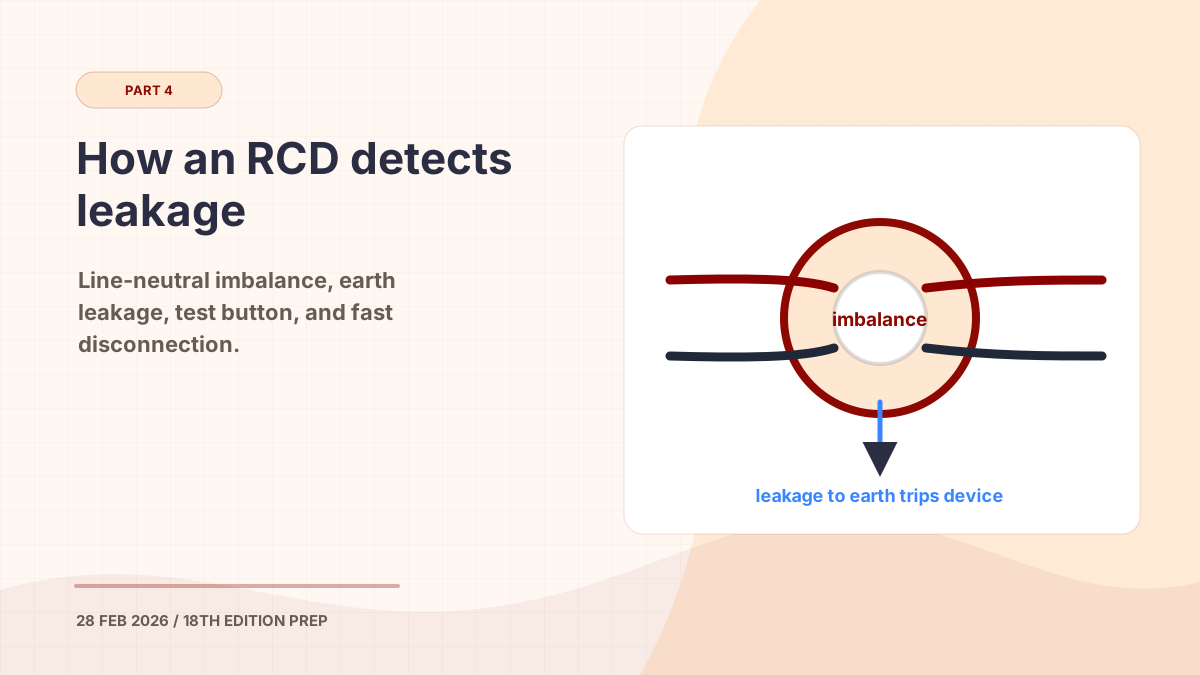
The Residual Current Device — the RCD — is one of the most important protective devices in modern electrical installations. It provides additional protection against electric shock by detecting current leakage to earth and disconnecting the supply in milliseconds — far faster than an MCB or fuse could react.
Understanding how RCDs work, the different types available, and where BS 7671 requires them is essential for the IET exam. This guide covers all of it.
In this guide:
How an RCD Works
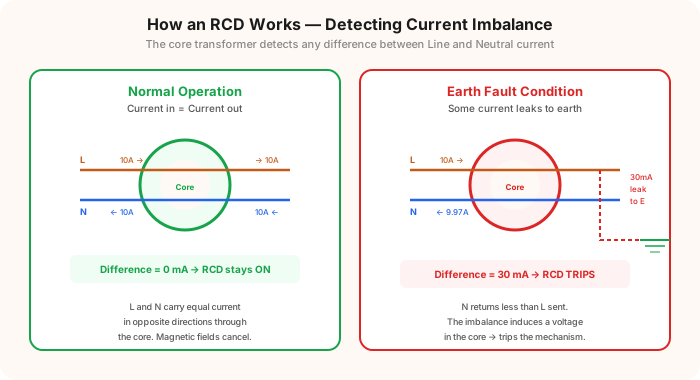
An RCD monitors the current flowing in the Line and Neutral conductors of a circuit. Under normal conditions, the current flowing out on the Line is exactly equal to the current returning on the Neutral — the two cancel each other out.
If a fault occurs — say, current leaks through a person touching a live part to earth — some current takes a different path and doesn’t return via the Neutral. The RCD detects this imbalance and trips.
The Core Transformer
Inside every RCD is a toroidal (ring-shaped) current transformer. Both the Line and Neutral conductors pass through this core.
| Condition | What Happens in the Core | Result |
|---|---|---|
| Normal operation | Line current magnetic field is exactly opposed by Neutral current — net magnetic flux is zero | No voltage is induced in the sensing coil — the RCD stays on |
| Leakage to earth | Less current returns via the Neutral — magnetic fields don’t cancel — net flux in the core | Voltage is induced in the sensing coil — trip mechanism disconnects the supply |
Key point: A 30mA RCD trips well below the level that would cause a fatal electric shock (typically 50mA and above for sustained periods).
Types of RCD
| Type | Ratings | Protection | Advantage |
|---|---|---|---|
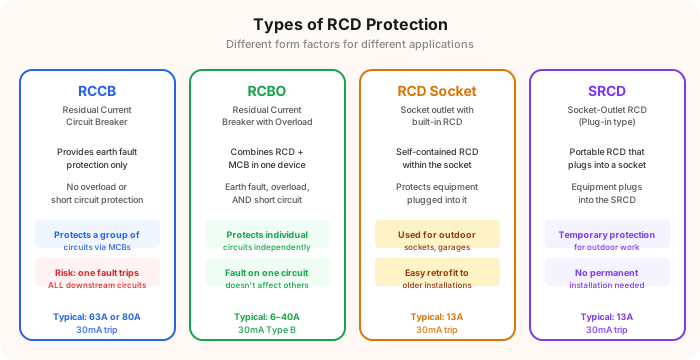
| RCCB (Residual Current Circuit Breaker) | 63A or 80A, 30 mA sensitivity | Earth fault protection only — no overload or short circuit protection. Requires individual MCBs downstream | Often found in split-load consumer units protecting a group of circuits |
| RCBO (Residual Current Breaker with Overcurrent) | 6A to 40A, 30 mA, Type B | Earth fault, overload, AND short circuit protection in a single device | A fault on one circuit only trips that RCBO — all other circuits remain live. The preferred solution for full discrimination |
| RCD Socket Outlet | 30 mA sensitivity | Earth fault protection for whatever is plugged into the socket | Self-contained — useful for outdoor sockets, garages, and retrofitting older installations without RCD protection at the consumer unit |
Where BS 7671 Requires RCD Protection
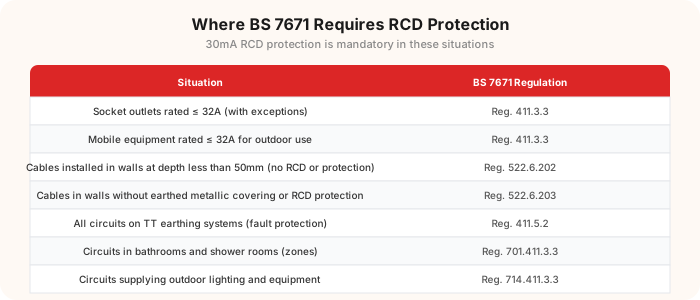
Regulation 411.3.3 is the key regulation. A 30 mA RCD is required for:
Key Requirements
| Scenario | Requirement | Regulation |
|---|---|---|
| Socket outlets ≤ 32A | Must have 30 mA RCD protection | Reg. 411.3.3 |
| TT systems | All circuits require RCD protection for fault protection, since the high Ze means overcurrent devices can’t clear faults fast enough | Reg. 411.5.2 |
| Cables in walls | If cables are installed at a depth less than 50 mm and are not otherwise protected, 30 mA RCD protection is required | Reg. 522.6.202 |
| Bathrooms | All circuits in locations containing a bath or shower require 30 mA RCD protection | Reg. 701.411.3.3 |
| Outdoor equipment | Circuits supplying outdoor lighting and equipment require 30 mA RCD protection | Reg. 714.411.3.3 |
Exceptions
Not every socket needs RCD protection. Exceptions include:
| Exception | Detail |
|---|---|
| Labelled socket outlets | For specific items of equipment, labelled and maintained by a skilled or instructed person |
| Non-outdoor portable use | Socket outlets not expected to supply portable equipment used outdoors |
| Industrial applications | Specific applications where risk assessment justifies an alternative approach |
RCD Testing
RCDs must be tested both by the user (via the test button) and by an electrician (using a calibrated RCD tester).
Test Button
Every RCD has a test button that simulates a small leakage. BS 7671 recommends pressing this button every 6 months to check mechanical operation (the notice wording was updated from quarterly to 6-monthly in Amendment 2:2022, Reg. 514.12.2). The test button only checks the mechanism — it does not verify the trip time or trip current.
Remember: The test button only checks the mechanism — it does not verify the trip time or trip current. Instrument testing is required for full verification.
Instrument Testing (Regulation 612.13)
During initial verification and periodic inspection, an electrician tests the RCD with a calibrated instrument that injects a known test current:
| Test | Current Applied | Maximum Trip Time |
|---|---|---|
| 1× rated residual current (IΔn) | 30 mA (for a 30 mA RCD) | 300 ms |
| 5× rated residual current | 150 mA | 40 ms |
| ½× rated residual current | 15 mA | Must NOT trip |
| Ramp test (optional) | Gradually increasing | Records actual trip current |
Exam Tip: The half-rated test (½× IΔn) is important — it confirms the RCD doesn’t trip too easily, which would cause nuisance tripping. The RCD must NOT trip at half its rated residual current.
RCD vs MCB — What’s the Difference?
| Feature | MCB | RCD (RCCB) | RCBO |
|---|---|---|---|
| Overload protection | ✓ | ✗ | ✓ |
| Short circuit protection | ✓ | ✗ | ✓ |
| Earth fault protection | ✗ | ✓ | ✓ |
| Additional protection | ✗ | ✓ | ✓ |
| Detects | Overcurrent | Current imbalance | Both |
| Trip speed (earth fault) | Up to 5 seconds | Under 300 ms | Under 300 ms |
Warning: An RCD is not a substitute for an MCB — they protect against different things. An RCCB needs MCBs downstream. Only an RCBO provides all three types of protection in one device.
Common Exam Questions
| Question | Answer |
|---|---|
| ”What does an RCD detect?” | An imbalance between Line and Neutral current |
| ”What trip current for additional protection?“ | 30 mA (Reg. 415.1.1) |
| “Maximum trip time at IΔn?“ | 300 ms |
| ”Maximum trip time at 5× IΔn?“ | 40 ms |
| ”Why is RCD essential on TT systems?” | High Ze means MCBs can’t clear earth faults fast enough |
| ”How often should the test button be pressed?” | Every 6 months (Reg. 514.12.2, updated in A2:2022) |
| “Does an RCCB provide overload protection?” | No — MCBs are needed downstream |
Key Regulations
| Regulation | Requirement |
|---|---|
| Reg. 411.3.3 | Additional protection by RCDs (≤ 30 mA) for socket outlets ≤ 32A |
| Reg. 411.5.2 | RCD required for fault protection on TT systems |
| Reg. 415.1.1 | Additional protection: RCD with IΔn ≤ 30 mA |
| Reg. 522.6.202–203 | RCD protection for cables in walls |
| Reg. 531.2 | Requirements for RCDs |
| Reg. 612.13 | RCD testing during verification |
| Reg. 701.411.3.3 | RCD requirements for bathrooms |
Practice and Further Study
RCD protection is covered under Part 4: Protection for Safety of BS 7671. Test your knowledge:
Study on the go with our mobile app: App Store | Google Play
Prepare for your exam with our mobile app
690+ practice questions with detailed explanations