Two-Way and Intermediate Switching: How It Works and How to Wire It
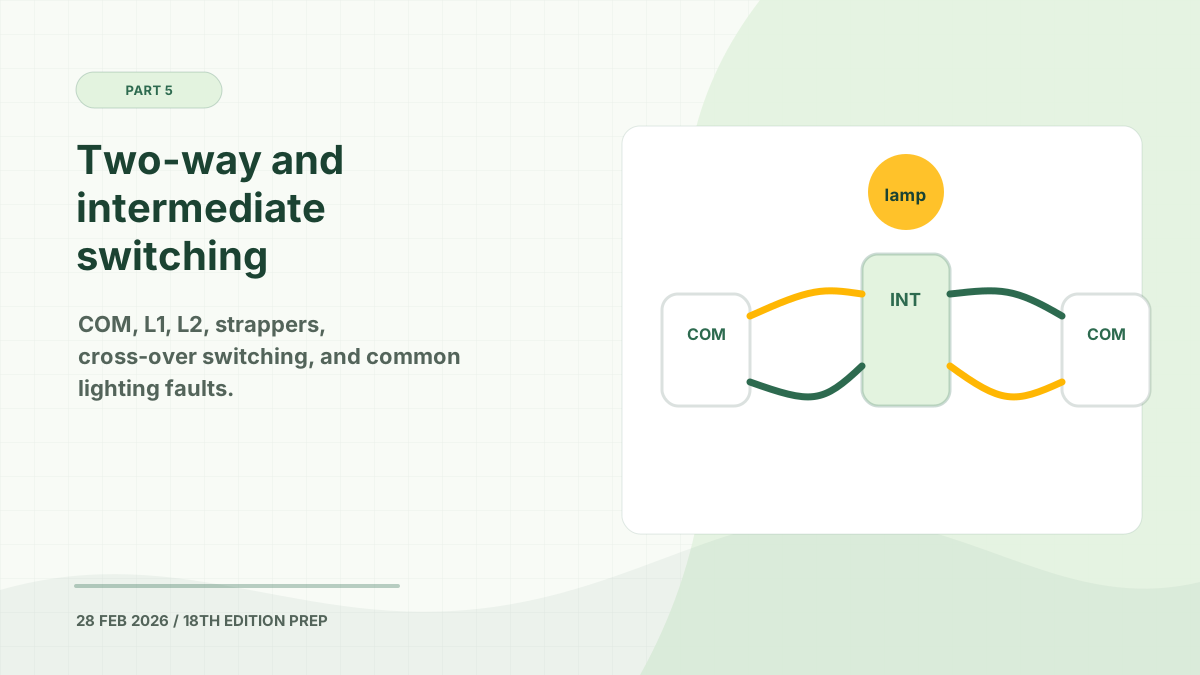
Two-way switching lets you control a single light from two different positions — for example, the top and bottom of a staircase. Intermediate switching extends this to three or more positions. These are fundamental wiring arrangements that come up regularly in the IET exam and in everyday domestic work.
This guide explains the principle behind the switching, the terminal markings, how to wire both arrangements, and common faults to watch for.
In This Guide
One-Way vs Two-Way Switches
Before diving into two-way switching, let’s be clear on the basics.
One-Way Switch
A standard one-way switch has two terminals: COM (common) and L1. It simply makes or breaks the circuit. When the switch is ON, COM is connected to L1. When OFF, the connection is broken.
One-way switching only controls a light from one position.
Two-Way Switch
A two-way switch has three terminals: COM (common), L1, and L2. The switch toggles the COM terminal between L1 and L2 — it’s always connected to one or the other, never both and never neither.
This is the key: a two-way switch doesn’t simply make or break a circuit. It diverts the current to one of two paths.
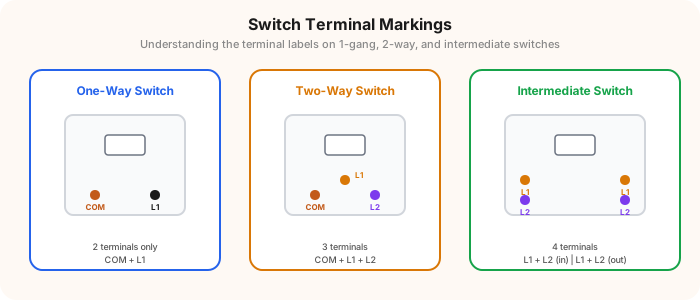
Important: A two-way switch can be used as a one-way switch (just leave one terminal unused), but a one-way switch cannot be used for two-way switching.
How Two-Way Switching Works
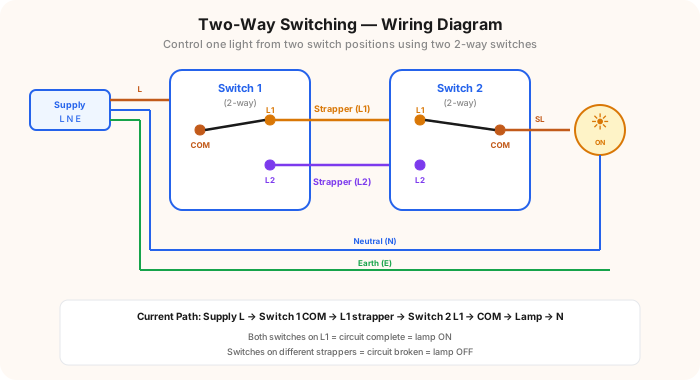
Two-way switching uses two 2-way switches connected by two conductors called strappers (sometimes called “travellers”).
The Principle
- The permanent live (L) from the supply connects to the COM terminal of Switch 1
- Two strappers connect L1 of Switch 1 to L1 of Switch 2, and L2 of Switch 1 to L2 of Switch 2
- The COM terminal of Switch 2 connects to the switched live going to the lamp
- The neutral and earth go directly to the lamp fitting
How It Switches
The light is ON when both switches select the same strapper — both on L1, or both on L2. The light is OFF when the switches select different strappers.
| Switch 1 Position | Switch 2 Position | Current Path | Light |
|---|---|---|---|
| L1 | L1 | Complete via L1 strapper | ON |
| L2 | L2 | Complete via L2 strapper | ON |
| L1 | L2 | Broken — different strappers | OFF |
| L2 | L1 | Broken — different strappers | OFF |
Toggling either switch changes the state of the light. This is why it works from two positions.
Wiring a Two-Way Switch
Using 3-Core and Earth Cable
The most common method uses 3-core and earth cable between the two switches. The three cores are:
| Colour | Function |
|---|---|
| Brown (or red) | Strapper L1 |
| Black (or blue) | Strapper L2 |
| Grey (or yellow) | COM at the far switch (carries switched live back) |
Safety Note: Both strappers and the switched live carry live voltage when the circuit is energised. They must all be identified as line conductors using brown sleeving where applicable — especially the blue and grey cores.
Connections at Switch 1
| Terminal | Connection |
|---|---|
| COM | Permanent live from supply (brown) |
| L1 | Strapper to Switch 2 L1 (brown core of 3C&E) |
| L2 | Strapper to Switch 2 L2 (black/blue core of 3C&E, sleeved brown) |
Connections at Switch 2
| Terminal | Connection |
|---|---|
| COM | Switched live to lamp (grey core, sleeved brown) |
| L1 | Strapper from Switch 1 L1 (brown core of 3C&E) |
| L2 | Strapper from Switch 1 L2 (black/blue core of 3C&E, sleeved brown) |
Intermediate Switching
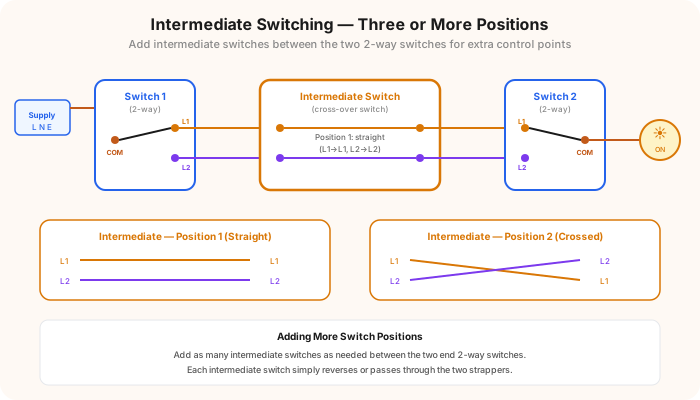
When you need to control a light from three or more positions — such as a long hallway or a room with multiple entrances — you add intermediate switches between the two end 2-way switches.
How an Intermediate Switch Works
An intermediate switch has four terminals — two inputs and two outputs. It has two positions:
- Position 1 (straight-through): L1 in → L1 out, L2 in → L2 out
- Position 2 (crossed): L1 in → L2 out, L2 in → L1 out
In other words, it either passes the strappers straight through or crosses them over. Each time you toggle the intermediate switch, it reverses the strapper connections — changing whether the two end switches agree or disagree, and therefore toggling the light.
Wiring the Intermediate Switch
The intermediate switch is wired between the two 2-way switches, in the strapper cables:
- The L1 and L2 strappers from Switch 1 connect to the input terminals of the intermediate switch
- The output terminals of the intermediate switch connect to L1 and L2 of Switch 2
- The intermediate switch has no COM terminal — it doesn’t connect to the permanent live or switched live
Adding More Positions
You can add as many intermediate switches as you need — each one goes in series between the strappers. For example:
| Positions | Configuration | Intermediate Switches |
|---|---|---|
| 3 | 2-way → intermediate → 2-way | 1 |
| 4 | 2-way → intermediate → intermediate → 2-way | 2 |
| 5 | 2-way → intermediate → intermediate → intermediate → 2-way | 3 |
The two end switches are always 2-way switches. Every switch in between is an intermediate switch.
Common Faults and Troubleshooting
| Symptom | Likely Cause | Fix |
|---|---|---|
| Light doesn’t switch from one position | Strapper disconnected at one switch | Check all terminal connections at the faulty switch |
| Light works from Switch 1 but not Switch 2 | Broken strapper wire or loose terminal | Test continuity of strappers between switches |
| Light only works in one switch combination | Strappers crossed at one switch (L1 and L2 swapped) | Swap L1 and L2 connections at one switch |
| Intermediate switch has no effect | Intermediate switch wired to COM instead of strappers | Rewire — strappers only go through the intermediate switch |
| Blown lamp after switching | Neutral and line swapped somewhere | Check polarity — COM on Switch 1 must be permanent live |
| Earth fault or RCD tripping | Strapper touching earth conductor or backbox | Check insulation and terminal tightness |
Testing Two-Way and Intermediate Circuits
When testing a two-way or intermediate lighting circuit during initial verification:
Continuity (R1+R2)
- Test with all switches in each position — the R1+R2 value should be consistent regardless of which switch position the light operates in
- A significantly different R1+R2 in one switch position suggests a poor connection on one strapper
Insulation Resistance
- Disconnect lamps before testing
- Test L–N, L–E, and N–E as normal
- Remember that strappers carry live voltage — they are line conductors, not neutral
Polarity
- Confirm the permanent live is connected to the COM terminal of the first switch (not to a strapper terminal)
- Confirm the switched live comes from the COM terminal of the last switch
- All switch wires should be line conductors — no neutral conductors pass through switches
Exam Quick Reference
| Question | Answer |
|---|---|
| ”How many terminals on a 2-way switch?“ | 3 — COM, L1, L2 |
| ”How many terminals on an intermediate switch?“ | 4 — L1 in, L2 in, L1 out, L2 out |
| ”What connects the two 2-way switches?” | Two strappers (L1 to L1, L2 to L2) |
| “Where does the permanent live connect?” | COM terminal of the first 2-way switch |
| ”Where does the switched live come from?” | COM terminal of the last 2-way switch |
| ”How many intermediate switches for 4 control points?“ | 2 intermediate switches (between the 2 end 2-way switches) |
| “Can a 2-way switch be used as one-way?” | Yes — leave one terminal unused |
Key Regulations
| Regulation | Requirement |
|---|---|
| Reg. 314.1 | Circuit arrangement and division |
| Reg. 512.2 | Selection based on external influences |
| Reg. 521 | Selection and erection of wiring systems |
| Reg. 559 | Luminaires and lighting installations |
| Chapter 61 | Initial verification (testing polarity and continuity) |
Practice and Further Study
Two-way and intermediate switching is covered under Part 5: Selection and Erection of Equipment of BS 7671. Test your knowledge:
Study on the go with our mobile app: App Store | Google Play
Prepare for your exam with our mobile app
690+ practice questions with detailed explanations