Zs Test: Procedure, Formula and Maximum Values
A Zs test measures earth fault loop impedance at a point in an electrical circuit. It is one of the most important checks in electrical testing because it shows whether, during an earth fault, enough current will flow to operate the protective device within the required time.
Warning: If Zs is too high, the fault current will be too low, the MCB won’t trip in time, and exposed metalwork will remain live long enough to kill someone. That’s why this test matters, and that’s why it appears in virtually every IET exam.
In This Guide
What Is the Earth Fault Loop?
When a live conductor touches an earthed metal casing (an earth fault), the fault current flows in a loop — from the supply source, through the line conductor, through the fault, back via the circuit protective conductor (CPC), through the main earthing terminal, through the earthing conductor, and back to the source through the supply earth.
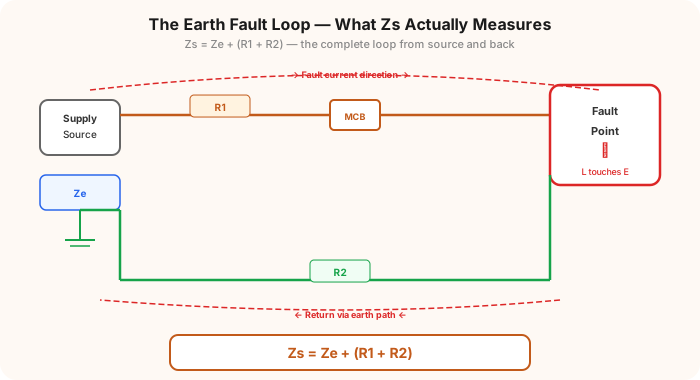
The total impedance of this loop is Zs — the earth fault loop impedance. It’s made up of two parts:
| Variable | Description |
|---|---|
| Ze | External earth fault loop impedance (the supply company’s side) |
| R1 + R2 | Resistance of the circuit’s line conductor (R1) and CPC (R2) from the DB to the point of the fault |
The formula is simply:
Key Formula: Zs = Ze + (R1 + R2)
Why Zs Matters
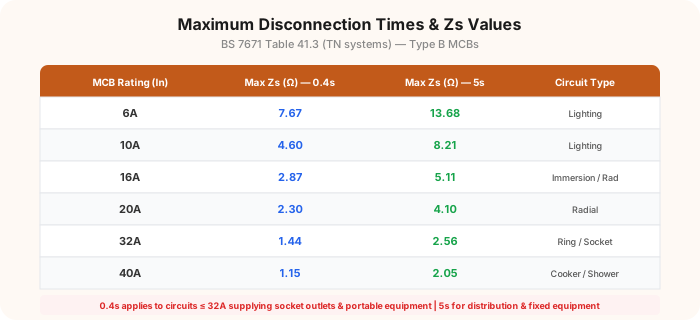
The lower the impedance of the loop, the higher the fault current, and the faster the protective device trips. BS 7671 sets maximum Zs values for each combination of protective device and disconnection time.
Regulation 411.3.2.2 requires that the earth fault loop impedance be low enough to ensure the protective device operates within:
- 0.4 seconds for circuits supplying socket outlets and portable equipment (up to 32A)
- 5 seconds for distribution circuits and circuits supplying fixed equipment
If your measured Zs exceeds the maximum value from BS 7671, the circuit is non-compliant and needs investigation.
Maximum Zs Values
The maximum permitted Zs depends on the type and rating of the protective device. Here are the values for Type B MCBs — the most common in domestic installations:
Commonly Tested Zs Values
| Device | 0.4s Max Zs (Ω) | 5s Max Zs (Ω) |
|---|---|---|
| 6A Type B | 7.28 | 7.28 |
| 16A Type B | 2.73 | 2.73 |
| 20A Type B | 2.19 | 2.19 |
| 32A Type B | 1.37 | 1.37 |
| 40A Type B | 1.09 | 1.09 |
| 50A Type B | 0.87 | 0.87 |
Rule of Thumb: The measured Zs should not exceed 80% of the BS 7671 tabulated maximum to allow for the increase in resistance when the conductors heat up under load.
Important: These are the values at the maximum permitted conductor operating temperature. When testing at ambient temperature (typically 10–20°C), the measured Zs should be significantly lower.
How to Measure Zs
There are two methods for determining Zs:
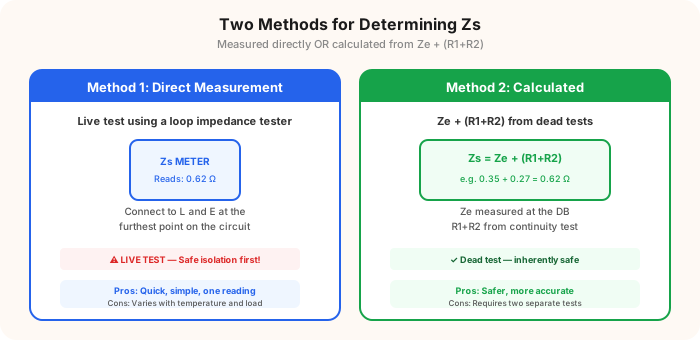
Method 1: Direct Measurement (Live Test)
Connect a loop impedance tester between Line and Earth at the furthest point on the circuit. The instrument passes a brief current pulse and measures the impedance of the complete loop.
| Consideration | Detail |
|---|---|
| Test location | Test at the furthest point from the DB — this gives the highest (worst-case) Zs |
| Circuit state | The circuit must be energised — this is a live test |
| RCD interference | RCDs may trip during the test (use a non-trip mode tester if available, or bypass the RCD temporarily under controlled conditions) |
Method 2: Calculated (Ze + R1+R2)
This is often the preferred method because it uses values obtained from dead tests (safer):
| Step | Action |
|---|---|
| 1 | Measure Ze at the distribution board with the installation’s main earthing conductor disconnected |
| 2 | Measure R1+R2 from the continuity test of the circuit’s ring or radial |
| 3 | Add them together: Zs = Ze + (R1 + R2) |
This method is inherently safer and can be more accurate, especially where RCDs make live Zs testing difficult.
Worked Example
Circuit: A 32A ring final circuit protected by a Type B MCB. The installation is TN-C-S.
- Ze measured at the DB: 0.35 Ω
- R1+R2 from the ring circuit test: 0.27 Ω
Zs = Ze + (R1 + R2) = 0.35 + 0.27 = 0.62 Ω
From BS 7671 Table 41.3, the maximum Zs for a 32A Type B MCB at 0.4s is 1.37 Ω.
0.62 Ω is well below 1.37 Ω — the circuit passes. ✓
Applying the 80% rule: 1.37 × 0.80 = 1.10 Ω. Our measured 0.62 Ω is still well within this margin.
What If Zs Is Too High?
If the measured Zs exceeds the maximum permitted value, the protective device may not disconnect quickly enough. Possible causes include:
| Cause | What to check |
|---|---|
| High Ze | Check the supply earth — is the earthing conductor connected? Is the supply company’s earth intact? |
| High R1+R2 | Long cable run, undersized cable, loose connection, or corroded terminal |
| Wrong protective device | MCB rating too high for the cable length — consider a smaller rating or larger cable |
| Broken CPC | The earth conductor in the cable is damaged or disconnected at a joint or accessory |
| Parallel earth paths | Supplementary bonding may be providing a parallel path, giving a falsely LOW reading — disconnect bonding before testing |
Ze vs Zs — Don’t Confuse Them
| Ze | Zs | |
|---|---|---|
| Full name | External earth fault loop impedance | Total earth fault loop impedance |
| What it measures | Supply side only | Complete loop (supply + circuit) |
| Where measured | At the distribution board (origin of supply) | At the furthest point of the circuit |
| Typical TN-C-S value | 0.35 Ω | 0.35 + R1+R2 |
| Typical TN-S value | 0.80 Ω | 0.80 + R1+R2 |
| When tested | During initial verification | During initial verification and periodic inspection |
Key Regulations
| Regulation | Requirement |
|---|---|
| Reg. 411.3.2.2 | Earth fault loop impedance must ensure disconnection within required time |
| Reg. 411.3.2.3 | Maximum disconnection times (Table 41.1) |
| Table 41.2 | Maximum Zs for fuses (BS 88, BS 1361, BS 3036) |
| Table 41.3 | Maximum Zs for MCBs (Types B, C, D) |
| Reg. 612.9 | Earth fault loop impedance testing requirements |
| Appendix 14 | Earth fault loop impedance values accounting for conductor temperature |
Practice and Further Study
Earth fault loop impedance testing is a core topic in Part 6: Inspection and Testing of BS 7671. Test your knowledge:
Study on the go with our mobile app: App Store | Google Play
Prepare for your exam with our mobile app
690+ practice questions with detailed explanations