Safe Isolation Procedure: The Step-by-Step Process Every Electrician Must Know
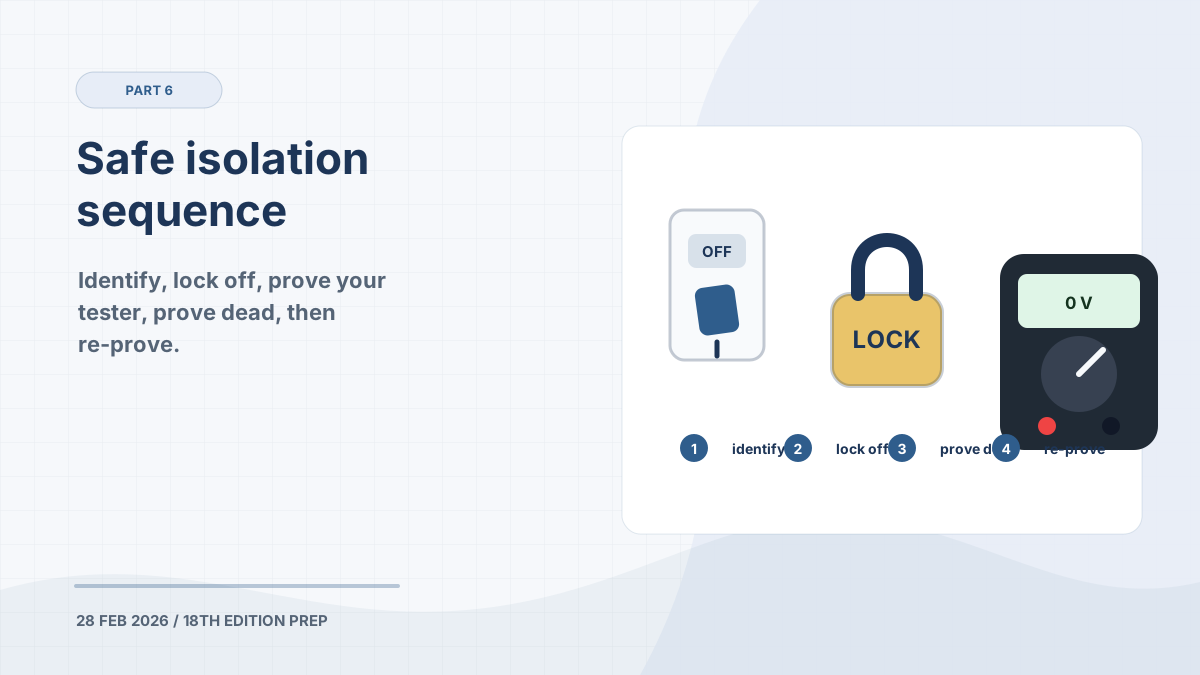
Safe isolation is the single most important safety procedure in electrical work. Every year, electricians are seriously injured or killed because a circuit they believed was dead turned out to be live. The safe isolation procedure exists to prevent this — and it’s a topic that appears in virtually every IET exam paper.
Warning: Electrical accidents caused by failure to properly isolate circuits result in deaths every year. Safe isolation is not optional — it is the procedure that keeps you alive.
This guide covers the full procedure step by step, the test equipment requirements under GS38, and the BS 7671 regulations you need to understand.
In This Guide
Why Safe Isolation Matters
Before any work is carried out on an electrical circuit — whether it’s replacing a socket, testing insulation resistance, or modifying a consumer unit — the circuit must be confirmed dead. Simply switching off an MCB is not enough. You need to prove it’s dead using a tested instrument, and you need to prevent anyone from switching it back on while you’re working.
Regulation 132.15 of BS 7671 states that every installation shall be arranged so that it can be properly maintained and that it allows for safe working. The safe isolation procedure is how this is achieved in practice.
The Safe Isolation Procedure — 5 Steps
The procedure follows a strict sequence that must not be skipped or shortened. It’s often summarised as “Prove – Isolate – Test – Re-prove”, though the full sequence has five distinct steps.
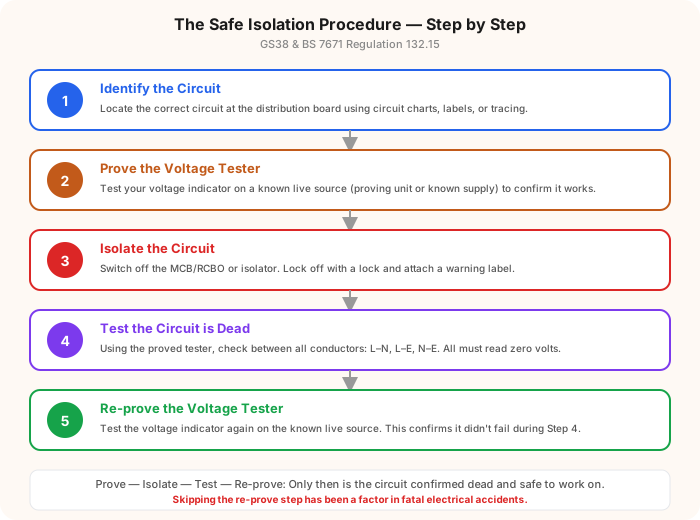
Step 1: Identify the Circuit
Before you can isolate a circuit, you need to know which circuit you’re isolating. This sounds obvious, but incorrect identification is a common cause of accidents — especially in large commercial installations with multiple distribution boards.
Use circuit charts, labels on the DB, and if necessary, a non-contact voltage detector to trace the circuit. Never assume that a label is correct — labels can be out of date or wrong.
Step 2: Prove the Voltage Tester
Your voltage tester (a two-pole voltage indicator compliant with GS38) must be tested on a known live source before use. This is typically done using a proprietary proving unit — a small battery-powered device that generates a known voltage.
The proving unit confirms that your tester is actually working. If your tester showed 0 V on a live circuit because of a dead battery or broken lead, you could be electrocuted.
Step 3: Isolate the Circuit
Switch off the protective device (MCB, RCBO, or isolator) for the identified circuit. Then:
- Lock off the device using an MCB lock-off device and a unique padlock
- Attach a warning label stating “Danger — Do Not Switch On”, along with your name and the date
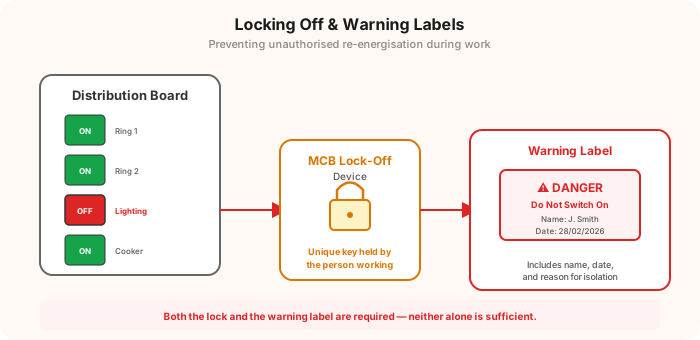
The key to the padlock must remain with the person doing the work at all times. If multiple people are working on the same circuit, each person applies their own lock (multi-lock hasp).
Step 4: Test the Circuit is Dead
Using the proved voltage tester, test between all combinations of conductors at the point of work:
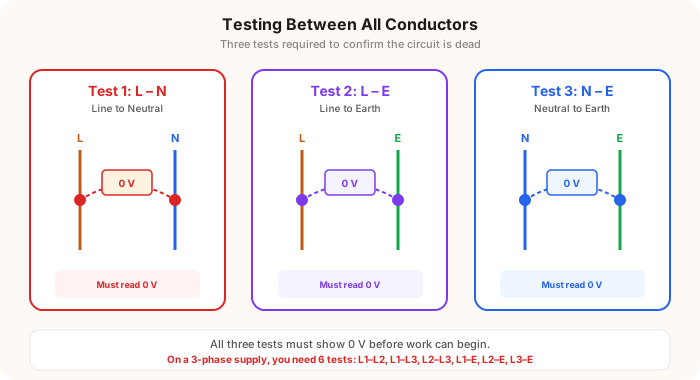
For a single-phase circuit, that means three tests:
| Test | Between |
|---|---|
| 1 | Line to Neutral (L – N) |
| 2 | Line to Earth (L – E) |
| 3 | Neutral to Earth (N – E) |
Key Rule: All three tests must read 0 V. If any test shows a voltage, the circuit is still live — do not proceed.
For a three-phase circuit, you need six tests: L1–L2, L1–L3, L2–L3, L1–E, L2–E, and L3–E.
Step 5: Re-prove the Voltage Tester
Immediately after confirming the circuit is dead, test your voltage indicator again on the known live source (proving unit). This critical step confirms that your tester didn’t fail during Step 4.
If the tester doesn’t read correctly on the proving unit, you cannot trust the “dead” reading from Step 4 — the entire procedure must be repeated with a different instrument.
Exam Tip: The re-prove step is the one most often skipped in practice, and it’s the one examiners are most likely to test you on. If the tester fails the re-prove, you cannot trust any of the “dead” readings — repeat the entire procedure with a different instrument.
GS38 Test Equipment Requirements
GS38 is the HSE Guidance Note that specifies the requirements for electrical test equipment used on low-voltage systems. Your voltage indicator and test leads must comply with these requirements.
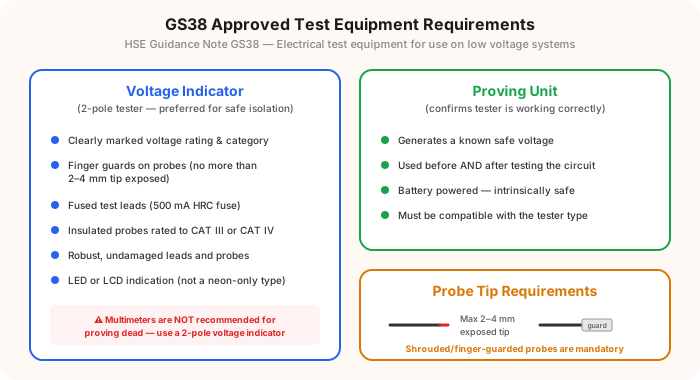
Key GS38 Requirements
| Requirement | Detail |
|---|---|
| Recommended instrument | Two-pole voltage indicator — not a multimeter |
| Test probe tips | Finger guards with no more than 2–4 mm of tip exposed |
| Test lead fuses | Must incorporate fuses (typically 500 mA HRC) |
| Insulation rating | Leads and probes rated to at least CAT III (CAT IV for origin of supply) |
| Markings | Clear voltage and category rating marked on the tester |
| Pre-use checks | All equipment must be visually inspected for damage before each use |
Why Not a Multimeter?
A multimeter can give a false 0 V reading if it’s on the wrong range, has a blown fuse, or has a broken lead. A two-pole voltage indicator is a simpler, more reliable instrument that provides a clear live/dead indication and is specifically designed for this purpose.
Single-Phase vs Three-Phase Isolation
| Aspect | Single-Phase | Three-Phase |
|---|---|---|
| Conductors to test | L, N, E | L1, L2, L3, E |
| Number of dead tests | 3 (L–N, L–E, N–E) | 6 (L1–L2, L1–L3, L2–L3, L1–E, L2–E, L3–E) |
| Typical isolation device | MCB, RCBO, or DP switch | Triple-pole isolator or MCCB |
| Lock-off method | MCB lock-off device | Isolator lock with padlock |
On three-phase systems, it’s critical to test between all phases — not just each phase to earth. A fault between two phases can still cause a lethal shock even if each phase reads 0 V to earth.
Common Mistakes
| Mistake | Risk | Solution |
|---|---|---|
| Not proving the tester first | Tester may be faulty — false “dead” reading | Always prove on a known source before and after |
| Skipping the re-prove step | Tester may have failed during use | Re-prove immediately after testing dead |
| Isolating the wrong circuit | Working on a live circuit | Verify identification using circuit charts and tracing |
| Using a multimeter to prove dead | Higher risk of false readings | Use a GS38-compliant two-pole voltage indicator |
| Not locking off | Someone else switches the circuit back on | Always lock off with a unique padlock |
| No warning label | Others may not know work is in progress | Attach a label with name, date, and reason |
| Testing at the DB only | Circuit may be fed from multiple sources | Test at the point of work, not just the DB |
Key Regulations
For quick reference, here are the main regulations and guidance relevant to safe isolation:
| Regulation | Requirement |
|---|---|
| Reg. 132.15 | Installations must allow for safe working and maintenance |
| Reg. 461.2 | Every circuit must be capable of being isolated from live supply conductors |
| Reg. 462.2 | Switching devices for isolation must isolate all live conductors |
| Reg. 514.11 | Warning labels must be provided where necessary |
| GS38 | HSE Guidance Note on electrical test equipment for low-voltage systems |
| Chapter 61 | Initial verification requires circuits to be dead-tested |
Practice and Further Study
Safe isolation falls under Part 6: Inspection and Testing and is also fundamental to the practical requirements of the AM2 assessment. Test your knowledge with our practice quizzes:
Study on the go with our mobile app: App Store | Google Play
Prepare for your exam with our mobile app
690+ practice questions with detailed explanations