Overload in a Ring Final Circuit: Why a 32A MCB Doesn't Always Protect the Cable
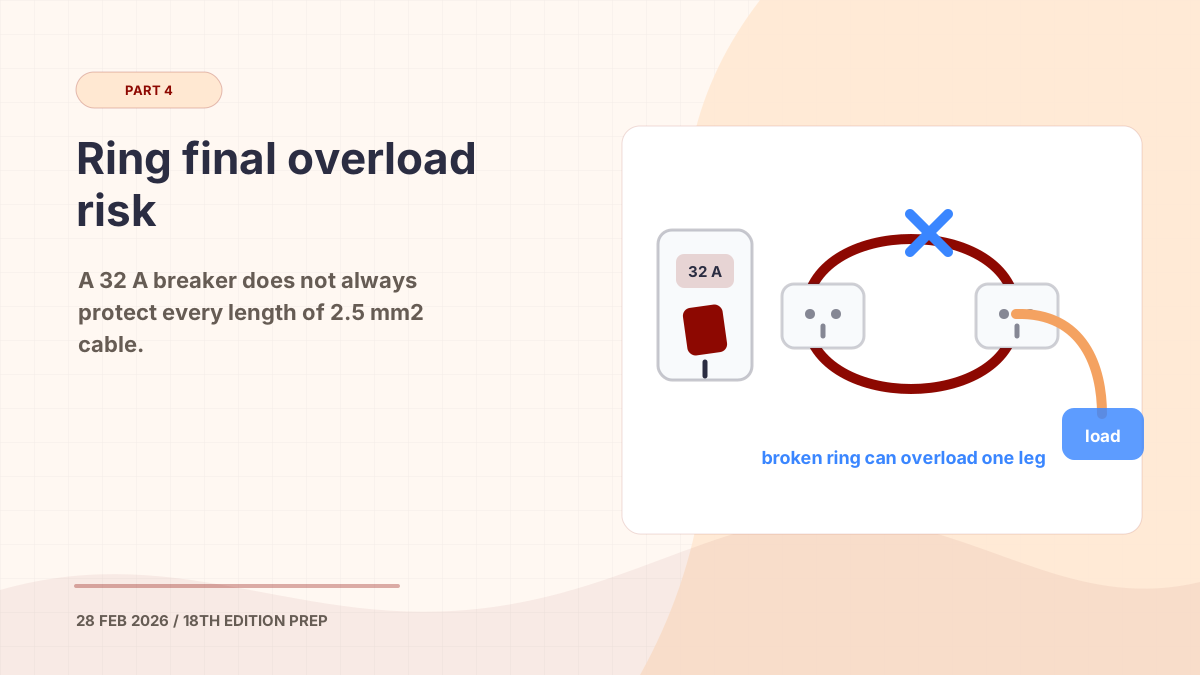
The ring final circuit is a uniquely British wiring arrangement — and one of the most misunderstood concepts in electrical installation. It relies on current sharing between two parallel cable paths, protected by a 32A MCB on just 2.5 mm² cable. But what happens when that sharing breaks down?
This guide explains how ring circuits work, why they can be overloaded without tripping the MCB, and the common faults that create hidden fire risks.
In This Guide
How a Ring Final Circuit Works
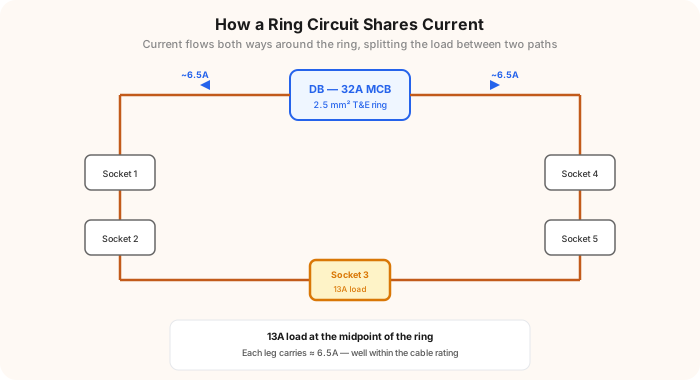
A ring final circuit starts and ends at the same terminals in the distribution board, forming a continuous loop. Every socket on the ring is fed from both directions — current can reach it via the left leg or the right leg of the ring.
The Current-Sharing Principle
When a load is connected to any socket on the ring, the current splits between the two legs. The split isn’t always equal — it depends on the position of the load around the ring — but it means:
| Scenario | Current in Each Leg |
|---|---|
| 13A kettle at the midpoint of the ring | Approximately 6.5A through each leg |
| 3 kW heater (13A) near one end | ~10A through the short leg, ~3A through the long leg |
| Maximum current in any cable section | Always less than the total circuit load |
Key Concept: BS 7671 allows a 32A MCB to protect 2.5 mm² cable in a ring — even though 2.5 mm² cable is only rated at 27A (Reference Method C, clipped direct). The design relies on current sharing so that no single cable section carries the full 32A.
This is the core design basis of the ring final circuit.
The Design Assumptions
The ring circuit design assumes:
| Assumption | Detail |
|---|---|
| Ring is complete | No breaks in any conductor |
| Ring is continuous | All connections are sound |
| Loads are distributed | Not all concentrated at one end |
| Total load within rating | Does not exceed 32A |
When any of these assumptions fails, the cable can be overloaded.
The Overload Problem
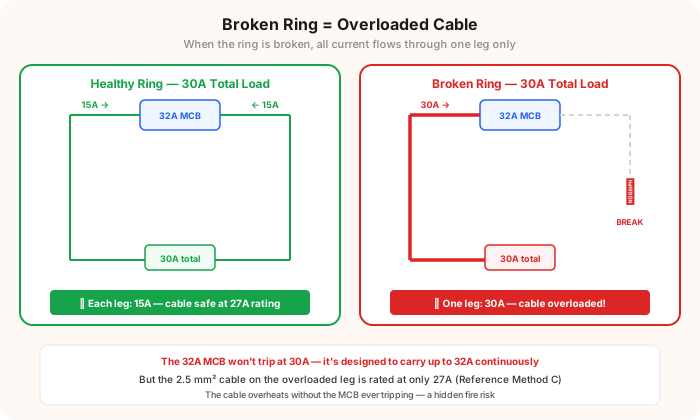
Warning: The core problem — a 32A MCB will not trip at 30A. It’s designed to carry up to 32A continuously. But 2.5 mm² cable is only rated at 27A.
Here’s the fundamental issue.
If the ring is broken and all 30A flows through one leg, the cable carries 30A — above its rating — but the MCB sees 30A which is below its 32A trip threshold. The MCB does not trip. The cable overheats.
What Breaks a Ring?
A ring can be broken without anyone knowing:
| Cause | Description |
|---|---|
| Loose terminal | Conductor not properly tightened at a socket |
| Broken conductor | Mechanical damage, rodent damage, or a cable nail |
| Disconnected at the DB | One leg of the ring not connected (surprisingly common after board changes) |
| Previous electrician | Ring converted to radial circuits during alterations without updating the MCB |
Warning: Everything appears to work normally when a ring is broken. All sockets still have power. The only difference is that current can only flow one way around the ring — and a heavy load on the wrong socket overloads the cable.
How the Ring Final Circuit Test Catches This
This is exactly why the ring final circuit continuity test (the 3-step test) is so important during initial verification and periodic inspection:
| Step | Method | What It Confirms |
|---|---|---|
| Step 1 | End-to-end resistance | The ring is complete |
| Step 2 | Cross-connection L–N | Continuity and correct polarity |
| Step 3 | Cross-connection L–E (figure-of-8) | R1+R2 values and that the ring is continuous |
If any step gives unexpected results (open circuit, values not “substantially the same” at each socket), the ring has a problem.
Spurs and Overload
Not every socket on a ring is on the ring itself. Spurs branch off the ring to supply additional sockets.
Non-Fused Spurs
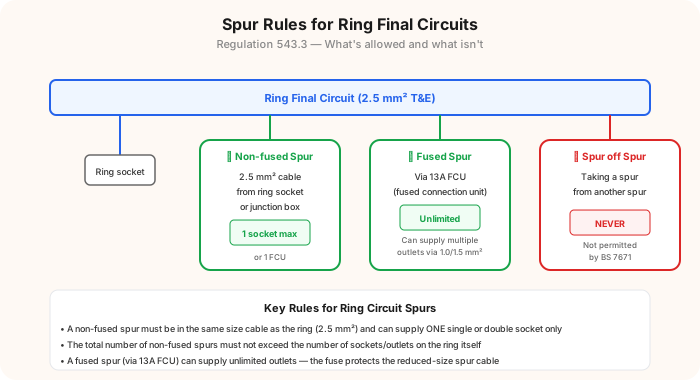
A non-fused spur is a single cable branching off from a socket on the ring (or from a junction box on the ring) to supply one additional socket. The rules are:
| Rule | Detail |
|---|---|
| Cable size | Must be the same as the ring (2.5 mm²) |
| Socket limit | Can supply one single or one double socket only |
| Maximum number | Total non-fused spurs must not exceed the number of sockets on the ring |
| Spur off a spur | Not permitted — cannot take a spur off a spur |
The overload risk with spurs is that they carry the full load current without the benefit of current sharing. A 13A kettle on a spur draws the full 13A through the spur cable — though this is within the cable rating for 2.5 mm², so it’s safe by design.
Fused Spurs
A fused spur uses a fused connection unit (FCU), typically with a 13A fuse, to protect a reduced-size cable running to one or more outlets. Because the fuse limits the current, the spur cable can be smaller (1.0 or 1.5 mm²), and there’s no limit on the number of outlets downstream of the fuse.
The Double Spur Problem
One of the most common wiring faults found during periodic inspection is a spur taken off a spur. This is dangerous because:
- The original spur is designed for one socket’s load
- Adding a second socket doubles the potential load
- There’s no current sharing — all current flows through the first spur cable
- The 32A MCB provides no meaningful protection for this arrangement
Loading Limits
Maximum Floor Area
Regulation 433.1.204 limits the floor area served by a single ring final circuit to 100 m². Beyond this, additional ring circuits are required.
Practical Loading
In a modern home, the real-world loading on a ring can be significant:
| Appliance | Typical Current |
|---|---|
| Kettle | 13A |
| Toaster | 5A |
| Microwave | 6A |
| Washing machine | 10A |
| Tumble dryer | 12A |
| Iron | 10A |
| Fan heater | 13A |
Running a kettle (13A), washing machine (10A), and tumble dryer (12A) simultaneously gives 35A — above the 32A MCB rating. In practice, these loads are rarely all at peak simultaneously, and the MCB will tolerate short-term overloads. But on a broken ring, a single leg could see the full 35A through cable rated at only 27A.
Common Faults Found During Inspection
| Fault | How It’s Found | Risk |
|---|---|---|
| Broken ring (one leg disconnected) | Ring test Step 1 — open circuit on one conductor | Cable overload, fire risk |
| Spur off a spur | Visual inspection and ring test — higher R1+R2 at end socket | Overloaded spur cable |
| Ring converted to two radials | Ring test Step 1 — conductors don’t connect | 32A MCB too large for 2.5 mm² radial |
| Loose connection at socket | Ring test — high R1+R2 at that socket, hot terminals | Arcing, fire risk |
| Cross-connected conductors | Ring test Step 2 — incorrect readings | Potential shock hazard |
Preventing Ring Circuit Overload
For New Installations
- Ensure the ring is complete and tested before energising
- Distribute sockets evenly around the ring
- Don’t exceed the 100 m² floor area limit
- Consider using radial circuits with correctly sized cables and MCBs for heavy loads (dedicated circuits for ovens, showers, etc.)
For Periodic Inspections
- Always perform the full 3-step ring test — don’t skip it
- Check for hot terminals using an infrared thermometer
- Count the spurs and verify none are spur off spur
- Verify the ring is complete at the DB — both legs connected
Consider Radials Instead
Many electricians now prefer radial circuits to rings for new installations. A properly designed radial circuit is simpler, easier to test, and the MCB directly protects the cable:
| Circuit Type | Cable Size | MCB Rating | Cable Rating (Method C) | Protected? |
|---|---|---|---|---|
| Ring (2.5 mm²) | 2.5 mm² | 32A | 27A per leg | Relies on sharing |
| Radial (4.0 mm²) | 4.0 mm² | 32A | 37A | Yes — 37A > 32A |
| Radial (2.5 mm²) | 2.5 mm² | 20A | 27A | Yes — 27A > 20A |
Key Regulations
| Regulation | Requirement |
|---|---|
| Reg. 314.1 | Every circuit shall be designed to ensure safety |
| Reg. 433.1 | Overload protection requirements |
| Reg. 433.1.204 | Ring circuits limited to 100 m² floor area |
| Reg. 543.3 | CPC sizing for ring final circuits |
| Chapter 61 | Initial verification test sequence (ring test is part of continuity testing) |
| Table 4D5 | Current-carrying capacity of cables (Reference Method C) |
Practice and Further Study
Ring final circuit design and overload protection are covered under Part 4: Protection for Safety of BS 7671. Test your knowledge:
Study on the go with our mobile app: App Store | Google Play
Prepare for your exam with our mobile app
690+ practice questions with detailed explanations