Insulation Resistance Test: Minimum Values and Procedure
Insulation resistance testing is one of the essential dead tests required by BS 7671 during initial verification and periodic inspection. Its purpose is straightforward: to confirm that the insulation between live conductors and between live conductors and earth is intact — preventing leakage currents, short circuits, and electric shock.
Yet it’s also the test that causes the most confusion. Low readings, false positives, the neutral conductor problem, and the risk of damaging electronic equipment all make IR testing more nuanced than it first appears. This guide covers everything you need to know.
In This Guide
Why Do We Test Insulation Resistance?
Every cable in an installation relies on its insulation to keep current flowing where it should — through the conductors, not through the insulation material and into other conductors, metalwork, or the earth.
Over time, insulation can degrade due to:
| Cause | Effect |
|---|---|
| Age and wear | PVC becomes brittle; rubber perishes |
| Heat damage | From overloaded cables or thermal insulation contact |
| Moisture | Water ingress in outdoor or damp locations |
| Mechanical damage | Nails, screws, rodent damage |
| UV exposure | Cables exposed to sunlight |
If insulation breaks down, the result is a leakage current — current flowing through a path it shouldn’t. This can cause RCDs to trip nuisance-wise, increase fire risk, and create electric shock hazards.
The IR test applies a DC voltage across the insulation and measures the resistance in megohms (MΩ). High resistance = good insulation. Low resistance = potential problem.
Test Voltages and Minimum Values
Regulation 612.3.2 of BS 7671 specifies the test voltage and minimum acceptable insulation resistance for different circuit voltages:
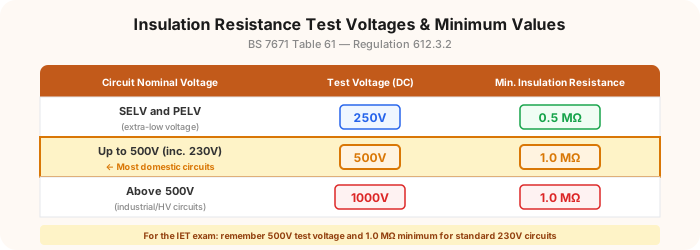
For the exam, the key figures to remember are:
| Circuit Type | Test Voltage | Minimum IR |
|---|---|---|
| Standard 230V circuits | 500V DC | 1.0 MΩ |
| SELV/PELV circuits | 250V DC | 0.5 MΩ |
Key Insight: In practice, a healthy domestic circuit should read well above 1.0 MΩ — typically 200 MΩ or higher. If you’re getting readings between 1 and 2 MΩ, the circuit technically passes but should be investigated, as this suggests deteriorating insulation.
The Three Test Connections
Warning: This must be a dead test — the circuit must be dead and isolated before testing.
The IR test must be carried out between all combinations of live conductors and earth.
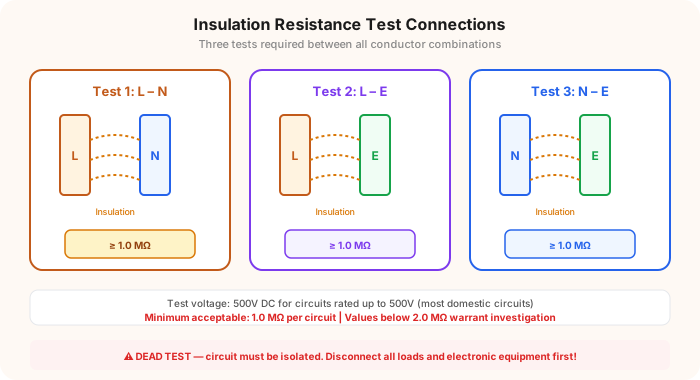
The three tests are:
| Test | What It Checks |
|---|---|
| Line to Neutral (L–N) | Insulation between live conductors |
| Line to Earth (L–E) | Insulation between line and protective conductor |
| Neutral to Earth (N–E) | Insulation between neutral and protective conductor |
Before testing, you must:
- Isolate the circuit from the supply
- Disconnect or switch off all current-using equipment (lamps, appliances, electronic devices)
- Set all switches to the ON position (so you test the complete circuit, not just up to a switch)
- Disconnect any electronic devices that could be damaged by the 500V test voltage (dimmer switches, PIR sensors, RCDs with electronic trip, smart home devices)
The Neutral Conductor Problem
This is the single most common cause of confusion in IR testing. When you test between Line and Neutral, any load that’s still connected across L and N creates a parallel path through its element or winding. This dramatically lowers the IR reading — even though the cable insulation is perfectly fine.
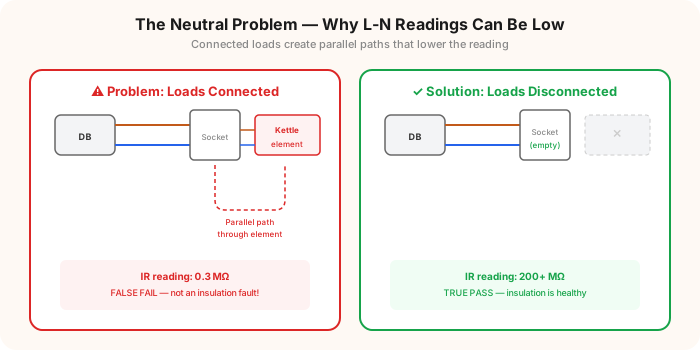
How to Avoid False Low Readings
- Unplug all appliances from sockets before testing
- Remove all lamps from lighting circuits (or disconnect them at the lampholder)
- Switch off immersion heaters, towel rails, and any hardwired loads
- Disconnect electronic equipment that can’t handle the test voltage
- If the L–N reading is still low but L–E and N–E are high, suspect a remaining connected load
The Practical Shortcut
On large installations, disconnecting every load can be impractical. A common approach is to link Line and Neutral together at the distribution board and test them as one conductor to Earth. This gives you an L+N to E reading.
This method confirms the insulation between live conductors and earth, which is the most safety-critical measurement. However, it does not test the insulation between L and N — so it shouldn’t be the only test on initial verification.
False Positives and False Negatives
False Positives (Low reading, no actual fault)
| Cause | Why it happens | Fix |
|---|---|---|
| Appliances still connected | Parallel path through load | Disconnect all loads |
| Neon indicators in switches | Low resistance through neon | Disconnect or accept as normal |
| SPDs (surge protection) | SPDs have low L-E impedance | Disconnect SPDs before testing |
| Moisture in accessories | Damp junction boxes or sockets | Dry out and retest |
| Long cable runs | Very long circuits accumulate leakage capacitance | Accept if above minimum; test individual sections |
False Negatives (Good reading, fault present)
| Cause | Why it happens | Risk |
|---|---|---|
| Fault only appears under load | IR test is at low current; fault needs heat/vibration to manifest | Fault may cause RCD tripping in service |
| Intermittent damage | Mechanical damage that makes contact only sometimes | Circuit may fail unpredictably |
| Testing only at the DB | Fault is beyond a switch in the OFF position | Set all switches ON to test complete circuit |
Interpreting Your Results
| IR Reading | Interpretation | Action |
|---|---|---|
| 200+ MΩ | Excellent — new or well-maintained insulation | None — record and move on |
| 2–200 MΩ | Acceptable — insulation is satisfactory | Record; note for comparison on next inspection |
| 1.0–2.0 MΩ | Marginal — technically passes but investigate | Check for moisture, damaged cables, or connections |
| Below 1.0 MΩ | FAIL — insulation is inadequate | Investigate and repair before energising |
| 0 MΩ | Dead short — insulation has completely failed | Major fault — locate and repair |
Sequence in the Testing Process
Insulation resistance testing is the third test in the BS 7671 testing sequence:
- Continuity of protective conductors (R1+R2)
- Continuity of ring final circuit conductors
- Insulation resistance ← you are here
- Polarity
- Earth fault loop impedance (Zs)
- RCD operation
It must be carried out as a dead test — before the circuit is energised for live tests (Zs and RCD).
Key Regulations
| Regulation | Requirement |
|---|---|
| Reg. 612.3 | Insulation resistance testing requirements |
| Reg. 612.3.2 | Test voltages and minimum values (Table 61) |
| Table 61 | Minimum insulation resistance values |
| Reg. 612.3.3 | Where SELV or PELV is used |
| Chapter 61 | Initial verification sequence |
Practice and Further Study
Insulation resistance testing is a core Part 6 topic. Test your knowledge:
Study on the go with our mobile app: App Store | Google Play
Prepare for your exam with our mobile app
690+ practice questions with detailed explanations