7.4 kW EV Charger Cable Size: BS 7671 Worked Example
Electric vehicle charger installations are now one of the most common jobs for domestic electricians — and they’re a growing topic in the IET exam. Section 722 of BS 7671 covers the specific requirements for EV charging installations, and it introduces several rules that differ from standard circuit design.
This guide walks through a complete cable sizing calculation for a typical domestic 7.4 kW charger, covering every step from design current to earth fault loop impedance verification.
In This Guide
EV Charger Types
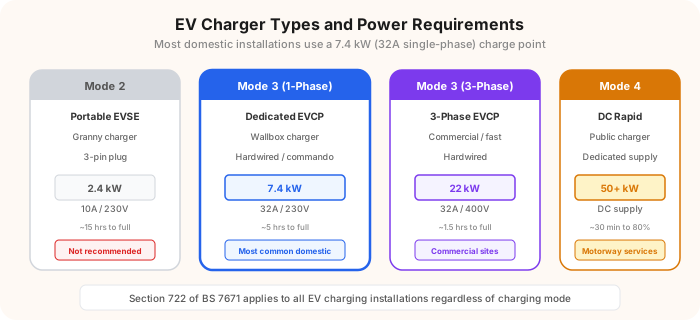
Before calculating anything, you need to know what you’re installing. Most domestic installations use a Mode 3, single-phase, 7.4 kW charge point — often called a “wallbox.”
Key Points for Cable Sizing
| Charger Type | Power | Current | Notes |
|---|---|---|---|
| 7.4 kW single-phase | 7.4 kW | 32A at 230V | Standard domestic installation |
| 22 kW three-phase | 22 kW | 32A per phase at 400V | Commercial premises |
The charger draws 32A continuously for several hours — this is critical for cable sizing.
The Continuous Load Problem
Here’s the single most important thing to understand about EV charging: Regulation 722.311 requires EV charging to be treated as a continuous load. This means:
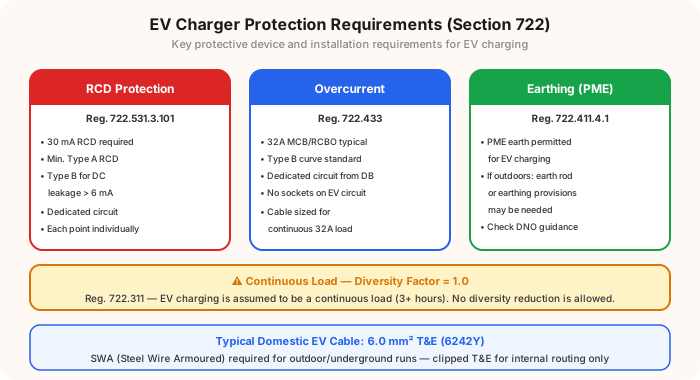
Key Regulation: Reg 722.311 requires EV charging circuits to be treated as continuous loads — no diversity is applied, and the cable must be rated for the full load current.
| Continuous Load Implication | Detail |
|---|---|
| No diversity | The cable must be rated for the full 32A, not a reduced figure |
| Assumed full-load duration | The circuit is assumed to run at full load for 3 hours or more |
| Standard diversity excluded | Domestic diversity factors (from BS 7671 Table 4A) do not apply to EV circuits |
Insight: This is why a 32A EV circuit often needs a larger cable than a 32A cooker circuit — the cooker gets diversity applied, the EV charger does not.
Protection Requirements
Section 722 has specific protection requirements that differ from standard circuits.
RCD Protection (Regulation 722.531.3.101)
Every EV charging point must have its own dedicated circuit protected by:
| Condition | Required RCD Type |
|---|---|
| Standard EV charging point | 30 mA Type A RCD (minimum) — detects pulsating DC fault currents |
| Charger produces smooth DC leakage greater than 6 mA | Type B RCD required |
| Charger has built-in DC leakage detection | Type A RCD permitted — check manufacturer’s documentation |
Overcurrent Protection
- A 32A MCB or RCBO (Type B curve is standard) on a dedicated circuit
- No other loads or socket outlets on the EV circuit
- An RCBO is the neatest solution as it provides both overcurrent and RCD protection in one device
PME Earthing (Regulation 722.411.4.1)
EV charging installations on PME (TN-C-S) supplies have additional earthing considerations. The 18th Edition Amendment 2 now permits PME earthing for EV charging, but you should check with the DNO for any local requirements — particularly for outdoor charge points.
Step-by-Step Cable Calculation
Let’s work through a real example.
The Scenario
| Parameter | Value |
|---|---|
| Charger | 7.4 kW single-phase wallbox (32A) |
| Cable run | 20 metres from the consumer unit to the garage |
| Installation method | Clipped direct (Method C) for 18 metres, then 2 metres through an insulated stud wall with the cable touching the inner wall surface (Installation Method 102) |
| Ambient temperature | 30°C (standard) |
| Earthing system | TN-C-S, Ze = 0.35 Ω |
| Protective device | 32A Type B RCBO |
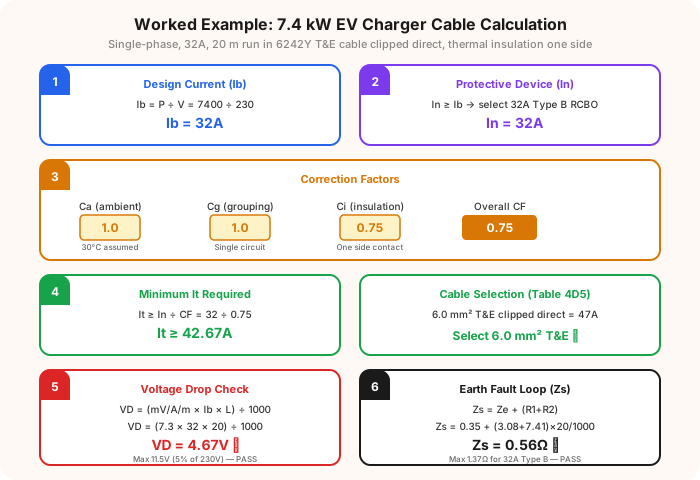
Step 1: Design Current (Ib)
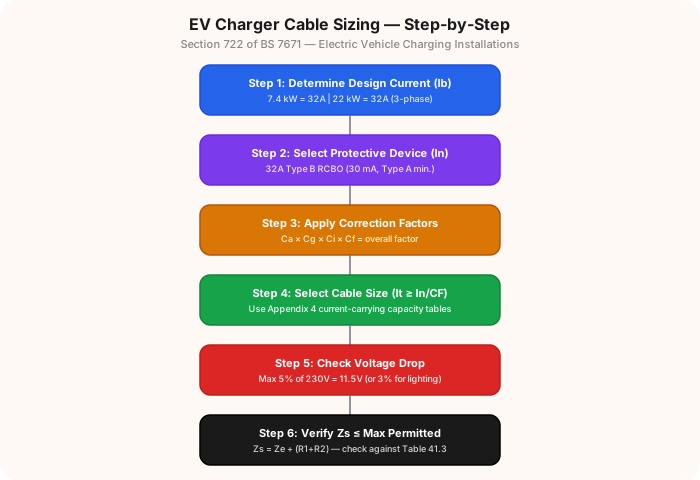
The design current is the maximum current the circuit will carry in normal service. For a Mode 3 EV charger, the charger’s own control electronics regulate the charging current to its nameplate rating — in this case 32A. This is the design current we use, not the theoretical P ÷ V figure.
Ib = 32A (charger nameplate rating)
The fundamental rule is: Ib ≤ In ≤ It.
Step 2: Protective Device Rating (In)
We need In ≥ Ib. A 32A Type B RCBO gives us In = 32A. This satisfies Ib ≤ In (32A ≤ 32A).
Step 3: Correction Factors
Now we calculate the overall correction factor to determine the minimum tabulated current rating (It) the cable must have.
| Factor | Value | Reason |
|---|---|---|
| Ca (ambient temperature) | 1.0 | 30°C ambient is the reference temperature for PVC cables |
| Cg (grouping) | 1.0 | Single circuit — no grouping derating needed |
| Ci (thermal insulation) | 1.0 | No factor — the insulated-wall section is rated from its own column of Table 4D5 (Reg 523.9) |
| Cf (semi-enclosed fuse) | 1.0 | Using an MCB/RCBO, not a BS 3036 fuse |
Overall correction factor = Ca × Cg × Ci = 1.0 × 1.0 × 1.0 = 1.0
Important: There is no correction factor for a cable that touches insulation on one side. Regulation 523.9 says that where a cable in a thermally insulated wall is in contact with a thermally conductive surface on one side, its current-carrying capacity is tabulated in Appendix 4. You pick the right column instead of multiplying by a factor. The Ci factors (0.88 down to 0.50) are only for a cable totally surrounded by insulation, and they apply to the clipped-direct rating.
Step 4: Minimum Tabulated Current (It)
It ≥ In ÷ CF = 32 ÷ 1.0 = 32A
Now look up the current-carrying capacity for flat T&E in Table 4D5 of BS 7671 Appendix 4. The cable runs in two conditions, and the most onerous part of the route decides the size. So check both columns:
| Cable Size | Clipped direct (Method C, col 8) | Insulated stud wall, touching inner surface (Method 102, col 4) |
|---|---|---|
| 4.0 mm² | 37A | 27A |
| 6.0 mm² | 47A | 35A |
| 10.0 mm² | 64A | 47A |
4.0 mm² is fine clipped direct (37A), but only gives 27A through the insulated wall — less than 32A, so it fails. 6.0 mm² gives 35A in the wall, which meets 32A. Select 6.0 mm² T&E.
Exam tip: If the cable went through the wall in conduit instead, Reference Method A (Table 4D5 col 6) applies: 6.0 mm² is rated 32A, which still meets It = 32A.
Step 5: Voltage Drop Check
Regulation 525 limits the voltage drop to 5% of the nominal voltage for power circuits, which is:
Max VD = 230 × 0.05 = 11.5V
From Table 4D5, the mV/A/m value for 6.0 mm² T&E is 7.3 mV/A/m.
VD = (mV/A/m × Ib × L) ÷ 1000 = (7.3 × 32 × 20) ÷ 1000 = 4.67V
4.67V is well within the 11.5V limit — PASS.
Step 6: Earth Fault Loop Impedance (Zs)
Finally, verify that the earth fault loop impedance allows the protective device to disconnect within the required time.
Zs = Ze + (R1 + R2)
From the resistance tables (at 20°C):
- R1 for 6.0 mm² = 3.08 mΩ/m
- R2 for 2.5 mm² CPC = 7.41 mΩ/m
- R1 + R2 per metre = 10.49 mΩ/m
For 20 metres: (R1 + R2) = 10.49 × 20 ÷ 1000 = 0.21 Ω
Zs = 0.35 + 0.21 = 0.56 Ω
The maximum Zs for a 32A Type B MCB (Table 41.3, 0.4s disconnection) is 1.37 Ω. Our calculated Zs of 0.56 Ω is well within the limit — PASS.
When to Use SWA Cable
For outdoor or underground cable runs, T&E is not suitable. You should use:
| SWA Cable Specification | Detail |
|---|---|
| Cable type | SWA (Steel Wire Armoured) — for buried or exposed outdoor runs |
| Minimum burial depth | 500 mm below ground (with cable tiles or warning tape) |
| Mechanical protection | SWA provides its own mechanical protection and can serve as the CPC (the steel wire armour) |
| Common choice | 6.0 mm² 3-core SWA (or 2-core + armour as earth) |
For runs that are entirely inside the building (e.g., consumer unit to an internal garage), clipped T&E is acceptable.
Common Exam Scenarios
| Scenario | Cable Size | Notes |
|---|---|---|
| 7.4 kW, 15 m, clipped direct, no derating | 4.0 mm² T&E | 37A ≥ 32A (Method C); VD: 11 × 32 × 15 = 5.3V (OK) |
| 7.4 kW, 30 m, clipped direct, no insulation | 6.0 mm² T&E | 4.0 mm² drops 11 × 32 × 30 = 10.6V — inside 11.5V with little margin; 6.0 mm²: 7.3 × 32 × 30 = 7.0V (OK) |
| 7.4 kW, 40 m, clipped direct | 10.0 mm² T&E | VD with 6.0 mm²: 9.3V — tight. Consider 10.0 mm² |
| 7.4 kW, outdoor underground | 6.0 mm² SWA | Must use SWA for external/underground runs |
| 22 kW three-phase, commercial | 6.0 mm² 5-core SWA | 32A per phase, check per-phase VD |
Quick Reference Summary
| Parameter | Value |
|---|---|
| Standard domestic EV charger | 7.4 kW, 32A, single-phase |
| Protective device | 32A Type B RCBO (30 mA, Type A minimum) |
| Diversity factor | 1.0 (no diversity — continuous load) |
| Typical cable (internal) | 6.0 mm² T&E (6242Y) |
| Typical cable (external) | 6.0 mm² SWA |
| Maximum voltage drop | 5% of 230V = 11.5V |
| Key BS 7671 section | Section 722 |
Key Regulations
| Regulation | Requirement |
|---|---|
| Section 722 | Electric vehicle charging installations (entire section) |
| Reg. 722.311 | Continuous load, diversity not applicable |
| Reg. 722.411.4.1 | Earthing arrangements for PME supplies |
| Reg. 722.531.3.101 | RCD protection requirements (Type A minimum) |
| Reg. 722.433 | Overcurrent protection |
| Table 4D5 | Current-carrying capacity for T&E cables (Reference Method C) |
| Reg. 525 | Voltage drop limits |
Practice and Further Study
EV charger cable calculation combines Part 4: Protection for Safety with Part 5: Selection and Erection and Section 722 of BS 7671. Test your knowledge:
Study on the go with our mobile app: App Store | Google Play
Prepare for your exam with our mobile app
690+ practice questions with detailed explanations