The Dangers of a Shared (Borrowed) Neutral: Why Every Circuit Needs Its Own
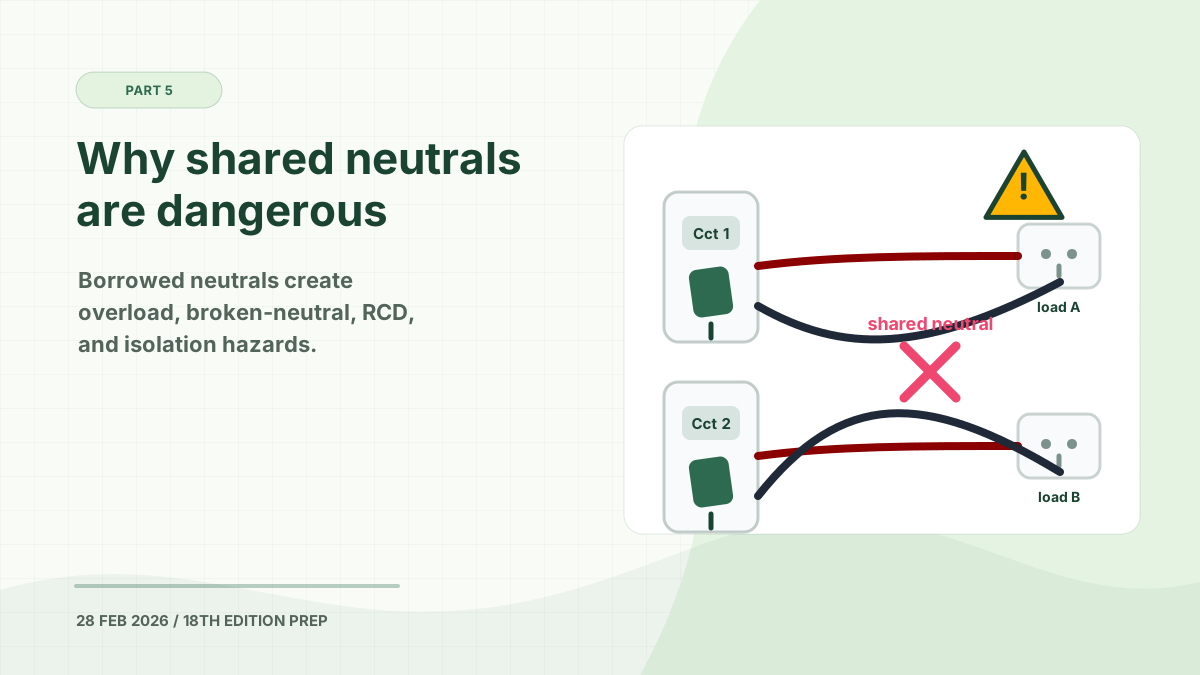
A shared neutral — sometimes called a “borrowed” neutral — is one of the most dangerous wiring faults found in older installations. It occurs when two or more circuits share a single neutral conductor instead of each having their own. While it might appear to “work” in normal operation, it creates serious safety hazards that can be lethal.
This is a topic that comes up regularly in the IET exam, particularly in questions about safe isolation, RCD operation, and circuit identification.
In This Guide
What Is a Shared Neutral?
In a correctly wired installation, every circuit has its own dedicated Line, Neutral, and Earth conductors running from the distribution board to the circuit. The neutral returns current from the load back to the neutral bar at the DB.
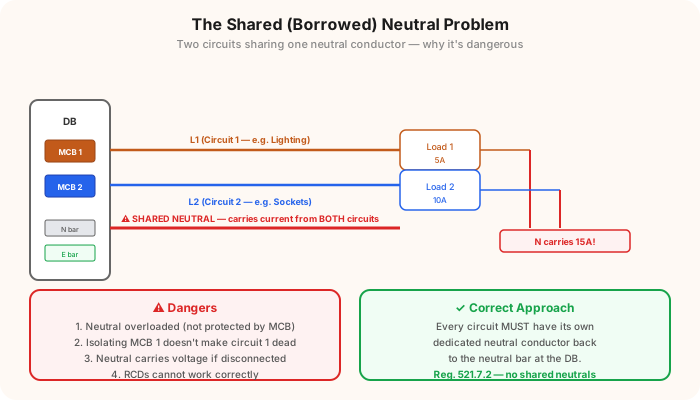
A shared neutral occurs when an installer has connected two (or more) circuits’ loads to the same neutral conductor — typically to save cable. Both circuits’ return currents flow through this single conductor.
Why Is It Dangerous?
1. Neutral Overload
Each circuit’s MCB protects the Line conductor only. The neutral has no overcurrent protection. If two circuits each draw their rated current (say, 6A and 10A), the shared neutral carries the combined current of 16A — but it may only be rated for one circuit’s current.
This can cause the neutral conductor to overheat, damaging insulation and creating a fire risk.
2. Safe Isolation Fails
This is the most immediately dangerous consequence. If an electrician isolates Circuit 1 by switching off its MCB, they expect the circuit to be completely dead. But the shared neutral is still energised by Circuit 2.
Anyone working on what they believe is a dead circuit could receive a fatal electric shock from the neutral conductor — which is supposed to be at 0 V but is now carrying current from the other circuit.
Warning: A shared neutral means that isolating one MCB does not make the neutral safe. The neutral conductor remains energised from the other circuit and can deliver a fatal shock.
3. Broken Neutral = Dangerous Voltages
If the shared neutral conductor breaks (at a connection, a terminal, or due to physical damage), the two loads end up effectively in series across the 230 V supply. The voltage splits between them in proportion to their resistance — and neither load gets the correct voltage.
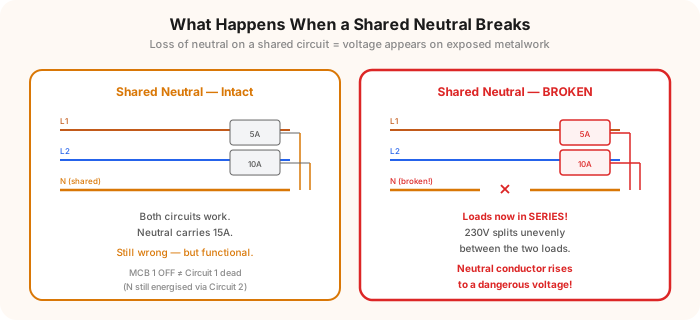
The neutral conductor itself can rise to a significant voltage — potentially up to 230 V depending on the load balance. This creates a shock hazard on what should be a “safe” conductor.
4. RCDs Cannot Work Properly
An RCD detects the difference between current flowing on Line and returning on Neutral. If two circuits share a neutral, the RCD for Circuit 1 sees current going out on L1 but the return current splits between the proper N1 path and the shared path to Circuit 2.
This causes:
| Problem | Explanation |
|---|---|
| Nuisance tripping | The RCD sees an apparent leakage that doesn’t exist |
| Failure to trip on a real fault | The current paths are confused and the RCD may not detect a genuine earth leakage |
5. Incorrect Test Results
During testing, a shared neutral produces misleading results:
| Test | Effect of Shared Neutral |
|---|---|
| Insulation resistance | Between L and N may read low due to the parallel path through the other circuit’s loads |
| Polarity | Testing may appear correct even though the wiring is wrong |
| Ring final circuit tests | Will give unexpected values |
How to Identify a Shared Neutral
During inspection and testing, the following symptoms suggest a shared neutral:
| Symptom | What it indicates |
|---|---|
| RCD trips when a different circuit is loaded | Current returning via the wrong neutral |
| Circuit remains live after MCB is switched off | Neutral energised by another circuit |
| Insulation resistance between L–N is unexpectedly low | Parallel path through connected loads on another circuit |
| Neutral conductor warm with only light load | Carrying return current from multiple circuits |
| Flickering lights when sockets are loaded | Shared neutral causing voltage fluctuations |
What BS 7671 Says
Regulation 521.7.2 requires that every circuit must have its own neutral conductor where the neutral is not common to several circuits (i.e., multi-core cables). In practice, this means each circuit in a domestic installation must have a dedicated L, N, and E back to the distribution board.
Key Regulation: Reg 521.7.2 is the primary regulation prohibiting shared neutrals. It requires every circuit to have its own neutral conductor.
Regulation 132.15 requires that installations allow for safe working — a shared neutral directly prevents safe isolation, violating this fundamental requirement.
Regulation 531.2.4 requires that the neutral of each circuit protected by an RCD passes through the RCD — shared neutrals violate this requirement.
What to Do If You Find One
If you discover a shared neutral during an inspection:
- Record it as a code C1 (danger present) or C2 (potentially dangerous) on the Electrical Installation Condition Report (EICR)
- Recommend remedial work — each circuit must have its own dedicated neutral
- Do not attempt to work on either circuit until the neutral has been properly separated
- If immediate work is needed, isolate both circuits at the DB and verify dead on both
Exam Tip: A shared neutral is typically coded C1 (danger present) on an EICR because it prevents safe isolation. If the risk is lower in context, C2 (potentially dangerous) may apply — but always justify your coding.
Common Exam Questions
| Question | Answer |
|---|---|
| ”Why is a shared neutral dangerous for safe isolation?” | Turning off one MCB doesn’t de-energise the neutral — still live from the other circuit |
| ”What regulation prohibits shared neutrals?” | Reg. 521.7.2 |
| ”How does a shared neutral affect an RCD?” | Causes nuisance tripping or failure to trip on genuine faults |
| ”What happens if a shared neutral breaks?” | Loads go in series; neutral rises to dangerous voltage |
| ”What EICR code for a shared neutral?” | C1 or C2 depending on risk assessment |
Key Regulations
| Regulation | Requirement |
|---|---|
| Reg. 521.7.2 | Each circuit to have its own neutral |
| Reg. 132.15 | Installations must allow safe working |
| Reg. 531.2.4 | Neutral of each circuit through its RCD |
| Reg. 461.2 | Isolation must disconnect all live conductors |
| Reg. 514.9.1 | Identification of circuits |
Practice and Further Study
Shared neutrals relate to Part 5: Selection and Erection of Equipment and testing under Part 6. Test your knowledge:
Study on the go with our mobile app: App Store | Google Play
Prepare for your exam with our mobile app
690+ practice questions with detailed explanations