Continuity of Protective Conductors: The Essential R1+R2 Test Explained
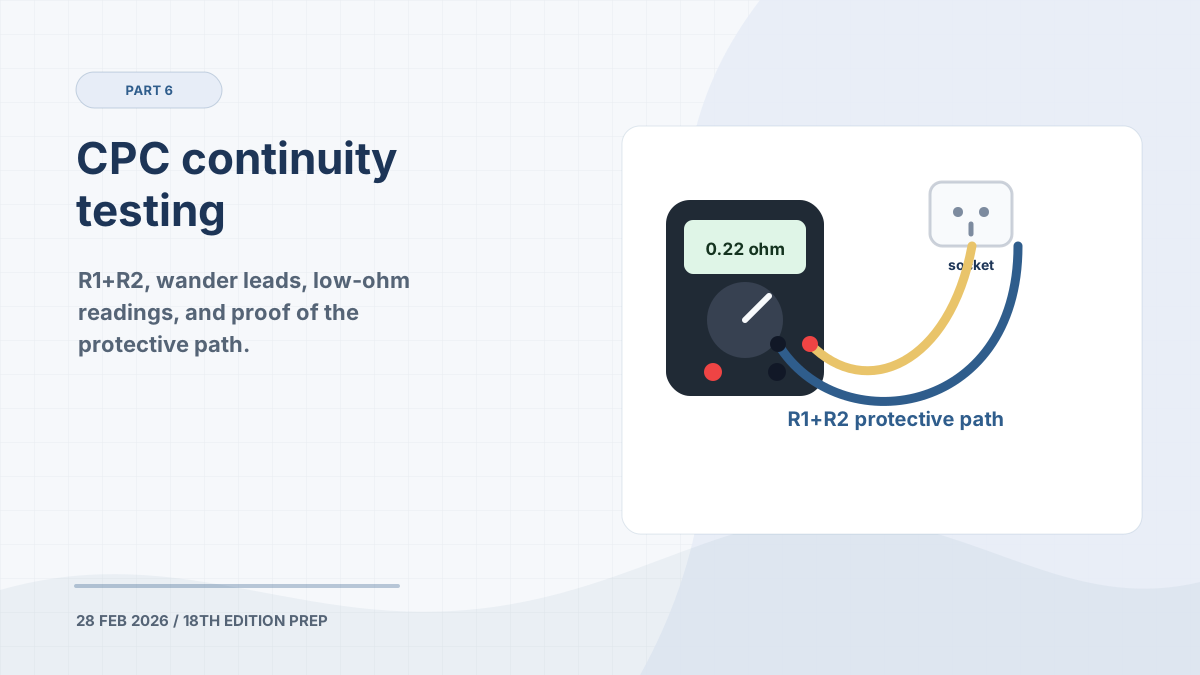
Continuity of protective conductors is the first dead test in the BS 7671 testing sequence — and for good reason. If the circuit protective conductor (CPC) isn’t continuous, the entire earth fault protection system fails. An earth fault won’t be cleared, exposed metalwork stays live, and the installation is dangerous.
This guide covers the two main test methods, what the readings should look like, and how to use the R1+R2 value to verify earth fault loop impedance.
In This Guide
Why Test Continuity?
The CPC (the earth wire in the cable) is your safety net. When a fault occurs, fault current flows through the CPC back to the distribution board and ultimately to the source. If the CPC is broken, has a loose connection, or has high resistance at a joint, the fault current may not be enough to trip the protective device — leaving the exposed metalwork live.
Regulation 612.2 of BS 7671 requires that every protective conductor, including the CPC, main bonding conductors, and supplementary bonding conductors, is tested for continuity during initial verification.
Method 1: The R1+R2 Method (Preferred)
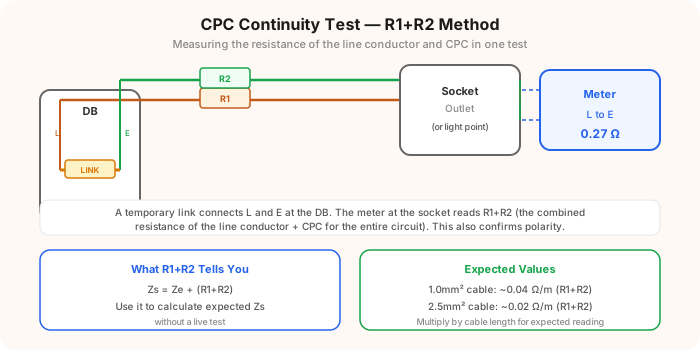
This is the most common and efficient method. It measures the combined resistance of the line conductor (R1) and the CPC (R2) in a single test, while simultaneously confirming correct polarity.
How to Do It
- Isolate the circuit at the DB — switch off the MCB and lock off
- Disconnect the circuit’s line and CPC at the distribution board
- Place a temporary link (short piece of wire) between the Line terminal and the Earth terminal of that circuit at the DB
- At each point on the circuit (each socket, light fitting, FCU, etc.), measure the resistance between Line and Earth using a low-resistance ohmmeter
- Record the reading at each point — this is the R1+R2 value for that point
- Remove the temporary link when testing is complete
What You’re Measuring
The meter sends a small current from Line, through R1 (the line conductor), through the link at the far end (the accessory), back through R2 (the CPC), and back through the link at the DB. The reading is the total resistance of R1 + R2 for that circuit at that point.
Why It’s Preferred
| Advantage | Why |
|---|---|
| Tests both conductors at once | Measures the line conductor and the CPC in one measurement |
| Confirms polarity | If L and E are reversed, you won’t get a reading |
| Provides R1+R2 value | Gives the value needed to calculate Zs: Zs = Ze + (R1+R2) |
Method 2: Long Wander Lead Method
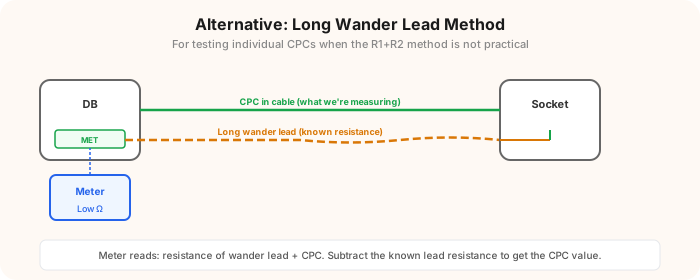
When the R1+R2 link method isn’t practical (for example, when the DB is far from the test point, or when you need to test the CPC independently), use the wander lead method.
How to Do It
- Connect one lead of the meter to the MET (main earthing terminal) at the DB
- Run a long test lead (wander lead) of known resistance from the meter to each test point
- At each point, connect the wander lead to the earth terminal of the accessory
- The meter reads: resistance of wander lead + resistance of CPC
- Subtract the known wander lead resistance to get the CPC resistance
Tip: Null the test leads before starting — touch the leads together and press the null button to zero out their resistance. This is especially important with the wander lead method, where lead resistance can significantly skew readings.
Expected Values
The R1+R2 value depends on the cable size and length. Here are typical resistance values per metre for standard T&E cable:
| Cable Size | R1 (mΩ/m) | R2 (mΩ/m) | R1+R2 (mΩ/m) |
|---|---|---|---|
| 1.0/1.0 mm² | 18.10 | 18.10 | 36.20 |
| 1.5/1.0 mm² | 12.10 | 18.10 | 30.20 |
| 2.5/1.5 mm² | 7.41 | 12.10 | 19.51 |
| 4.0/1.5 mm² | 4.61 | 12.10 | 16.71 |
| 6.0/2.5 mm² | 3.08 | 7.41 | 10.49 |
| 10.0/4.0 mm² | 1.83 | 4.61 | 6.44 |
For example, a 20-metre run of 2.5/1.5 mm² T&E should read approximately: 19.51 × 20 ÷ 1000 = 0.39 Ω.
Interpreting Results
| Reading | Interpretation |
|---|---|
| Expected value (±10%) | CPC is continuous with good connections |
| Slightly higher than expected | Possible loose connection or corroded terminal |
| Much higher than expected | High-resistance joint — investigate |
| Open circuit (no reading) | CPC is broken — find and repair the break |
| Lower than expected | Parallel earth path (bonding) — disconnect bonding and retest |
Using R1+R2 to Calculate Zs
The R1+R2 value from this test feeds directly into the earth fault loop impedance calculation:
Zs = Ze + (R1+R2)
Key Formula: Zs = Ze + (R1+R2) — where Ze is the external earth fault loop impedance (measured at the origin) and R1+R2 is the value obtained from this continuity test. This is fundamental to verifying that protective devices will disconnect within the required time.
Compare your calculated Zs against the maximum permitted Zs from BS 7671 Table 41.3 for the protective device type and rating. If Zs is within limits, the circuit’s earth fault protection is adequate.
Common Mistakes
| Mistake | Problem | Solution |
|---|---|---|
| Forgetting to null test leads | Lead resistance adds to every reading | Always null before testing |
| Not removing the temporary link | Link left in place bridges L and E permanently | Always remove the link after testing |
| Testing with loads connected | Electronic equipment can give false low readings | Disconnect all loads |
| Not testing every point | A break further down the circuit is missed | Test at every accessible point |
Key Regulations
| Regulation | Requirement |
|---|---|
| Reg. 612.2 | Continuity of protective conductors testing |
| Reg. 612.2.1 | Requirement to verify every protective conductor |
| Table 41.3 | Maximum Zs values for MCBs |
| Chapter 61 | Initial verification test sequence (continuity is first) |
Practice and Further Study
CPC continuity testing is a core Part 6: Inspection and Testing topic. Test your knowledge:
Study on the go with our mobile app: App Store | Google Play
Prepare for your exam with our mobile app
690+ practice questions with detailed explanations